Foreign Shoppers Overtook Koreans in Duty-Free Headcount for the First Time — The Crossing of Two Charts in H1
2026-07-30 9:03 AMKorea
Overview
June duty-free revenue, released by the Korea Duty Free Shops Association on July 27, came to KRW 1,128.6 billion — a rare return to positive year-over-year total revenue growth (+4.0%). But look inside the numbers and foreign shoppers outnumbered Korean shoppers for the first time ever, while Korean revenue collapsed by nearly 20% year-over-year. The real story of the first half is the crossing point of these two diverging charts.
On July 27, the Korea Duty Free Shops Association released its June duty-free sales statistics: total revenue of KRW 1,128.6 billion, up 4.0% year-over-year. In a market that has spent recent years drifting between stagnation and decline, this is a rare "plus" figure. But there's an even more striking number buried in the same release. In June, foreign shopper count reached 1,279,206, up 31.9% year-over-year — overtaking Korean shopper count (1,196,865) for the first time ever. At first glance, this crossover reads as a "foreign-tourist windfall." In reality, half of it is the result of Korean demand sharply weakening. June's Korean revenue came to KRW 211.0 billion, down 19.8% year-over-year and down 17.1% month-over-month. Behind the headline of a return to positive total revenue, two very different curves that have run through the entire first half are only now crossing paths.
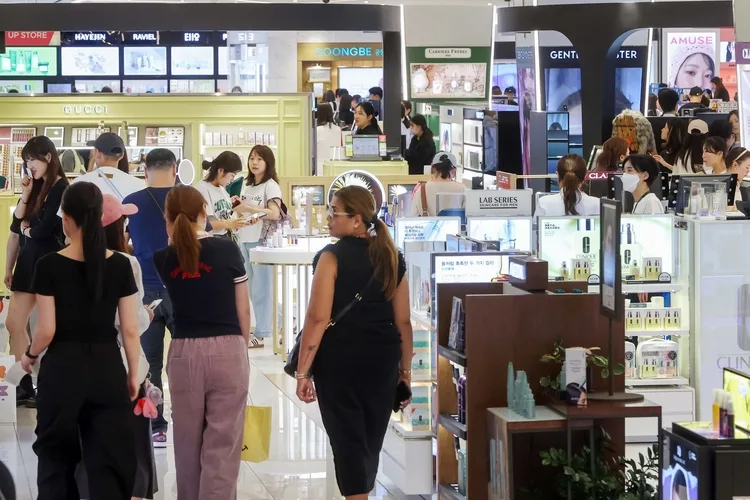
Foreign shoppers browsing a duty-free cosmetics counter in June — shopper counts overtook Koreans for the first time ever, even as per-person spending fell
June's Numbers, and the First-Half Trend
The facts from this release, laid out plainly:
Total revenue: KRW 1,128.6 billion (+4.0% YoY)
Foreigners: Revenue KRW 917.6 billion (+11.6% YoY, +7.1% MoM) / Shoppers 1,279,206 (+31.9% YoY) — 81.3% of total revenue
Koreans: Revenue KRW 211.0 billion (-19.8% YoY, -17.1% MoM) / Shoppers 1,196,865 — overtaken by foreigners for the first time
Foreign average spend: KRW 717,000, down 15.4% year-over-year
Total inbound foreign visitors: 1,993,128 in June (+23.1% YoY); as of the third weekend of June, cumulative annual visitors passed 10 million — roughly a month faster than last year's pace
Placing these numbers against the full first-half trend sharpens the picture. Foreign shopper counts climbed steadily, from roughly 940,000 in January to 1.279 million in June. Koreans, by contrast, fell for three straight months from January through March (1.63 million → 1.45 million → 1.36 million shoppers, with revenue also falling from KRW 284.2 billion → KRW 257.6 billion → KRW 231.2 billion), briefly rebounded in May to 1.389 million shoppers and KRW 254.6 billion in revenue, then fell sharply again in June. The association cited "exchange-rate pressure" and "channel diversification" as reasons for the revenue decline, and itself diagnosed that "converting foreign tourists into actual purchases and raising average spend is the industry's challenge."
Key Insight #1 — Half of This "Crossover" Isn't Growth, It's Collapse
News that foreigners overtook Koreans for the first time is easy to read purely as an optimistic story — "a K-content-driven foreign tourist boom." But overlay the two shopper-count curves, and half the cause of this crossover isn't a foreigner surge — it's a Korean exodus. Foreign shopper counts rose only a little over 4%, from 1.229 million in May to 1.279 million in June. Koreans, meanwhile, fell roughly 14% in a single month, from 1.389 million in May to 1.197 million in June. In other words, the crossover line wasn't formed by foreigners charging sharply upward — it was formed by the Korean line bending sharply downward.
This also reframes how we should read the headline "+4.0%" total-revenue figure. Foreign revenue growth (+11.6%) was large enough to more than offset the Korean revenue decline (-19.8%), producing a positive total — not because the market grew broadly and evenly. What's more, even that foreign revenue growth wasn't driven by higher per-person spending, but by a higher shopper count. Foreign average spend actually fell 15.4% year-over-year, to KRW 717,000. Put together, June's results are the sum of "more foreigners, spending less per person each, while Koreans closed their wallets in the meantime." The total grew, but the composition got worse.
Key Insight #2 — May's "Korean Recovery" Was an Illusion
Worth flagging here is a conflict with what this publication noted at the time of the May results. Back then, we read the rise in Korean revenue share to 23% as a signal of "structural recovery after six years." June's numbers put the brakes on that reading. May's rebound was likely a temporary bounce tied to a golden-week holiday overlap across Korea, China, and Japan. Once the holiday effect faded in June, Korean shopper counts and revenue returned precisely to the downward trend that had prevailed before April. The underlying cause behind the decline that ran from January through March — reduced price appeal for duty-free goods due to a weak won — had only been obscured for one month in May, not resolved.
This is more than a simple fact-check. Reading each monthly release in isolation, with "rebound" and "crisis" headlines alternating, can make it look like the industry has lost all sense of direction. But string several months together, and the story converges into one: Korean demand remains pinned under the macro variable of a weak won, with holiday and event effects only temporarily pushing the numbers up and down on top of that — the underlying trend itself hasn't turned.
Key Insight #3 — The Stage for Growth Is Shifting Outside Duty-Free
Foreign spending itself hasn't disappeared. In fact, throughout the first half, inbound foreign visitors reached record levels. The problem is that this spending doesn't necessarily flow to duty-free. In the same first half, combined foreign revenue at Lotte, Shinsegae, and Hyundai department stores hit an all-time high of KRW 1,720.0 billion, and department-store-sector revenue overall rose 20.1%. While hypermarkets (-7.3%) and supermarket chains (SSM, -6.6%) contracted, department stores alone sustained double-digit growth — powered by foreign tourists' wallets. Duty-free's total revenue, meanwhile, has stayed stuck in the KRW 1,100 billion range throughout the first half, unable to break out.
The reason channels diverge so sharply despite riding the same inbound-foreigner boom lies in a shift in shopping patterns. As spending carried by tour bus to downtown duty-free stores fades, and independent travelers (FIT) increasingly seek out downtown department stores, concept stores, and local commercial districts on their own, brand experience and space now weigh more heavily on purchase decisions than duty-free's traditional core advantage — tariff exemption. The same pattern shows up in foreign visitors' itineraries spreading beyond Seoul to Busan, Gyeongju, Gangwon, and elsewhere nationwide. Foreign tourism itself is unmistakably a growth engine — but duty-free isn't capturing that engine outright; it is being restructured into something duty-free now shares with department stores and local commercial districts.
Business Impact — Why "The Numbers Say Plus, the Feeling Says Minus"
Put these three insights together, and the industry's complicated reaction to June's results makes sense. The association's statistics show the surface-level good news of a return to positive total revenue, but the reason the industry itself diagnoses "raising average spend" as its challenge is that this "plus" leans on volume growth, not an improvement in the quality of spending. If the entire source of revenue growth is a rise in foreign visitor headcount, then the moment inbound-visitor growth slows, today's rebound could reverse right along with it. Conversely, Koreans are likely to keep structurally drifting away from duty-free as long as the weak won persists, and relying on event-driven bounces like May's alone won't reverse the trend. In practical terms, the response needed now splits in two directions. On the foreign side, bundling and upsell offers that lift per-visitor spend need to be prepared in advance, so there's a buffer in place once inbound-visitor growth slows. On the Korean side, rather than waiting for price appeal to recover, it's more realistic to defend against attrition with benefits that don't depend on the exchange rate — membership points, pre-booking perks, domestic-only promotions. From an operator's standpoint, the current phase isn't "revenue is up, so we can relax" — it's closer to an unstable equilibrium where neither side of demand is solid, yet the numbers happen to line up. June's duty-free revenue release carried the headline "+4.0%," but dig in and the structure is one where foreign volume filled the hole left by weakened Korean demand — and whether this balance holds into the next quarter depends on whether inbound-visitor growth continues and where the won-dollar exchange rate heads next.
✦RIT's Insights
Taken one month at a time, the association's monthly statistics look like they alternate between rebound and crisis, but from the vantage point of having watched this space for a long time, June's numbers feel more like they cleared away May's "illusion" than anything else. Even RIT, which flagged the recovery in Korean revenue share with some optimism at the time, now has to admit — looking at this release — that it was a holiday-driven temporary bounce. The biggest trap for anyone working with data is cherry-picking a single month's numbers that fit the narrative one wants to tell. For anyone in corporate planning or working with association data, this lesson has a more practical application: reporting monthly releases using a single metric — total revenue growth — alone risks mistaking a temporary bounce, as with May, for structural recovery. Foreign and Korean shopper counts, revenue, and average spend should be tracked together on at least a three-month moving average, to separate event effects from the underlying trend.
More importantly, this "crossover" — foreigners overtaking Koreans — shouldn't be packaged as something to celebrate. This crossover wasn't formed because foreigners did well; it was formed because Koreans collapsed. What the duty-free industry needs right now isn't to consume this crossover as evidence of growth, but to find a structural answer for why Korean shoppers keep leaving.
One more thing — it's worth asking how seriously the industry is taking the fact that foreign spending is flowing to department stores rather than duty-free. If duty-free is losing the channel competition despite holding a built-in advantage — tariff exemption — that's not a pricing problem, it's a problem of experience design. In RIT's view, this is not a trend duty-free can defend against alone. A far more realistic approach is promotions coordinated with affiliated department stores, airports, and regional tourism infrastructure, sharing revenue across the visitor's entire itinerary — and that is also what will determine whether this gap narrows by the time next quarter's release comes around.