Gentle Monster Turned Eyewear Into Fashion — Now It's Taking On "the Face of AI"
2026-09-01 12:22 AM
Overview
Launched in 2011, Gentle Monster grew into a global brand by turning eyewear from a vision-correction device into a fashion item, and its stores from sales floors into exhibitions and media. Operator I.I. Combined posted consolidated revenue of KRW 789.1 billion and operating profit of KRW 233.9 billion in 2024, but both fell in 2025 as its growth streak broke. Amid a design dispute with Blue Elephant and a labor-authority inspection, the AI glasses it's building with Google and Samsung have emerged as Gentle Monster's next growth engine — and the test that will validate the roughly KRW 3.6 trillion valuation implied by Google's equity investment.
It's hard to describe Gentle Monster as simply "a well-made Korean sunglasses brand." What the company changed wasn't just the shape of eyewear. It touched how consumers perceive glasses, what a store is for, and how a fashion brand produces content.
Gentle Monster's first act of growth was moving eyewear from a medical device to a fashion item. Its second act was turning the store itself into media through exhibition-style spaces that didn't put products front and center. Its third act was replicating that formula across other categories — the perfume and cosmetics brand Tamburins, the dessert brand Nudake, and more. The fourth act, now beginning, is turning eyewear into the interface where humans meet AI.
But just as this new growth narrative gets underway, the existing business has slowed, and legal disputes over design and labor issues have surfaced. Understanding where Gentle Monster stands today requires looking past the flashy stores and global collaborations, to the earnings, organization, intellectual property, and competitive landscape of the AI wearables industry that underpin its brand premium.
Where the Brand Began — From Medical Device to Fashion Item
Gentle Monster was founded in 2011 by CEO Kim Han-kook, who had worked at a financial firm and an English-education company before reportedly pitching the eyewear business through an internal new-venture contest. The core idea was to reinterpret glasses — then treated as vision-correction products — as a fashion item. The company that grew out of roughly KRW 50 million in seed capital is I.I. Combined.
The gap in the market was clear. At the time, the global eyewear industry was dominated by Western brands, and frames were often designed around Western facial proportions. Gentle Monster leaned into oversized frames that made the face look smaller, factoring in traits common among Asian consumers — a lower nose bridge and relatively wider face. It aimed at functional fit and visual effect at the same time.
Early on, the company relied on online sales and a home try-on service, letting customers try several pairs at home before choosing what to buy — a strategy for a new brand to build a direct relationship with consumers without depending on existing opticians or department-store networks. Once it moved offline, Gentle Monster didn't simply stock more product; it focused on giving people a reason to visit.
The breakout moment came with the drama My Love from the Star, which aired from late 2013 into early 2014. Actress Jun Ji-hyun wore Gentle Monster sunglasses on screen, and they became known as the "Cheon Song-yi sunglasses" after her character — sending brand awareness soaring across Asia, China included. Collaborations and sightings involving BLACKPINK's Jennie, Gigi Hadid, and other celebrities at home and abroad further strengthened the brand's global image.
The Secret to Gentle Monster's Growth — It Sold Space, Not Sunglasses
If celebrity exposure made Gentle Monster famous, what built its long-term differentiation was space.
In 2014, Gentle Monster launched the "Quantum Project" at its Hongdae showroom, swapping out the theme and installations of the space on a regular cycle and putting art, not product, at the front of the store. Consumers experienced the space before they saw the sunglasses. The store was a sales channel and an exhibition hall at once — a piece of media producing images and video for social sharing.
In 2015 came Bath House, built inside a converted old bathhouse in Bukchon. The strategy expanded from there into House Dosan — which houses Gentle Monster, Tamburins, and Nudake under one roof — and large mixed-use spaces in Shanghai and Shenzhen. Stores filled with robots, kinetic art, and large-scale installations drew in people who had no plan to buy anything. Visitors photographed the space and posted it online, generating organic virality for the brand.
This strategy matters because of eyewear's price structure. Glasses are a product whose retail price is hard to justify on manufacturing cost alone. Gentle Monster bundled design, space, collaborations, packaging, and scarcity into the frame — consumers paid not just for materials and production, but for the cultural experience of Gentle Monster itself.
Based on disclosed financial figures, I.I. Combined's 2024 cost-of-goods ratio works out to roughly 15.7%, with a consolidated operating margin of 29.6%. Accounting classifications and the scope of consolidation should be kept in mind, but the low cost burden paired with the high margin supports the reading that the company has defended its pricing through design, space, and scarcity rather than manufacturing cost.
The Path to a Global Brand — From New York and China to L Catterton's Investment
Once it had secured domestic recognition, Gentle Monster moved abroad quickly. It opened its first U.S. store in New York's SoHo in 2016 and a second in Los Angeles in 2017. In China, it expanded flagship stores to major cities including Beijing, Shanghai, and Chengdu, and entered the European market with a London store in 2018.
In 2017, it raised investment from L Catterton Asia, a private equity fund backed by LVMH, among others. Korean media at the time reported the investment at roughly KRW 60-70 billion. Some sources present different investor compositions and stake sizes, making the exact deal terms hard to pin down from public material alone. Still, the investment signaled that Gentle Monster was being evaluated as a brand capable of expanding within global luxury retail, not just a popular Korean label.
Brand collaborations were also central to going global. Gentle Monster partnered not only with luxury houses like Fendi and Maison Margiela, but also with figures carrying very different fandoms, such as BLACKPINK's Jennie and Bratz. Collaboration products generated short-term sales while keeping the brand positioned at the intersection of fashion, art, and pop culture.
From Gentle Monster to I.I. Combined — Replicating One Success Formula Across Categories
I.I. Combined didn't stop at running Gentle Monster as a single brand. It rolled out the perfume and cosmetics brand Tamburins, the dessert brand Nudake, the headwear brand Atishu, and a tableware brand in succession. The product categories differ, but the same playbook — sculptural packaging, experimental spaces, large-scale installations, celebrity marketing — applies across all of them.
Within this structure, I.I. Combined looks less like an eyewear manufacturer and more like a brand-building platform. It channels the visitors and awareness Gentle Monster generates into Tamburins and Nudake through mixed-use spaces like House Dosan and House Nowhere. Because different brands share space and foot traffic, new brands can acquire customers at a lower independent cost.
The results showed the power of this model. Based on reported consolidated financials, I.I. Combined's revenue grew from KRW 209.6 billion in 2020 to KRW 322.0 billion in 2021, KRW 410.0 billion in 2022, KRW 608.3 billion in 2023, and KRW 789.1 billion in 2024. By these figures, consolidated revenue grew roughly 3.8x between 2020 and 2024. The individual-year figures are based on disclosure data as cited in media reports.
Year
Consolidated Revenue
Operating Profit
Operating Margin
2020
KRW 209.6B
—
—
2021
KRW 322.0B
—
—
2022
KRW 410.0B
—
—
2023
KRW 608.3B
—
—
2024
KRW 789.1B
KRW 233.9B
29.6%
2025
KRW 772.3B
KRW 177.0B
22.9%
Source: media reports citing I.I. Combined's consolidated results. The 2024 operating profit figure is standardized at KRW 233.9 billion to account for rounding differences across sources.
2025, the Year Growth Broke — Profit Fell Faster Than Revenue
2025 is where the trouble starts. Consolidated revenue fell 2.1%, from KRW 789.1 billion to KRW 772.3 billion, while operating profit dropped 24.3%, from KRW 233.9 billion to KRW 177.0 billion. The operating margin fell 6.7 percentage points, from 29.6% to 22.9%. Revenue slipped only slightly; operating profit lost nearly a quarter of its value.
The fact that operating profit fell so much faster than revenue implies costs grew relative to sales. Possible factors include cost of goods, labor costs, rent, marketing spend, and investment in new spaces — but because the company hasn't disclosed a detailed cost breakdown, it isn't confirmed which line item drove the margin decline.
The core businesses slowed together at the segment level, too. Revenue in the eyewear segment, which includes Gentle Monster, came to KRW 604.9 billion, down 1.5% year-over-year, while the cosmetics segment centered on Tamburins fell 7.4% to KRW 152.5 billion. Combined, eyewear and cosmetics total KRW 757.4 billion — KRW 14.9 billion short of total consolidated revenue. That gap likely comes from the remaining businesses — Nudake, Atishu, tableware — but since those aren't disclosed as separate segments, their exact composition isn't known.
The cosmetics segment's decline rate was about 4.9 times steeper than eyewear's. Given that Tamburins had been expected to replicate Gentle Monster's success formula in another category, this suggests the diversification strategy's momentum may have weakened too, not just eyewear demand. Still, it's too early to conclude from a single year's decline that Tamburins' medium-to-long-term growth has stalled.
The Legal Fight With Blue Elephant — How a "Similar Glasses" Dispute Became a Criminal Trial
Blue Elephant is a domestic eyewear brand founded in 2019 that grew on lower price points, fast product launches, and aggressive store expansion in major commercial districts. According to reports, its revenue grew roughly ninefold, from KRW 5.8 billion in 2023 to KRW 50.7 billion in 2025.
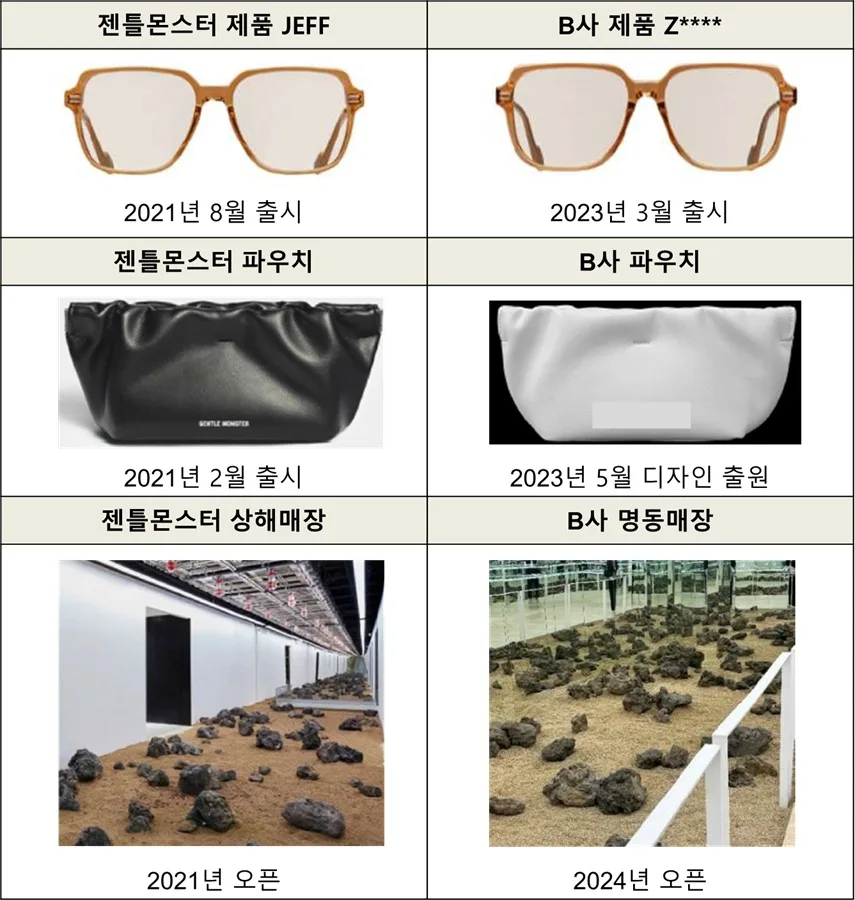
The legal dispute between the two companies escalated when Gentle Monster operator I.I. Combined filed a criminal complaint in December 2024, alleging Blue Elephant's products copied its product shapes. A civil damages suit and an invalidation trial over an eyewear-pouch design registration followed.
Prosecutors allege that Blue Elephant's founder and former CEO, from February 2023 to June 2025, directly commissioned eyewear that copied Gentle Monster's product shapes from factories in China, among other sources, or sourced them from domestic wholesalers for sale. In March 2026, the former CEO was indicted while in custody on charges including violation of the Unfair Competition Prevention Act, and the Blue Elephant corporate entity and other individuals were also indicted.
The number of infringing products identified by investigators varies across reports — either 49 or 51 types. Later reports tied to the bail decision cited 51 types, roughly 321,000 units, and sales of approximately KRW 12.3 billion. The discrepancy in product counts across articles may reflect adjustments made during the investigation and indictment process; the indictment and eventual court ruling should be treated as the authoritative source.
The IP authorities' special judicial police said that of the 51 types in question, 29 matched within a 1mm margin of error at a rate of 95% or higher in 3D scan comparisons, and 18 of those matched at 99% or higher. Separately, I.I. Combined said its own 3D analysis by an outside firm found some Blue Elephant products showed 95-99% similarity to its own.
That said, these figures come from the investigators and the complainant. High 3D-shape similarity alone doesn't automatically establish criminal liability. Whether the similarity stems from the functional constraints inherent to eyewear, or from copying a specific product shape worth protecting, is for the court to decide.
Blue Elephant denies the allegations. Its position is that glasses are ergonomic products worn on the face, leaving limited room for formal variation, and that forms commonly shared by products in the same category fall outside the scope of protection under the Unfair Competition Prevention Act. It has also said that differing logos make consumer confusion unlikely, and that referencing prior products is standard practice in an eyewear industry where trends move quickly.
Blue Elephant said it stopped selling the disputed products in April 2025 and turned over its remaining inventory to investigators. It has since said it strengthened its dedicated design organization across product, space, and content, along with its IP compliance framework, and moved to a professional-management structure after the founder's resignation.
The design-copying dispute between Gentle Monster operator I.I. Combined and Blue Elephant escalated into a criminal trial. (Source: Yonhap News)
The former CEO was released on bail in July 2026 following a court decision and is standing trial without detention. As of September 1, 2026, no final guilty verdict on the eyewear-copying charges has been confirmed in publicly available information. It's therefore more accurate to say Blue Elephant "was indicted on copying allegations" than to say it "plagiarized."
The Pouch Design Dispute — A Separate Ruling Favored Gentle Monster First
In a separate proceeding over an eyewear-pouch design registration, Gentle Monster came out ahead. In May 2026, the IP Trial and Appeal Board ruled to invalidate a pouch design Blue Elephant had registered in 2023, finding it could easily have been derived from a pouch Gentle Monster unveiled in 2021.
The board cited the overall trapezoid-like shape, the pleating and opening structure at the mouth, the stitching at the top-center and front/back, and the base structure as grounds for its decision, ruling that the two designs shared a similar overall aesthetic impression that an ordinary consumer would struggle to tell apart at a glance, even with differences in color and some curved surfaces.
But invalidating a pouch design registration and establishing criminal liability over the eyewear products are separate matters. Gentle Monster's favorable ruling in the pouch case doesn't confirm the broader eyewear-copying allegations. The criminal court will separately decide what specific product shape is entitled to protection, whether substantial identity is established beyond functional or commonplace elements, and whether the defendant acted with intent to copy.
Why This Lawsuit Matters — The Real Asset Isn't the Glasses, It's the "Brand Grammar"
Gentle Monster's competitiveness doesn't rest on the shape of any single frame. Its core asset is the ability to bind product, pouch, store, installation, campaign, and collaboration into one visual language. If similar frames, packaging, and spatial staging spread quickly at a lower price, it isn't just individual product sales at risk — the scarcity and premium the brand has built up can erode too.
On the other hand, drawing the scope of legal protection too broadly risks letting a leading company effectively monopolize frame shapes the industry uses generally — square, Boston, cat-eye. That's precisely the ground Blue Elephant's counterargument stands on.
Ultimately, the crux of the trial isn't whether the two products simply look alike. The question is whether, beyond the forms that inevitably arise from eyewear's function and prevailing trends, Blue Elephant substantially copied the specific product shapes Gentle Monster invested in creating.
This case also carries weight for the fashion industry more broadly. Products with short trend cycles are hard to register design rights for before launch, and in fact, some of the Gentle Monster products at issue here didn't have registered design rights. Investigators pursued the case on the view that even an unregistered form can be protected as a product shape under the Unfair Competition Prevention Act. The final ruling could become a benchmark for how far fashion brands can protect unregistered product designs.
The Labor Issue — The Cost of the Organization Behind the Creativity
Beyond the 2025 earnings slowdown and the legal dispute over Gentle Monster's designs, I.I. Combined ran into a labor issue in 2026. After allegations surfaced of excessive working hours and improper use of the discretionary-work-hour system, the Ministry of Employment and Labor launched a planned inspection.
Results disclosed in July 2026 found 12 legal violations, including KRW 430 million in unpaid wages. The ministry found that 279 workers under the discretionary system weren't paid KRW 340 million in premium pay for night and holiday work, while 185 non-discretionary workers weren't paid KRW 90 million in overtime, night, and holiday pay. It also confirmed 115 violations of overtime limits and violations of maternity-protection rules related to pregnancy and childbirth. The ministry issued 10 corrective orders and a total of KRW 5.8 million in fines.
The ministry did not, however, find that the introduction and overall operation of the discretionary-hour system applied to designers was unlawful across the board. The company said it identified improper operation in some departments during the inspection, abolished the discretionary system from February 9, 2026, and introduced a flexible-hours system in its place.
The KRW 430 million in unpaid wages is small relative to the company's annual revenue. But given how heavily the brand's competitiveness depends on creative talent — designers, spatial planners, content producers — the labor issue is hard to reduce to a mere fine. It raises the question of whether the high-intensity creative organization that built Gentle Monster's growth was sustainable.
How much the response to the labor inspection, the system overhaul, back-pay, and legal costs from the litigation weighed on 2025's profit decline isn't confirmed — and given that the inspection results were disclosed in 2026, they shouldn't be treated as a direct cause of 2025's profitability decline. Still, the earnings slowdown, the litigation, and the labor issue arriving in succession is a signal worth watching: whether the organization and management systems kept pace with the brand's speed of global expansion.
The KRW 3.6 Trillion Google Assigned — What's Left Without the AI Premium
Google reportedly invested about $100 million — roughly KRW 145.0 billion at the exchange rate at the time — in I.I. Combined in 2025, securing about a 4% stake. A simple calculation from that puts I.I. Combined's valuation at the time of investment at roughly KRW 3.6-3.7 trillion.
That price shouldn't be treated the same as a valuation set by a typical financial investor, though. Google likely invested with an eye not just on I.I. Combined's current results, but on the design partnership for AI glasses and the strategic synergy that comes with it.
In fact, some in the investment community have argued that stripping out the premium tied to the Google partnership would put a more realistic valuation in the mid-KRW-2-trillion range. That view, however, comes from some investment bankers and asset managers — it isn't a formal market consensus price.
Even so, it's worth reading alongside the 2025 earnings slowdown. The roughly KRW 3.6 trillion valuation implied by Google's investment looks closer to a price that combines I.I. Combined's accumulated results and brand value with the strategic potential of AI glasses. With eyewear and cosmetics both slowing and the consolidated operating margin down 6.7 percentage points, the less clarity there is on the AI business's actual revenue and profit structure, the less tolerance investors may have for that premium.
AI Glasses — Gentle Monster Already Had a Dry Run in 2019
Gentle Monster's collaboration with a tech company didn't start with Google. It partnered with Huawei on smart glasses in 2019 and later released a follow-up, the Huawei X Gentle Monster Eyewear II. Those products were closer to audio wearables than display-based AR devices — speakers, a microphone, touch controls, and phone, music, and voice-assistant functions built into the frame — with Gentle Monster handling the exterior and wearing experience and Huawei supplying the electronics.
That experience may have been a meaningful asset in being chosen as a partner by Google and Samsung. Fitting electronic components and a battery inside the temple of a pair of glasses while preserving the exterior and fit is a different problem from designing an ordinary frame. Even without developing its own semiconductors or AI models, Gentle Monster had experience bringing smart eyewear to an actual market.
The Google-Samsung-Gentle Monster Alliance — Wearing Gemini on Your Face
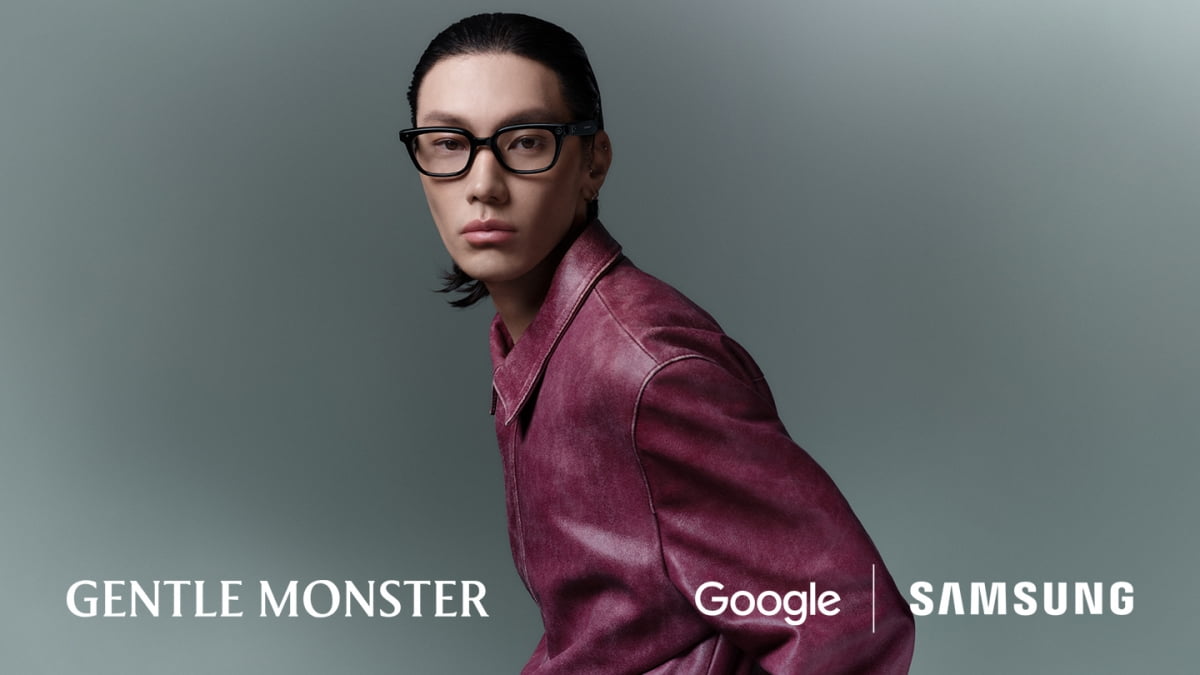
At Google I/O on May 19, 2026, Google and Samsung Electronics unveiled "Intelligent Eyewear," co-developed with Gentle Monster and Warby Parker. The structure combines Google's Gemini and Android XR platform, Samsung Electronics' hardware and mobile-ecosystem capabilities, and eyewear design from Gentle Monster and Warby Parker.
Google split the AI glasses into audio and display types. The audio type launches first. Users can say "Hey Google" or tap the temple to summon Gemini, and use it to ask about surrounding objects, get directions, make calls and send messages, take photos and video, get real-time translation, manage schedules, and carry out multi-step tasks. The display type shows information directly in the wearer's field of view, but as of September 1, 2026, a specific launch date hadn't been disclosed.
Google and Samsung Electronics co-developed the Android XR-based 'Intelligent Eyewear' with Gentle Monster and Warby Parker.
According to Gentle Monster's official page, its first Intelligent Eyewear collection is set to launch in fall 2026. The disclosed product supports both Android and iOS devices and offers Gemini-based real-time translation, navigation, situational awareness, and visual-understanding features. Per official guidance, the glasses run up to 9 hours on a single charge, and the charging case supports 7 or more additional charges. Pricing, country-by-country launch timing, and the full product lineup haven't all been disclosed yet.
A Different Entry Point Than EssilorLuxottica — Same AI Shift, Different Weapons
In the global eyewear industry, profitability is driven as much by the pricing and scarcity of the brands in a company's portfolio as by scale. Kering Eyewear's high margins from a luxury-house-centered portfolio, and I.I. Combined's low cost-of-goods ratio and 29.6% consolidated operating margin in 2024, can be explained by similar logic: defending price through brand, design, narrative, and space rather than manufacturing cost.
But I.I. Combined's consolidated operating margin falling to 22.9% in 2025 shows that even this "brand density" strategy isn't permanently defensible. Even a premium brand can see profitability erode quickly if space, personnel, marketing, and global-expansion costs rise while revenue growth stalls.
The shift toward AI wearables isn't unique to Gentle Monster, either. EssilorLuxottica, the world's largest eyewear company, has partnered with Meta to build Ray-Ban- and Oakley-based AI glasses into a core growth engine.
EssilorLuxottica said it sold more than 7 million AI glasses over the course of 2025. With AI glasses emerging as a major growth driver, the company's 2025 revenue rose 11.2% at constant currency, with fourth-quarter revenue up 18.4%. AI glasses are no longer a concept product — they've entered a consumer market measured in the millions of units.
The two companies are entering the same industry shift by different routes. EssilorLuxottica owns its own brands in Ray-Ban and Oakley, lens technology, large-scale production facilities, and a global network of opticians and retail stores. Even combined with Meta's AI and platform, EssilorLuxottica sits at the center of production and sales.
Gentle Monster, by contrast, enters as a design partner inside Google and Samsung's platform — a realistic entry point given the gaps in its own technology and manufacturing infrastructure. But because the specific contract structure hasn't been disclosed, it isn't confirmed how much authority Gentle Monster holds over customer data, product timelines, or revenue sharing.
Sitting outside the traditional eyewear Big Four is both a weapon and a weakness for Gentle Monster. It's relatively unencumbered by existing license agreements and distribution structures, which let it negotiate directly and strategically with Big Tech. On the other hand, its experience with large-scale electronics production, after-sales service, prescription-lens support, and optical retail distribution is more limited than EssilorLuxottica's. Given that AI glasses are simultaneously a fashion product and an electronic and optical device, Gentle Monster has to lean on its partners for much of the customer experience beyond design.
Why Google Chose Gentle Monster — The Ability to Turn Advanced Devices Into Cultural Consumer Goods
Google unveiled Project Glass in 2012 and launched a limited Explorer program in 2013. It later widened availability to general consumers, but high pricing, a bulky look, short battery life, and privacy concerns kept it from taking hold in the consumer market. Sales of the consumer prototype ended in 2015, after which the product line continued in enterprise form.
This time, Google brought a fashion eyewear brand in from the start of development, placing weight on creating a form people would want to wear every day. Meta and EssilorLuxottica's success points to the same lesson: for smart glasses to go mainstream, the technology shouldn't stand out — it should disappear into an ordinary pair of glasses. Consumers need to feel like they're wearing their usual glasses, not strapping a computer to their face.
That's where Gentle Monster's capability comes in. It has spent years designing forms people want to wear on their face and building the narrative and spaces that let those products read as fashion. Google's investment reads as a bet not just on frame-design skill, but on Gentle Monster's ability to turn an advanced device into a cultural consumer good.
If the AI glasses succeed, Gentle Monster can expand from a fashion brand into an AI-interface brand. Where the screen and operating system were the key touchpoint in the smartphone era, in the AI-glasses era, adoption hinges on the frame touching the face, the placement of the camera and microphone, and a weight and design wearable all day.
Gentle Monster's stores could also become an experience channel for AI glasses. AI glasses are hard to buy from a photo alone — the weight and pressure of the frame, speaker sound quality, camera field of view, voice recognition, and real-time translation all need to be experienced directly. Gentle Monster's stores, which have functioned as experience destinations in major cities worldwide, can introduce the technology in a way an ordinary electronics store can't.
The Risks That Remain — Nice-Looking Glasses Aren't Enough
The conditions for AI-glasses success are more complex than those for fashion-brand success. Beyond design, the product has to satisfy weight, heat, battery life, sound quality, camera, AI accuracy, privacy, prescription-lens support, and after-sales service all at once.
Reliance on tech partners is also high. Gentle Monster doesn't control Gemini, Android XR, or the core semiconductors. If Google's or Samsung's product strategy or launch timeline shifts, Gentle Monster's collection is affected too.
Privacy is the more fundamental problem. When a camera and microphone are built into a product indistinguishable from ordinary glasses, the people around the wearer can't easily tell whether they're being recorded. Meta's AI glasses, which have sold more than 7 million units, have already drawn growing privacy concerns, and in 2026 civic groups raised objections and pursued legal action. Hiding the technology naturally inside the glasses is a strength for the product, but it can just as easily become a risk for social acceptance.
✦RIT's Insights
Gentle Monster's first competitors were the legacy eyewear brands designing products around Western facial proportions. Its second competitors were fashion stores and exhibition spaces vying for consumers' time. Now the arena has widened to the AI wearables market, where global eyewear players and Big Tech — Meta, EssilorLuxottica, Google, Samsung — collide.
Seen this way, the Blue Elephant lawsuit and the AI glasses aren't separate issues. The most important asset Gentle Monster brings to Google isn't a factory or an AI model — it's the ability to create forms people want to wear on their face. If that design asset can be copied easily, it loses value not just as a consumer premium, but as leverage in negotiating with Big Tech. Defending IP is about protecting past products, and about protecting negotiating power for the AI glasses business, at the same time.
Still, defending IP alone doesn't guarantee the future. In 2025, both the eyewear and cosmetics businesses slowed, and I.I. Combined's consolidated operating margin fell sharply. In 2026, labor authorities found violations tied to unpaid wages and overtime and maternity-protection rules. The brand needs to prove its internal organization is as sustainable as the creativity it shows the world.
The roughly KRW 3.6 trillion valuation implied by Google's investment looks close to a price that combines the brand value I.I. Combined has built with the promise of AI glasses. That's also why some in the investment community argue that stripping out the strategic premium puts a more realistic figure in the mid-KRW-2-trillion range. Only if the Intelligent Eyewear launching in fall 2026 turns into real sales and profit can that gap between the two figures be explained.
RIT will be watching five indicators going forward. First, whether the AI glasses launch on schedule in fall 2026. Second, the launch price, the countries covered, and the level of initial sales. Third, whether Gentle Monster secures repeatable revenue streams like royalties or licensing, beyond product sales. Fourth, whether eyewear and cosmetics revenue return to growth. Fifth, how far the scope of protection for unregistered product shapes is recognized in the Blue Elephant litigation.
Gentle Monster's last 15 years were a story less about how well it made glasses than about how much meaning it built into them. The question for the next 10 years is harder: can it protect the design premium it created, while carrying that premium onto the hardware interface of the AI era?
Google's choice isn't a final verdict that Gentle Monster has succeeded. It's closer to a starting point — a global eyewear brand getting the chance to become part of a technology platform.
DART electronic disclosure system (dart.fss.or.kr) — I I Combined Co., Ltd. annual reports for FY2024–2025 (cited by name where a specific filing URL could not be pinpointed)