Korea's Health Functional Food Market Has Been Stagnant for Three Years, Yet Manufacturers Just Posted Record Results — What's Behind the Polarization
2026-08-22 9:27 AM
Overview
Korea's health functional food market peaked at KRW 6.1498 trillion in 2022 and has been stuck around KRW 6 trillion for three straight years (KRW 5.9626 trillion in 2025, +0.2%). Yet over the same period, the three contract manufacturers Novarex, Kolmar BNH, and Cosmax NBT saw operating profit grow anywhere from double digits to as much as 452%, and KGC Ginseng Corp's revenue and operating profit both rebounded together in H1 2026. It's a signal that premium, personalized, and export volume are growing separately inside an otherwise stagnant market.
Korea's health functional food market peaked at KRW 6.1498 trillion in 2022, then came in at KRW 6.1415 trillion in 2023, KRW 5.9531 trillion in 2024, and KRW 5.9626 trillion in 2025 (+0.2%) — essentially flat around the KRW 6 trillion mark for three straight years. Looked at as a whole, the natural read is "a mature industry that's stalled out." Yet over the same period, the three major contract manufacturers (OEM/ODM) — Novarex, Kolmar BNH, and Cosmax NBT — all posted double-digit revenue and profit growth in H1 2026, with Cosmax NBT's operating profit surging 452.8% as it swung to profitability. On the brand side, KGC Ginseng Corp (Cheong Kwan Jang) moved through a H1 2025 stretch of falling revenue and surging operating profit, then saw both revenue and operating profit rebound together, in double digits, in H1 2026. So what's actually happening inside this stagnant market?
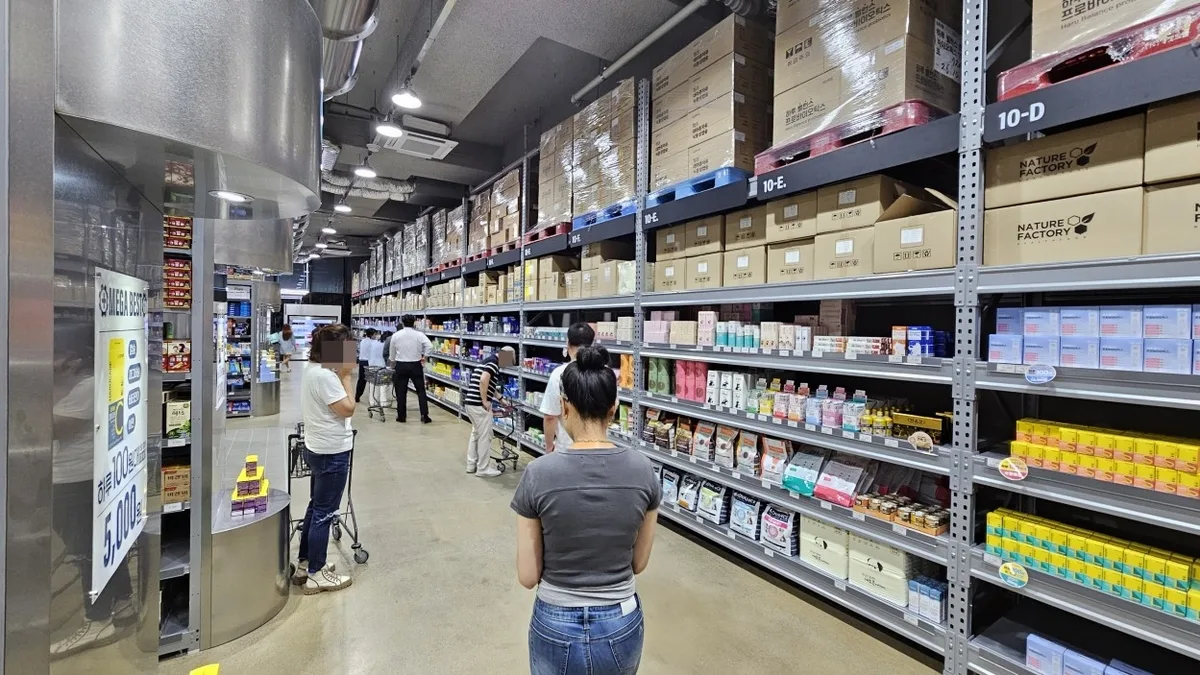
Mass-channel health functional food shelves — the overall market has been flat for three straight years, but segment-level differences within it are stark
What Happened — The Market and the Companies, in Numbers
Let's start with the size of the overall market.
Year
Total Market Size (KRW 100M)
YoY Change
2022
61,498
—
2023
61,415
-0.1%
2024
59,531
-3.1%
2025
59,626
+0.2%
Looking at production output by company (factory-gate shipment value, 2024 basis), here's how the leaderboard shapes up.
Company
Production Output (KRW 100M)
Note
Korea Ginseng Corp (KGC, Cheong Kwan Jang)
6,723
#1 for the 4th straight year
hy
3,874
Chong Kun Dang Health
2,974
Novarex
2,832
Contract manufacturer (OEM/ODM)
Kolmar BNH
2,729
Contract manufacturer (OEM/ODM)
The top 15 companies' combined production output comes to KRW 2.7207 trillion, or 67.8% of the total on this basis. What stands out here is how narrow the gap is between the #3 through #5 spots — Chong Kun Dang Health, Novarex, and Kolmar BNH. That a finished-goods brand owner (Chong Kun Dang Health) and two contract manufacturers (Novarex, Kolmar BNH) are already roughly the same size by production scale is itself evidence of just how much brand owners now lean on contract manufacturing rather than their own production lines.
Over the same period, here's how the three contract manufacturers' most recent results (H1 2026) look.
Company
Revenue (KRW 100M)
Operating Profit (KRW 100M)
Note
Novarex
2,226 (+17.3%)
251 (+29.2%)
Operating margin 11.3% (+1.1pp)
Kolmar BNH
2,454 (+8.1%)
206 (+46.7%)
Standalone basis
Cosmax NBT
1,955 (+32.3%)
188 (+452.8%)
Net income 173, swung to profit
The brand-owner side tells a different story. After a stretch where revenue fell even as profitability improved, the most recent quarters show revenue rebounding as well.
Company
Period
Revenue (KRW 100M)
Operating Profit (KRW 100M)
KGC Ginseng Corp (Cheong Kwan Jang, a KT&G subsidiary)
H1 2025
5,350 (-6.7%)
261 (+74.3%, highest since segment disclosure began in 2020)
KGC Ginseng Corp
Q1 2026
3,326 (+5.8%)
279 (+53.3%)
KGC Ginseng Corp
Q2 2026
approx. 2,238 (domestic 1,742, +7.8%; overseas 496, down 94)
100 (+61.3%)
KGC Ginseng Corp
H1 2026 total
5,564 (+4.0% vs. H1 2025)
379 (+45.2% vs. H1 2025)
Chong Kun Dang Health (Lacto-Fit)
FY2025 (annual, most recent disclosure)
4,728.9 (-4.9%)
323 (swung to profit, highest in 5 years)
(Table figures above are in KRW 100 million (억원) units.)
Core Insight #1 — The Market Is Stagnant, But Premium and Personalized Live in a Different World
Even as the overall market shrinks, two segments are visibly expanding. One is premium. KGC Ginseng Corp has layered high-end lines on top of its standard red ginseng extract — "Red Ginseng Extract Cheon (天)," "Red Ginseng Extract Masterclass," "Red Ginseng Extract Limited" — while Dongkook Pharmaceutical opened a physical store for its health functional food brand Myfit's high-dose, department-store-exclusive line at Connect The Hyundai in Busan. The other is personalization. By industry estimates, Korea's personalized health functional food market reached roughly KRW 450 billion in 2025 — small next to the roughly KRW 5 trillion-scale overall market, but a subscription model built on individual genetic and lifestyle data is gaining traction quickly.
The picture comes together once you see why growth in these two segments feeds straight into the contract manufacturers' results. Premium and personalized products tend to run in small batches, wide variety, and high-spec formulations — conditions under which brand owners more often outsource to a contract manufacturer with specialized formulation technology than invest in their own production lines. Novarex naming "differentiated formulation and manufacturing technology, beyond a raw-material focus" as one pillar of its growth strategy, and its ongoing construction of a second plant in Osong, both read as moves to absorb this demand. Exports overlap here too. Novarex said it plans to attend "Vitafoods Asia 2026" in Thailand this September to line up overseas clients, and Korea's health functional food export value grew at an average 13.8% a year from 2023 to 2024 — meaning overseas volume is offsetting a meaningful share of the stagnant domestic demand. In short, the manufacturers' strong results aren't coming from the domestic mass market; they're coming from a separate pipeline — domestic premium/personalized demand plus overseas exports.
Core Insight #2 — "Revenue Falls, Profit Rises" Keeps Repeating
The pattern on the brand-owner side is even more interesting. KGC Ginseng Corp's H1 2025 revenue fell 6.7%, yet operating profit rose 74.3% to the highest level since the company began disclosing segment results in 2020. The company attributed this to a smaller share of low-margin home-shopping sales, a lower cost ratio from improved raw-material yield, and a strategy of addressing the market's polarization by offering "both value-for-money and premium products." Chong Kun Dang Health tells the same story — in its most recently disclosed results, FY2025 revenue fell 4.9%, yet operating profit swung to a profit at its highest level in five years. Both companies made the identical choice: give up some revenue in order to strip out low-margin volume and protect profitability.
That the same pattern showed up simultaneously at two companies this different looks less like coincidence and more like a signal that Korea's health functional food market is shifting from an "era of growth" to an "era of selection." Where revenue scale alone used to signal market standing, now it's which channel and which segment that revenue comes from that determines the margin. KGC Ginseng Corp's most recent results, for H1 2026, show this restructuring moving into its next phase — revenue rose 4.0% versus H1 2025, while operating profit rose a much faster 45.2%, meaning the company captured revenue growth and margin improvement at the same time. That said, Q2 overseas revenue fell KRW 9.4 billion on Chinese distributor inventory adjustments — a reminder that the rebound isn't yet running evenly across the board.
Business Impact — Price Competition in the Mass Channel Remains Fierce
On the other side of this polarization sits a mass channel where low barriers to entry keep price competition brutal. In a market where cheap OEM products keep flooding in, smaller players without brand power absorb the full weight of that price pressure. When large brand owners like KGC and Chong Kun Dang Health say they're shrinking their low-margin channels, the flip side is that even large companies are struggling to protect margin in those channels (home shopping, discount promotions, and the like). As the big brand owners pull back from that space, smaller OEM brands and e-commerce private labels are likely filling the gap, with the same low-margin structure intact. In the end, today's "polarization" isn't the market uniformly trading up — it looks more like the top (premium, personalized, export) and the bottom (ultra-low-price mass channel) splitting apart, each moving at its own pace. From an operational standpoint, an MD running the mass channel is likely the first to feel the shadow side of this polarization.
✦RIT's Insights
What stood out most in this research is that KGC Ginseng Corp and Chong Kun Dang Health — two companies in the same industry but with entirely different ownership structures and product lines — showed the identical pattern of "revenue down, operating profit at a record" at the same time. That isn't one company's idiosyncratic management call; it means the whole industry is moving in the same direction, and in RIT's view, a pattern that shows up simultaneously like this is better read as an industry-wide structural shift than as an individual company's story. It's also worth noting that KGC Ginseng Corp has since moved into the next phase of that pattern, with revenue growth returning to double digits in H1 2026 — proof, in its own subsequent numbers, that pruning low-margin channels wasn't a one-off event but a genuine turnaround that fed back into revenue growth.
It's also worth sitting with the fact that the three contract manufacturers' strong results had nothing to do with the shrinking domestic market. Usually, when "the market is shrinking but one company is doing great," the easy read is that the company took share from competitors. This case is different. That their growth stories feature far more talk of overseas exports, formulation technology, and facility investment than domestic market-share competition is itself a signal — they're not splitting up the existing domestic pie, they're building an entirely different pie: exports and premium contract manufacturing.
Finally, in RIT's view, Korean retail shouldn't read this polarization purely as an optimistic story of "health functional food trading up like beauty and luxury did." As the premium side grows, price competition on the other side, in the mass channel, is likely to get even more brutal. From an operational standpoint, department store and duty-free MDs now need to treat health functional food more like luxury and beauty — as KGC's premium red-ginseng lines and Dongkook Pharmaceutical's Myfit department-store-exclusive store show, the time has come to build a dedicated curated-shop or pop-up strategy. Hypermarket and e-commerce MDs, by contrast, face the more urgent task of defending margin in the low-price channel.
What concerns RIT, looking at this data, is that the market hasn't yet properly registered the choices both brand owners and manufacturers are making. Given that the KGC/Chong Kun Dang Health playbook — protect profit even at the cost of revenue — is becoming the industry's shared answer, brand strategy and MD teams need to re-examine their own channel-by-channel margin structure first. Anyone managing OEM/ODM vendors should keep in mind that Novarex's, Kolmar BNH's, and Cosmax NBT's strong results are coming from premium/personalized/export volume rather than domestic mass demand — when expanding a partnership, checking whether it's a mass line or a premium line, a domestic slot or an export slot, is what will actually predict future supply stability. And investment and analyst teams should recognize that, as these cases show, a revenue decline is often a deliberate result of pruning low-margin channels that leads straight to improved operating profit — a pattern that keeps repeating — so don't judge a headline revenue decline as automatically negative; always track the direction of revenue and profit separately.
DART electronic disclosure system (dart.fss.or.kr) — Novarex, Kolmar BNH, Cosmax NBT, Korea Ginseng Corporation, and Chong Kun Dang Health audit reports (cited by name where a specific filing URL could not be pinpointed)