From Selling to Making — What It Takes to Build the Future Food Platform
2026-09-04 6:10 AMFood & Confectionery
Overview
Food is emerging as a core content category in offline retail. Comparing Paris's premium grocer La Grande Épicerie de Paris with Korean cases — Twelve at House of Shinsegae Cheongdam, Gourmet494 Hannam, Shinsegae Gangnam's food hall, Lotte's L'Épicerie, and SSG.com's Misikgwan — shows that the competitiveness of a future food platform lies not in product assortment but in curation, manufacturing capability, exclusive products, and brand worldview.
In an e-commerce environment where price comparison has become routine, the way food stores compete is changing. Rather than piling on endless assortment, spaces that explain the standard behind each selection — and let customers experience production and cooking firsthand — are drawing attention. Fashion and accessories have lost much of their channel-to-channel differentiation as online sales, parallel imports, and resale platforms expanded. Food, by contrast, still carries elements — origin, artisanship, seasonality, aroma and taste — that are hard to replicate on a digital screen.
The place that most symbolically captures this shift is La Grande Épicerie de Paris, the premium grocer operated by Le Bon Marché in Paris.
La Grande Épicerie: From a Department Store Annex to a Gourmet Destination
La Grande Épicerie's history begins in 1923, when a high-end grocery opened on the first floor of Le Bon Marché Rive Gauche. Today it operates out of a separate building adjacent to Le Bon Marché's main store.
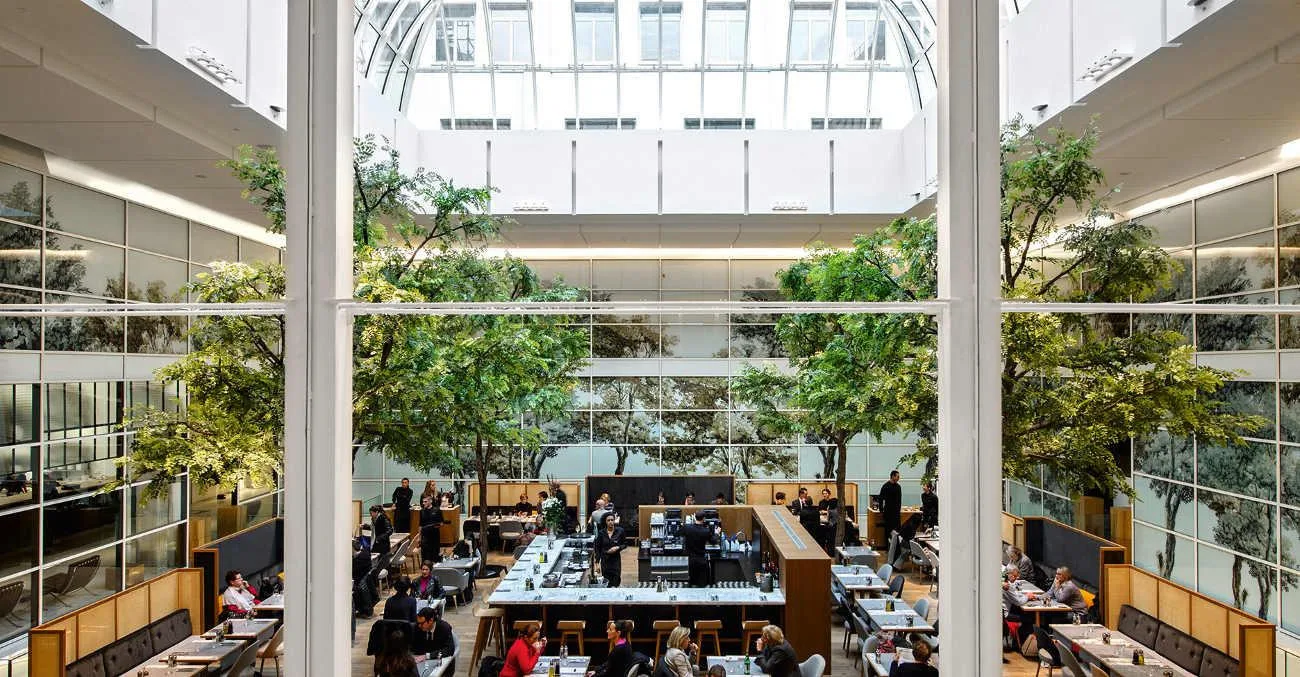
La Grande Épicerie de Paris, the premium grocer operated by Le Bon Marché in Paris
Ownership changed hands in 1984, when Bernard Arnault acquired the Boussac-Agache business group, which held Le Bon Marché, Christian Dior, and other assets. Arnault subsequently gained control of LVMH, and Le Bon Marché and La Grande Épicerie came to sit within LVMH's Selective Retailing division as a result. So it's more accurate to treat the 1984 acquisition and the move into LVMH as two separate steps rather than a single event.
La Grande Épicerie underwent a major renovation completed in December 2013 after 18 months of construction. The overhaul unified a marketplace-style area evoking a traditional market ("Place du Marché"), a basement wine cellar, the restaurant "La Table," and expanded production facilities within a single space — a renovation that came to symbolize today's luxury grocery model, combining gourmet retail with on-site production, dining, and experience. In November 2017, the brand opened a Rive Droite store in the Passy district, extending from Paris's Left Bank to the Right Bank. That store likewise paired grocery retail with tasting areas and a restaurant, presenting food as a cultural experience rather than just a purchase.
According to key operating figures LVMH has disclosed, the Rive Gauche store spans roughly 3,650 square meters of retail space and draws about 8,000 visitors a day. Total staff number 390, of whom 62 are introduced as artisans. In the roughly 1,500-square-meter basement production space, artisans and apprentices in baking, pastry, and catering make products by hand. In other words, what sits behind the shop floor isn't a warehouse — it's a "culinary workshop" producing the brand's own goods.
Not a Food Hall, But an Integrated Production-Curation-Service Model
This structure differs fundamentally from a typical department store food hall. A traditional food hall operates by leasing space to outside brands and collecting sales commissions or rent, with product development, production, and brand management often left to the tenants themselves.
La Grande Épicerie, by contrast, brings together the buyers who source products, the artisans who make them, the chefs who cook them, the content that tells their story, and the online and offline sales channels — all under one brand.
The production organization in particular is no mere demonstration facility. It's a supply-chain asset the company directly controls — recipes, quality specifications, production schedules, launch timing, and sales channels. A food hall that depends on outside name brands can lose its differentiation the moment those brands move to another retail channel or open at a competitor. Products made and branded in-house, by contrast, remain an exclusive asset that stays with the platform.
On-site production is also content that can only be delivered offline. Consumers aren't just buying the finished bread, pastry, or ready meal — they're experiencing the skill and process behind making it. The people and space required for food production function as both a cost center and a stage that draws customers in.
La Grande Épicerie also connects its rooftop hub garden to cooking classes and runs programs where customers make chocolate and desserts themselves in the pastry workshop. Product sales, dining, education, and events aren't kept separate — they flow together into a single customer journey.
What Matters More Than Product Count Is "Curatorial Authority"
La Grande Épicerie carries roughly 30,000 products spanning wine and spirits, cheese, charcuterie, fresh food, spices, oils, sauces, pastry, tea, and coffee. Some are sold exclusively in-store or produced on-site.
But in terms of scale alone, hypermarkets and e-commerce platforms can offer far more products. This store's real asset is its curatorial ability — being able to explain why a given product earned a place there.
Product specialists travel across France and abroad to source goods. In the store, products are organized not simply by origin or price tier but by season, provenance, cooking method, and cultural context. Customers aren't picking one option out of countless choices — they're being offered options the platform has already vetted and interpreted.
In an era when too much choice has become exhausting in itself, value shifts from "the cheapest place" to "the place that won't let you choose wrong." La Grande Épicerie has built exactly that kind of trust as a brand asset over time.
That trust, in turn, converts into private label. La Grande Épicerie's own-brand products aren't cheaper substitutes for name-brand goods. They're the store's sourcing network, quality standards, and culinary know-how compressed into a single product — an "edible brand experience" that lets customers take the store's worldview home with them.
Hyundai Department Store Introduces La Grande Épicerie Online First
In March 2026, Hyundai Department Store signed an MOU with La Grande Épicerie for gourmet-trend exchange and joint marketing. Both companies describe it as La Grande Épicerie's first global partnership with a department store in Asia.
The partnership includes about 300 private-label items — olive oil, jam, sauces, and more developed with artisans across France — along with regional grocery products. Hyundai Department Store said it would sell roughly 400 items in total, including these, in stages online and in its major store food halls, and was also considering exhibition- and experience-style events introducing French food culture.
In April 2026, Hyundai Department Store began selling about 300 La Grande Épicerie private-label and European premium grocery items first on The Hyundai Hi, its premium curated online mall, with plans to expand the range to roughly 400 items. Notably, the company chose its digital channel as the initial customer touchpoint rather than opening a permanent physical store first.
The case illustrates that online and offline don't need to play the same role on a future food platform. Offline can handle tasting, discovery, production, and experience, while online handles repeat purchases, personalization, and long-term customer relationships.
Similar Attempts Exist in Korea Too — But Not Quite the Same
Attempts to make food a core content category are growing quickly in Korea as well. But while there are plenty of cases of upgraded department-store basement food halls, standalone platforms where food itself is the reason to visit — integrating production, private label, dining, education, and online channels the way La Grande Épicerie does — remain limited.
The Closest Case: Twelve at House of Shinsegae Cheongdam
House of Shinsegae Cheongdam, which opened December 10, 2025, reconfigured the basement and ground floors of the former SSG Food Market Cheongdam into a roughly 1,500-pyeong destination retail space. It's notable as Shinsegae's first attempt to expand the House of Shinsegae model into an independent space outside a department store.
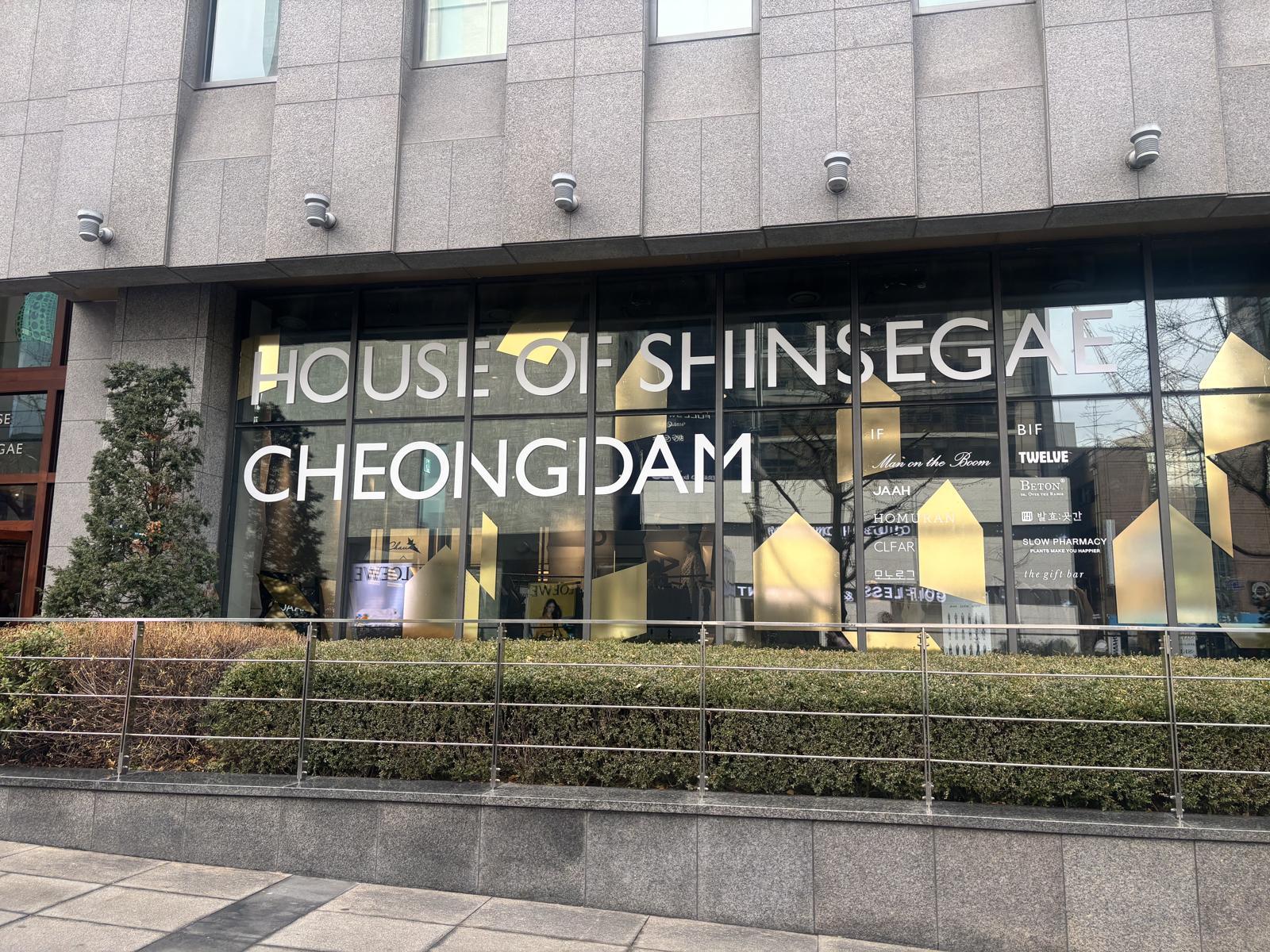
House of Shinsegae Cheongdam — the basement food hall 'Twelve' is its core content
At the center is Twelve, the basement food hall. It curates roughly 6,000 wellness grocery items around 12 criteria, and pairs them with about 40 smoothies and juices and customizable deli plates offering roughly 900 combinations. Signature ingredients are displayed in standalone showcases, much like fashion merchandise.
At the entrance, the store built a roughly 100-seat plaza called "Agora" and a courtyard that lets in natural light — designed so customers can rest or eat there without buying anything. According to the company, the space drew 400,000 visitors in its first 100 days.
That said, the building housing Twelve also contains fashion, home goods, beauty, spirits, and dining content. So it's more accurate to describe it not as a platform built entirely around food, but as one that uses food as its core axis to expand into wellness and lifestyle more broadly.
An Earlier Experiment: Gourmet494 Hannam
Galleria's Gourmet494 Hannam is an F&B and retail complex built not in a department store but in the commercial facilities of the Nine One Hannam residential complex. Galleria describes it as a "fine living platform" that combines gourmet food with lifestyle content.
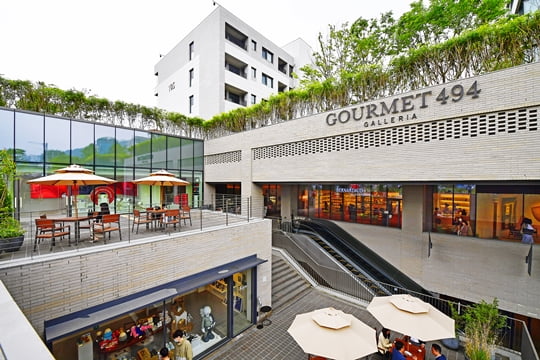
Gourmet494 Hannam, built in the Nine One Hannam commercial complex — its layout evokes European old-town market lanes
Notably, the roughly 200-meter basement space isn't divided into conventional floor-by-floor stores. Instead it's designed as a continuous space evoking the market squares and lanes of a European old town — a large plaza for the market, a mid-size plaza for dining, and smaller spaces for pop-ups and events.
But it also includes non-food content like audio equipment and art, and outside tenants make up a large share of the space. So Gourmet494 Hannam is better classified as a mixed-use platform in which food drives the layout and identity, rather than a space made up of food alone.
Economies of Scale: Shinsegae Gangnam's Food Hall
Shinsegae Gangnam built out Sweet Park, House of Shinsegae, Shinsegae Market, and a dedicated deli hall in sequence, completing a roughly 6,000-pyeong food hall system. Dessert, dining, fresh food, grocery shopping, ready meals, health food, and traditional liquor have each been expanded into dedicated content zones.
According to the company, cumulative customer visits topped 10 million in the year following the food hall renovation. Chef-collaboration brands, global deli offerings, live kitchens, exclusive menus, and pop-ups have continually created new reasons to visit.
Physically, though, it's still located inside a department store and the adjoining Centralcity complex. So it's better understood not as a case that has broken fully free of the traditional mall structure, but as one where food content has grown into a massive destination within a department store.
Turning Fresh Food Into Content: Lotte's "L'Épicerie"
Lotte Department Store's L'Épicerie is a premium grocery brand that launched at its Incheon store in 2023. The Nowon store, which opened in March 2026, spans about 550 pyeong and was designed with a customer flow based on purchase cycles and priorities.
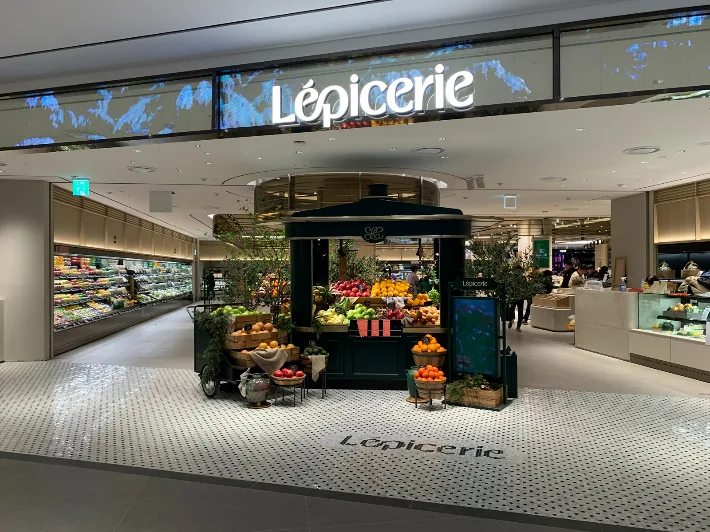
Lotte Department Store's premium grocery brand L'Épicerie — defined by producer branding and health-based curation
The store introduced "With Farmer," which puts standout producers front and center; "Better Food Zone," which sorts products by health criteria; and "Dimple Fruit," which reframes cosmetically imperfect fruit. It also runs a live sushi bar, ready-to-eat seafood HMR, and a "Korean Food Archive" stocked with about 170 premium banchan items.
Despite the constraint of operating inside a department store, the combination of origin, producer relationships, customer data, health criteria, and on-site production points toward the direction in which a traditional supermarket evolves into a personalized fresh-food gourmet platform.
A Digital Curation Platform: SSG.com's "Misikgwan"
SSG.com opened Misikgwan, a dedicated food vertical, in 2024, combining premium grocery, thematic curation, online pop-ups, short-form content, and AI-based personalization. It offers content on product varieties, storage, and cooking methods, and recommends items to individual customers based on their search history, purchase history, and interests.
In its 2025 relaunch, it strengthened six themes — Italian ingredients, chef collaborations, producer-centered fresh food, global premium products, SSG-exclusive items, and eco-friendly products — and introduced "Misikjog," a feature letting customers participate through votes, surveys, posts, and recipes.
It shows that curatorial strength can be built through content and data even without a physical building. But it's hard for it to replace the on-site experience of aroma, taste, the production process, and human conversation.
What the 2023 SSG Food Market Reacquisition Says
There's also an interesting capital move worth noting. SSG Food Market Cheongdam launched in 2012 as a standalone premium supermarket that broke from the traditional department-store floor layout.
In 2016, Shinsegae consolidated operation of its premium supermarket business under E-Mart, transferring the SSG Food Market and Star Super businesses for roughly KRW 129.7 billion. But in August 2023, it reacquired the land and buildings of SSG Food Market's Cheongdam and Dogok stores from E-Mart for KRW 129.825 billion. At the time, Shinsegae said the goal was to strengthen the competitiveness of its department store premium food hall business.
The Cheongdam store was subsequently reorganized into House of Shinsegae Cheongdam in December 2025. This sequence of events can be read as a long-term strategy of pulling both operational control and key real estate for the premium food business back into the department store business.
It's a signal that a food hall is no longer just an ancillary draw for a department store — it's being reassessed as a strategic asset capable of generating its own brand and profit model.
What Determines a Future Food Platform's Enterprise Value
Competition among Korean food halls has long centered on how many famous restaurants and overseas brands a space can attract. But when a space stays a collection of popular tenants, its differentiation lasts only as long as the lease terms. Once a name brand also opens at a competitor or the contract ends, the reason to visit disappears along with it.
Proprietary recipes, private label, co-branding with producers, content formats, and membership data, by contrast, accumulate with the operator. A future food platform's enterprise value should be measured less by floor space or tenant count than by how many exclusive products and repeatable content formats it holds.
The metrics used to gauge performance need to shift too. A new space can draw visitors quickly through opening buzz and social media attention. But visitor counts alone in the early going are a poor gauge of whether a platform is actually succeeding. Going forward, the following metrics deserve equal weight:
Repeat-visit rate after 30 and 90 days post-opening
Revenue share from private label and in-house-made products
Conversion rate from tasting to purchase
Online reorder rate among in-store customers
Repeat-participation rate for paid classes
Utilization rate of production facilities
Waste rate for fresh food and ready-to-eat products
The profitability gap between outside tenants and in-house brands
What separates a food hall that's simply busy from a food platform that's genuinely repeatable ultimately comes down to repeat visits, exclusive products, and purchase data.
A Korean Model Needs to Connect With Korea's Own Producers and Artisans
If Korean operators simply transplant La Grande Épicerie as-is, they risk ending up with nothing more than a high-priced food hall stocked with imported goods and famous restaurants. A Korean model needs to be redesigned as a system that connects urban consumers with Korea's own regional producers, fermentation traditions, seasonality, artisans, and food culture — not a copy of French gastronomy.
The starting point is putting farmers, fishing communities, breweries, mills, and jang and kimchi artisans front and center as co-creators of the brand, rather than treating them as anonymous suppliers. Stores can dedicate space to on-site production of tofu, rice cakes, jang, banchan, noodles, and desserts, and open that process up to customers.
Grocery sales need to be linked to recipes, deli offerings, and restaurants too. Customers who eat a dish at the restaurant should be able to buy it as deli food, and reorder the sauces and ingredients used in that dish for home cooking. A space only truly becomes a platform once visits, tastings, purchases, delivery, and reorders are tied together within a single membership system.
Revenue structure needs to move beyond rental commissions as well. Combining private label and co-developed products, incubating small producers, subscriptions, corporate gifting, paid classes, dining, and overseas sales can turn a food hall from an expensive customer-draw facility into a standalone profit platform.
There are risks, of course. Excessive premiumization can turn a food hall into a showcase for a small slice of customers, and over-reliance on famous restaurants and pop-ups means having to swap out content every time a trend shifts. On-site production carries heavy costs for hygiene management and skilled staffing, and inventory and waste burdens grow as product counts climb. That's why the price ladder — everyday food, discovery-oriented products, and ultra-premium items together — needs to be designed from the outset, rather than building a space that's simply a collection of expensive goods.
The Future La Grande Épicerie Points Toward
The future La Grande Épicerie points toward isn't a bigger food hall. It's a shift from a place that sells products to a platform that creates content, cultivates artisans, makes products itself, and learns customers' tastes.
In Korea, Twelve at House of Shinsegae Cheongdam is the closest comparison to La Grande Épicerie in terms of spatial design and the destination experience it offers. Gourmet494 Hannam has shown the potential of a standalone, food-led mixed-use space; Shinsegae Gangnam demonstrates economies of scale; L'Épicerie shows how fresh food and producer relationships become content; and SSG.com's Misikgwan fills in the piece around data and digital personalization.
But no Korean platform has yet clearly established itself as one that fully integrates an in-house artisan organization, on-site production, a strong private label, dining, education, and online sales under a single food brand. That gap is exactly the space Korea's food retail sector will need to fill next.
✦RIT's Insights
RIT sees the most important takeaway in this case as the fact that La Grande Épicerie's competitiveness doesn't come from the number of premium products on its shelves — it comes from the organizational structure that integrates buyers, artisans, chefs, content, and distribution channels under one brand.
The investment Korean department stores are now pouring into their food halls reads as a signal that they're gradually moving toward this integrated model. Twelve combines wellness curation, customizable deli offerings, and a space designed for lingering. L'Épicerie is bundling standout producers and food into a co-brand and turning the fresh-food production process into a customer experience. Shinsegae's 2023 reacquisition of the SSG Food Market Cheongdam and Dogok assets can likewise be read as a decision that treats the premium food business as a long-term core asset.
That said, most Korean cases so far still lean heavily toward the model of a curated shop that's simply good at gathering outside tenants. How much proprietary production know-how, recipe assets, and private-label worldview stays with the operator — rather than the tenant brands — is likely to determine the next stage of competition. Merchandisers and buyers would do well to invest first in sourcing relationships and content that can explain why a product was brought in, rather than competing purely on how many products they can secure. Space planners should treat on-site production, tastings, and classes as standing content built into the store, not one-off events. Online teams would be better served by designing offline's discovery-and-experience function separately from online's repurchase-and-personalization function, rather than running both channels the same way.
There are three things RIT wants to watch going forward. First, whether a food-led platform independent of a department store, like Twelve, can sustain long-term repeat-visit rates and in-house product sales beyond its opening-period buzz. Second, whether the Hyundai Department Store–La Grande Épicerie partnership expands beyond online sales into permanent stores or production-and-experience content at major branches. Third, which Korean retailer is first to build a fully integrated food platform that combines an in-house production organization, a private-label worldview, dining and education, and digital repurchasing under one brand.
The winner among future food platforms is unlikely to be the retailer with the most products. It's more likely to be the brand that most persuasively explains what to eat and why — and turns that experience into its own products and repeat purchases.