Record Revenue, Yet Closing Downtown Duty-Free — Why Louis Vuitton Korea Is Moving to Department Stores and Airports
2026-08-27 9:18 AMFashion & Luxury
Overview
After a 2023 correction, Louis Vuitton Korea posted back-to-back revenue records in 2024 and 2025 — 2025 revenue reached KRW 1.8543 trillion (+6.1%), with a record operating margin of 28.3%. Yet Louis Vuitton has reportedly decided to close all three of its Seoul downtown duty-free stores. The exact closure timing hasn't been fixed, and the process is expected to proceed gradually as each duty-free operator's contract is negotiated. While the brand opens the world's largest Louis Vuitton complex in a department store and pours major investment into Incheon Airport's Terminal 2, its downtown duty-free stores are quietly being wound down.
Same company, diverging channel strategy. Louis Vuitton Korea posted a 2.4% revenue decline in 2023 — a correction — before writing new revenue records two years running: +5.9% in 2024 and +6.1% in 2025. 2025 revenue reached KRW 1.8543 trillion with a 28.3% operating margin, a record high. Yet Louis Vuitton has reportedly decided to close all three of its Seoul downtown duty-free stores — Lotte Duty Free's Myeongdong flagship, Shilla Duty Free Seoul, and Shinsegae Duty Free's Myeongdong store. The exact closure timing hasn't been confirmed; the process is expected to unfold gradually as Louis Vuitton negotiates contract terms with each duty-free operator. This isn't a completed, past-tense exit — it's a realignment that has only just begun. Louis Vuitton currently operates five duty-free locations in Korea in total: the three downtown stores, plus two at Incheon Airport (Terminal 1 via Hyundai Duty Free, Terminal 2 via Shinsegae Duty Free). Only the three downtown stores are slated for closure; the airport stores remain in place, and Terminal 2 in particular has just seen a major investment. We break down what's behind this overhaul, department store by duty-free.
Louis Vuitton Korea — Two Straight Years of Growth After a 2023 Correction
Start with the corporate-level picture. The figures below are Louis Vuitton Korea LLC's standalone (unconsolidated) financial statements.
Metric
2023
2024
2025
Revenue
16,511
17,484
18,543
Revenue growth
-2.4%
+5.9%
+6.1%
Operating profit
2,867
3,891
5,256
Operating profit growth
-31.3%
+35.7%
+35.1%
Operating margin
17.4%
22.3%
28.3%
Net profit
2,177
2,816
3,890
Net margin
13.2%
16.1%
21.0%
Figures in KRW 100 million (억원) unless noted otherwise.
2023 was a correction — as post-pandemic revenge spending normalized, revenue fell 2.4%, and cost pressure drove operating profit down 31.3%. The operating margin climbed from 17.4% in 2023 to 28.3% in 2025, a 10.9-point gain over two years — and breaking down the 2024-to-2025 stretch shows what actually drove that gain. Gross margin rose from roughly 42.3% in 2024 (KRW 740.3 billion / KRW 1.7484 trillion) to roughly 49.9% in 2025 (KRW 925.6 billion / KRW 1.8543 trillion), a 7.6-point jump, while the SG&A ratio actually ticked up slightly over the same period, from about 20.1% to 21.6% (SG&A itself rose 14% to KRW 400.1 billion — more than twice the 6.1% pace of revenue growth). In other words, the 2025 operating-margin improvement wasn't a story of cost discipline — it's more accurate to read it as gross-margin expansion, likely driven by procurement structure, sales mix and pricing effects, outrunning the rise in the SG&A ratio. 2025 also saw three separate price increases, in January, April and November, with pre-hike demand pull-forward and a richer mix of high-price items cited as contributing factors — though since the company doesn't disclose the individual contribution of price, volume and product mix, the precise weight of each factor can't be confirmed.
One thing worth flagging here: these results are for the whole company, duty-free included, and since the three downtown stores hadn't yet been wound down, they're still partly reflected in the 2025 numbers. In other words, the company posted record results in 2025 before the downtown duty-free wind-down was even complete — which suggests, at minimum, that dependence on the existing downtown duty-free channel wasn't so absolute that it alone drove the company's overall growth. That said, since channel-level revenue isn't disclosed, there's no way to confirm exactly how much department stores or flagships individually grew.
Channel 1: Department Stores — The World's Largest Complex Store Opens in Seoul
Louis Vuitton's investment in Korea's department-store channel peaked from late 2025. And this wasn't simply "a big store" — it was a project on the scale of transplanting the brand's entire universe into one city.
Louis Vuitton Visionary Journey Seoul (Shinsegae Department Store Main Branch, "The Reserve") In November 2025, the culturally immersive flagship "Louis Vuitton Visionary Journey Seoul" opened at Shinsegae's main branch. Combining retail space with an exhibition zone, café, chocolate shop and restaurant, it spans roughly 4,892 square meters — the largest Louis Vuitton complex anywhere in the world. The retail floor alone ("LV The Place Seoul") occupies four floors; add the cultural-experience zone "Visionary Journey Seoul," the café "Le Café Louis Vuitton," the chocolate shop "Le Chocolat Maxime Frédéric at Louis Vuitton," and the restaurant "JP at Louis Vuitton," and the whole complex spans six floors. It's a single vertical journey unfolding the house's core narrative of travel, craftsmanship and innovation across retail, exhibition and dining — designed not as a sales floor but as a space meant to let visitors experience the brand's world. Pietro Beccari, Chairman of LVMH's Fashion Group and CEO of Louis Vuitton, personally attended the opening — a signal worth reading as evidence of how highly headquarters values this project, though the visit alone doesn't directly confirm how country-level investment priorities are being set. Still, as covered in our previous global piece, LVMH did cite the Seoul store alongside Beijing as evidence of its rebound on its Q2 2026 earnings call.
Why Shinsegae — a symbol of the Myeongdong "luxury town" strategy Behind Shinsegae's main branch landing this mega-investment is a broader race among Korea's three department-store majors to secure luxury tenants. Shinsegae has been renovating its Myeongdong main branch — rebranding the existing main building as "The Reserve" and the new wing as "The Estate" — and alongside Louis Vuitton, it secured a roughly 2,300-square-meter Chanel store in the same complex. That's a strategy of pulling in rival luxury houses under one roof to turn Myeongdong itself into a "luxury town." Against that backdrop, Shinsegae's main branch landing the largest Louis Vuitton complex in the world is a symbolic achievement that shows how much presence Shinsegae's flagship has built in Seoul's northern luxury district. That said, Korea's department-store luxury competition plays out on several fronts — Shinsegae Gangnam (past KRW 3 trillion in annual sales), Lotte Jamsil (also past KRW 3 trillion, with talk of a "KRW 4 trillion single-store club"), and Hyundai's Pangyo and The Hyundai Seoul stores among them — so it would be premature to call this one project a decisive "win" for Shinsegae overall.
What's worth noting is that the rules of this competition are themselves changing. Department-store luxury competitiveness used to be decided by "how many brands can we land" — the deciding factor is increasingly "how well can we design and present that brand and the experience around it." Shinsegae's push to turn its main branch into a tourist-magnet landmark spanning global luxury and K-culture content runs on exactly that logic. For Louis Vuitton too, the choice wasn't simply the highest-revenue store — it was the partner best equipped to co-design the café, restaurant and cultural content the brand actually wanted.
La Beauté Louis Vuitton (Shinsegae Gangnam) Louis Vuitton has said it plans to open its first makeup brand, "La Beauté Louis Vuitton," as its first standalone store in Korea at Shinsegae's Gangnam branch in August 2026 (whether it has actually opened, and the exact date, would need separate confirmation as of this writing). If it goes ahead as planned, beauty — not just leather goods and fashion — is now being prioritized for Korean department stores too, and it's worth noting that, after the main-branch flagship, this would be a second consecutive new line handed to Shinsegae specifically.
Taken together, these three cases send an unmistakable message — for Louis Vuitton, Korea's department-store channel is no longer just a place to sell. It's a testing ground for brand-experience design and a priority destination for investment, and Shinsegae has turned in a notable performance in the competition for that partner role.
Channel 2: Duty-Free — Three of Five Stores Now in a Phased Wind-Down
The duty-free channel should be read precisely as an ongoing realignment, not a completed exit.
The wind-down so far
Timing
Detail
2022
Lotte Duty Free Jeju closed
2022–2023
Shilla Duty Free Jeju closed; Lotte Duty Free Busan and World Tower closed
2026 (in progress)
Decision made to close Lotte Duty Free Myeongdong flagship, Shilla Duty Free Seoul, and Shinsegae Duty Free Myeongdong — exact closure timing not yet fixed, expected to proceed in phases as each operator's contract is negotiated
In other words, this is an extension of a trend that began in 2022 with regional and Busan-area stores — the process has now reached the final three downtown Seoul locations. But there's a gap between the notice and actual closure: as of this writing, all three stores remain open and operating normally. The exact closure timing hasn't been set, and the stores are likely to close in phases depending on each operator's contract terms — some reports suggest the full process could take about two years.
Why Downtown Duty-Free, and Why Now — Confirmed Market Shifts and Strategic Interpretation
Factors ①–③ below are reasonably well confirmed by market data and industry reporting. Factors ④–⑤ are closer to strategic interpretation than something Louis Vuitton has stated directly, and it's worth keeping that distinction in mind.
① The group-tour and daigong model has weakened (confirmed factor) Korea's downtown duty-free stores long depended heavily on bulk purchases by Chinese group tourists and "daigong" — resellers who buy in bulk to resell elsewhere. Since COVID, the mix of visitors to Korea has shifted from group tours toward independent (FIT) travelers, and as duty-free operators cut commissions paid to tour agencies starting in 2023, daigong purchasing fell in step. Independent travelers tend to spread their spending across department stores, Seongsu-dong, Hongdae, pop-up stores and airports, rather than concentrating it in downtown duty-free along a set tour-agency itinerary — and some luxury brands are reportedly already seeing more foreign-tourist revenue from department stores than from Seoul's downtown duty-free stores.
② The downtown duty-free market itself has shrunk sharply (confirmed factor) Korea's total duty-free sales fell from KRW 24.8586 trillion in 2019 to KRW 12.534 trillion in 2025 — roughly halved in six years. Downtown stores' share of total duty-free sales also fell over the same period, from 84% to 73%; applying that share directly implies downtown duty-free revenue fell from roughly KRW 20.9 trillion in 2019 to roughly KRW 9.15 trillion in 2025 — a decline of about 56% (this is a rough estimate from multiplying the share figures, and may differ from actual downtown-specific sales data). In other words, the contraction in downtown duty-free appears to have been steeper than the contraction in the overall duty-free market. Rent, interior fit-out, staffing and inventory costs haven't gone anywhere, but the revenue base underneath them has shrunk this much — and the bigger and more elaborate the luxury store, the faster fixed-cost pressure builds as sales fall.
③ A weaker won has dulled duty-free's price appeal (confirmed factor) Duty-free pricing is heavily influenced by dollar-denominated costs. When the won weakens, the won-converted price rises even with taxes waived, narrowing — or sometimes erasing — the gap versus domestic department-store prices, to the point some consumers now perceive duty-free as more expensive. For a brand like Louis Vuitton that tightly manages official discounts and price differentiation, the felt benefit of duty-free pricing can be minimal — and once shoppers conclude "it's tax-free but not really cheaper," there's less reason to bother with pre-departure registration and airport pickup.
④ Bulk buying and resale undermine brand control (strategic interpretation) Daigong have long bought in bulk at duty-free and resold through Chinese e-commerce channels or unofficial distribution networks. Industry consensus holds that this structure can boost short-term volume but, over time, disrupts official pricing policy and erodes a product's scarcity and premium image. The view that department stores and flagships outperform downtown duty-free on customer data, VIP management, new-product introductions, and cross-selling higher-priced items follows the same logic.
⑤ Airports and department stores now carry more strategic value (strategic interpretation) Louis Vuitton doesn't appear to be exiting duty-free as a business — it looks more like it's shifting weight away from downtown while maintaining and reinforcing airport stores. It's a common industry explanation that airport stores, sitting directly on the departure path, convert purchases at a comparatively higher rate and suit Louis Vuitton's core brand message of "the art of travel" — but Louis Vuitton itself hasn't confirmed this directly.
Airport Duty-Free — T1 Holds Steady, T2 Gets a Major Investment
While downtown is being scaled back, the airport channel is holding steady — and Terminal 2 in particular has just received a major investment.
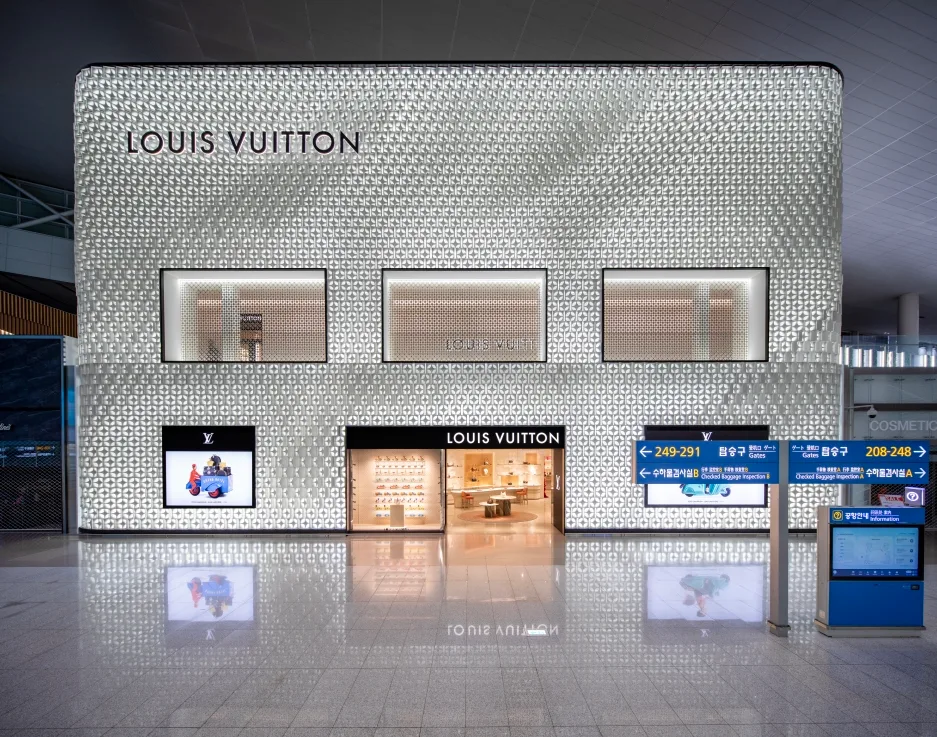
Incheon Airport T2's duplex store — unlike the downtown duty-free stores being wound down, this is where Louis Vuitton has invested most heavily of late
Louis Vuitton has stores at both of Incheon Airport's duty-free operators — Hyundai Duty Free at Terminal 1 and Shinsegae Duty Free at Terminal 2. Incheon T2, which opened in 2018, got its first-ever Louis Vuitton store in February 2025, in partnership with Shinsegae Duty Free. In June 2026, its facade was completed and it was unveiled in full as Incheon Airport's first-ever duplex (two-story) store. Its spiral staircase creates a sense of dimensional depth, and the store carries a wide range of categories — leather goods, accessories, ready-to-wear, shoes, fine jewelry and travel goods. There's no evidence of a comparable new investment at the T1 store. That this kind of investment landed in T2 around the same time the decision to close the three downtown stores was made says something about where the airport channel sits in this realignment.
Channel-by-Channel Summary
Channel
Strategic direction
Underlying drivers
Seoul downtown duty-free (3 stores)
Closure decided (exact timing not fixed, phased)
Declining group tours/daigong, weaker price appeal, falling profitability
Airport duty-free (T1)
Maintained
—
Airport duty-free (T2)
Reinforced, scaled up (duplex store unveiled in full, June 2026)
Direct access to departing travelers, growing FIT segment
Department stores
Reinforced and scaled up
Revenue from domestic VIPs and individual foreign tourists (unconfirmed — channel-level revenue not disclosed)
Flagships/standalone stores
Investment centered on brand experience
Control over product, pricing, and customer data
Korea overall
Not an exit
Louis Vuitton Korea's revenue is, if anything, at a record high
Business Impact — "Reallocation," Not "Retreat"
Louis Vuitton's move looks like a strategy of reallocating the reach it's giving up downtown toward department stores, flagships, and a key airport hub. Department stores and flagships offer stronger control over customer experience, product assortment and CRM, while airport stores offer a symbolic touchpoint with actual departing travelers. There's a separate issue RIT keeps getting stuck on, though: since channel-level revenue and costs aren't disclosed, there's no way to confirm whether airport stores are actually more profitable than downtown duty-free — if anything, Korea's duty-free industry has seen operators hand back parts of their Incheon Airport concessions due to the burden of high rent. As shown above, Louis Vuitton Korea's 2025 revenue and operating profit were already at record levels. One caveat: Louis Vuitton Korea's corporate operating margin can also be shaped by procurement pricing and transfer-pricing policy with headquarters, so this figure shouldn't be read as a pure, direct measure of the brand's underlying retail profitability. In the end, what this realignment confirms isn't so much "a move toward better-paying channels" as it is a case of selective concentration — moving away from a shrinking downtown duty-free market toward core hubs where brand experience and customer touchpoints are easier to control.
✦RIT's Insights
What RIT most wanted to correct here is the misunderstanding the word "exit" invites. There's a clear gap between the announcement and the actual closure, and the fact that even the exact closure timing hasn't been fixed yet matters more than it might seem. A brand at Louis Vuitton's scale doesn't shut down a channel on impulse when it winds one down — it takes the time to work through inventory, staffing and customer data, negotiating with each operator along the way. In practice, the bigger the brand, the wider the gap tends to be between the announcement and the actual shutdown, since remaining lease terms, inventory drawdown and staff reassignment all have to line up. Missing that pacing is exactly how a premature read like "Louis Vuitton is leaving Korea" takes hold.
The fact that LVMH's Fashion Group chairman and Louis Vuitton CEO personally attended the Shinsegae main-branch opening is worth reading as a symbolic signal. But turning that alone into proof that "headquarters has locked in its resource-allocation priorities" is a stretch — a visit is a visit, and the actual scale and priority of investment remains a matter of inference unless the company discloses it directly. The safest reading available right now is simply that Shinsegae had already built momentum by reshaping Myeongdong into a luxury town — landing a roughly 2,300-square-meter Chanel store alongside this project. For anyone running a department store's luxury floor, what matters in this Shinsegae case isn't floor space or revenue-share terms, but how much of the experiential space a brand wants — café, restaurant, cultural content — a retailer can help co-design. The rules of the competition themselves are shifting toward the store becoming content in its own right.
For anyone operating a duty-free business, the right read on the decision to close these three downtown stores isn't that it's Louis Vuitton's issue alone — it's a symbolic marker of ultra-premium brands drifting away from downtown duty-free generally. Fortunately, the fact that closure timing hasn't been set and is likely to unfold in phases also means there's still time to plan how another brand or category could fill that gap. For anyone running airport duty-free, on the other hand, the choice to leave T1 untouched while concentrating major investment in T2 alone deserves attention — the more ultra-premium a brand gets, the more it puts its weight behind a small number of anchor stores rather than many locations, which suggests the better-paying strategy may be pouring resources into landing and designing one anchor brand at the highest possible level, rather than expanding store count. The fact that the downtown pullback and the department-store mega-investment landed around the same time is worth reading, for anyone setting HQ or retail strategy, as a signal that in the Korean market, "how you're presented" is overtaking "where you're sold" as the priority — and it's worth expecting similar channel realignments in other markets too.
The fact that the downtown duty-free market itself roughly halved in six years, and that downtown specifically appears to have contracted even more sharply — an estimated ~56% — makes something clearer: this isn't one brand's judgment call, it's a structural crisis in the channel itself. In RIT's view, this looks less like a brand abandoning a channel, and more like the channel losing its ability to hold onto brands in the first place. That said, the airport channel isn't automatically more profitable either — some duty-free operators have handed back Incheon Airport concessions over high rent — so it's more accurate to read Louis Vuitton's move as "toward channels it can control more," rather than simply "toward channels that pay more."
DART electronic disclosure system (dart.fss.or.kr) — Louis Vuitton Korea LLC audit reports for FY2023–2025 (cited by name where a specific filing URL could not be pinpointed)