Louis Vuitton Hit a Record, Dior's Operating Profit Fell 59% in Two Years — Too Early to Pin It on a 'Trust Crisis' Alone
2026-08-27 7:58 PMFashion & Luxury
Overview
While Louis Vuitton Korea posted a third straight year of record results, Dior Korea — under the same LVMH umbrella — fell sharply for two years running. A company with a 29.8% operating margin in 2023 sank to 16.7% by 2025. Several incidents did shake trust in the brand — a subcontractor labor-conditions controversy, a data breach (occurred 2025, fined February 2026), a repair-trust dispute — but when you line up the actual dates, few of them can be pinned down as the "cause" of the 2025 decline. With full-year 2026 results not even existing yet, this piece lays out several possibilities side by side rather than reaching for a tidy causal story.
Same LVMH, two brands that once both crossed KRW 1 trillion in Korean revenue — and three wildly diverging years. Louis Vuitton Korea, covered in our previous piece, posted 2025 revenue of KRW 1.8543 trillion, a third consecutive record year. Dior, right next door within the same group, went the exact opposite direction. A company that first crossed KRW 1 trillion in revenue in 2023 — with a 29.8% operating margin — fell back below that mark in 2024 and 2025, landing at KRW 773.9 billion in revenue and a 16.7% operating margin by 2025. On an operating-profit basis, it went from KRW 312.0 billion in 2023 to KRW 129.2 billion in 2025 — down roughly 59% in two years. That fact itself is clear. The question is "why." Several incidents did rattle trust in the brand — a subcontractor labor-conditions controversy (June 2024), a data breach (occurred 2025, fined by regulators in February 2026), a repair-trust dispute (2026) — but when you line up exactly when each of these happened against the actual results, "trust collapsed, so results collapsed" turns out to be too simple a story to hold up. This piece lays out that timing gap plainly, and looks at several possibilities beyond the trust narrative that could explain the decline.
Scope of this analysis: This piece focuses on Christian Dior Couture — bags, ready-to-wear, and jewelry. Parfums Christian Dior, which handles fragrance and cosmetics, is a separate division within LVMH with a different sales and distribution structure, so its results aren't combined with Couture's here.
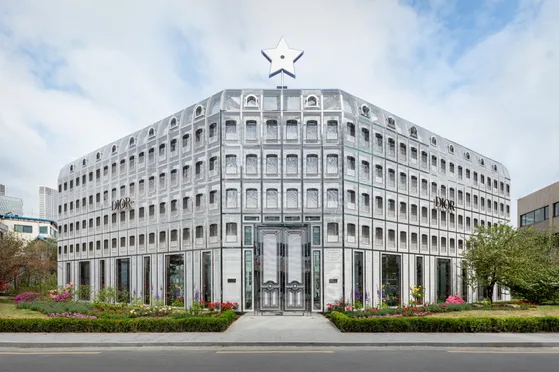
Dior is expanding beyond department stores too — its Seongsu-dong flagship, 'Dior Seongsu'
Dior's Place Within LVMH — Global Results
Like Louis Vuitton, Dior doesn't disclose standalone revenue or operating profit. It sits inside LVMH's "Fashion & Leather Goods" division alongside Louis Vuitton, Celine, Loewe, Fendi, Loro Piana, Givenchy, Rimowa and Berluti, so the figures below represent the whole division, not Dior alone.
Metric
2023
2024
2025
Revenue
€42.17B
€41.06B
~€37.77B
Revenue growth (organic)
+14%
~0%
Declining
Recurring operating income
€16.84B
€15.23B
~€13.21B
Recurring operating margin
39.9%
37.1%
~35.0%
In Q2 2026, Dior rebounded faster than Louis Vuitton
Metric
Q1 2026
Q2 2026
Fashion & Leather Goods organic growth
-2%
+1%
LVMH group organic growth
+1%
+3%
In Q2 2026, this division posted organic growth (+1%) for the first time in seven quarters. On the earnings call, LVMH said both Louis Vuitton and Dior returned to growth in Q2, with Dior posting the slightly higher growth rate of the two (brand-level figures weren't disclosed). Behind the rebound: the debut collection from new creative director Jonathan Anderson, a positive early response to the new Cigale bag, and new store openings — the Bamboo Pavilion in Tokyo and a new boutique in Osaka. Some reports also cited double-digit growth in the US and Japan, though since LVMH doesn't regularly disclose brand-level regional revenue, that figure should be treated as directional at best. Either way, one thing is clear: the notion that global Dior is "still in freefall" simply isn't accurate, at least as of Q2 2026.
Dior Korea — Two Straight Years of Steep Decline
The global picture shows signs of a rebound. The Korean entity's picture is different. The figures below are from the audited financial statements of Christian Dior Couture Korea Ltd.
Metric
2023
2024
2025
Revenue
10,456
9,454
7,739
Revenue growth
+12.4%
-9.6%
-18.1%
Operating profit
3,120
2,266
1,292
Operating profit growth
-3.6%
-27.4%
-43.0%
Operating margin
29.8%
24.0%
16.7%
Net profit
2,386
1,727
1,011
Net margin
22.8%
18.3%
13.1%
Figures in KRW 100 million (억원) unless noted otherwise.
One thing needs to be said clearly here. This table reflects confirmed results only through 2025. Fiscal year 2026 hasn't closed yet, and Dior Korea, as a privately held foreign subsidiary, doesn't disclose quarterly results the way a public company would. In other words, there is currently no way to confirm Dior Korea's 2026 revenue or operating profit. That's exactly why the various 2026 incidents covered later in this piece can't be used as evidence that "results kept worsening into 2026" as well.
Store Count Held Steady Even Through the Downturn
Even as results collapsed, Dior Korea's store footprint itself didn't shrink. Even amid declining results, Dior operates at 25 addresses across Korea — including its top department-store locations and standalone flagships — with 14 addresses in Seoul alone. The footprint is concentrated in Korea's top-tier department stores — Lotte (Main, Jamsil), Shinsegae (Main, Gangnam, Centum City, Daegu), Hyundai (Apgujeong Main, The Hyundai Seoul), and Galleria (Luxury Hall, Gwanggyo) — and Dior also operates standalone flagships beyond department stores, like House of Dior Seoul and Dior Seongsu (pictured). That said, "address" and "store" aren't quite the same thing — some department stores carry separate addresses for women's, men's and jewelry boutiques, so 25 addresses shouldn't automatically be read as 25 independent locations. Nor can this number alone tell us whether the footprint grew or shrank relative to the past — there's no comparable historical store-count figure to check it against.
The cost structure is worth examining too. 2025 gross profit fell sharply to KRW 400.4 billion from KRW 540.3 billion the year before, while SG&A (KRW 271.2 billion, including KRW 115.0 billion in rent and KRW 33.0 billion in advertising) didn't shrink nearly as much — advertising spend actually ticked up slightly from the prior year. Fixed costs like store rent and brand-building spend like advertising aren't easy to cut, so when revenue turns down, profit collapses far more steeply. Maintaining store operations and ad spend does show the company is continuing to invest in the Korean market. Whether that reflects a deliberate long-term strategy that accepts short-term pain, cost rigidity from long-term leases, or a global investment mandate from headquarters isn't something public data alone can settle.
The Incidents Around Dior — Lined Up Against the Calendar
There have certainly been several incidents that touched on trust in Dior. But it's worth carefully working out exactly when each happened, and how that lines up against the 2025 results period (January–December 2025).
June 2024 — Italian subcontractor labor conditions and the "€53 wholesale price" controversy (timing overlaps with 2024 results) Reuters reported on an Italian police raid of a Dior bag subcontractor. The investigation uncovered poor labor conditions and undocumented hiring at some of the subcontractors producing Dior products — the subcontractor had reportedly employed undocumented workers, running the factory around the clock. On top of that, the subcontractor's wholesale price (€53, about KRW 78,700) spread through public discussion simplified into "the bag's total production cost." Strictly speaking, that €53 is closer to a bare assembly-and-delivery price, excluding materials, design, distribution and marketing. This incident's timing overlaps with the 2024 results period, so an effect can't be ruled out — but with no data on domestic sales shifts or consumer surveys, the actual size of that effect can't be confirmed either.
Occurred January 2025, fined February 2026 — data breach A breach that occurred on January 26, 2025 wasn't recognized by Dior until May 7. Korea's Personal Information Protection Commission (PIPC) found that Dior had violated its safeguard obligations (access controls, access-log reviews) and, without justifiable cause, missed the statutory deadline (72 hours under Korea's Personal Information Protection Act) for reporting to authorities and notifying affected users (notification came May 12). That investigation has already concluded — the PIPC finalized its ruling on February 11, 2026, fining Dior Korea KRW 12.236 billion plus an administrative fine of KRW 3.6 million, with roughly 1.95 million people's personal information found to have been exposed (Tiffany, another LVMH brand, was sanctioned in the same ruling). Breaking the timeline into three stages — ① the breach itself (January 2025), ② consumer awareness and media coverage (from May 2025), and ③ the regulatory ruling (February 2026) — and exactly how the fine flows into which fiscal year's expenses is a separate question that would need to be checked against the financial statements. Since the breach became known to consumers only from May 2025 onward, the window in which it could have affected full first-half 2025 results was limited. How much it affected second-half purchasing behavior is also hard to confirm, since brand-level quarterly revenue isn't disclosed.
May 2026 — complaint to Korea's Fair Trade Commission over "fake repair" allegations (timing doesn't align with 2025 results) Dior allegedly told customers their luxury bags were being sent to Paris headquarters for repair, when they were reportedly handled by a domestic repair shop instead — leading to a complaint filed with Korea's Fair Trade Commission, with the case later transferred to Seoul Namdaemun Police Station in June for investigation. No judicial finding has been reached, so this can't yet be characterized as "fraud." And more to the point, this incident surfaced after 2025 results had already been tallied — it cannot be a cause of the 2025 revenue decline (-18.1%); it should instead be read as a new risk that could weigh on future recovery.
Lined up this way, few of the trust-related incidents can directly explain the steep 2025 decline (-18.1%). The subcontractor labor-conditions controversy overlaps with the 2024 decline in timing, but explaining the larger 2025 drop requires looking at other factors as well.
What Else Is Worth Looking At Beyond Trust
Other luxury brands reportedly held up better in Korea over the same period. Louis Vuitton Korea alone moved in exactly the opposite direction in 2025 — revenue +6.1%, operating profit +35.1%. But it's hard to turn that directly into a contrast of "Louis Vuitton kept trust, Dior lost it." The two brands differ in their signature product categories (Louis Vuitton centers on travel leather goods and monogram canvas; Dior skews more toward women's ready-to-wear and leather goods), customer base, and store composition, and the data breach hit both LVMH brands, so that alone can't explain the gap in results. If anything, this comparison suggests something closer to: the mere existence of a trust controversy doesn't determine results by itself — brand equity and product competitiveness likely determine how well a brand absorbs the shock of that controversy.
Base effects can't be ignored either. Dior Korea's revenue went from KRW 186.7 billion in 2019 to KRW 328.5 billion in 2020, KRW 613.9 billion in 2021, roughly KRW 930.5 billion in 2022, and KRW 1.0456 trillion in 2023 — a roughly 5.6x surge in four years, driven by marketing built around BLACKPINK's Jisoo and pandemic-era revenge spending. Some of the pullback that follows a run-up of that magnitude may simply be a natural reversion, regardless of brand trust.
Other candidate factors worth naming include:
Consumer polarization: high-spending customers may have concentrated further into top-tier houses with stronger resale value and status — Hermès, Chanel, Louis Vuitton
Product portfolio mix: recent luxury growth has been led by jewelry and watches, a category where Dior, weighted more toward women's fashion and leather goods, may be at a relative disadvantage
Product freshness fatigue: repetition of established bag styles and a long-tenured creative regime may have bred some fatigue (the positive reception to Jonathan Anderson's 2026 arrival connects to this point too)
Price-to-value perception: repeated price increases may have pushed more consumers to ask "is Dior really worth it at this price"
Overall Assessment — Multiple Causes, Not a Single Verdict
To sum up: reducing Dior Korea's earnings decline to "the result of a trust crisis" makes for an appealing single sentence, but it isn't accurate. The subcontractor labor-conditions controversy overlaps in timing with the 2024 decline, but the sharper 2025 drop and the 2026 incidents are hard to tie to results on a timing basis. The more accurate picture, as of now, looks like this: confirmed annual results in Korea clearly deteriorated through 2025, but there is no public data yet for 2026 Korea results, so judgment has to be reserved. As for 2026 Korea brand risk, the repair-dispute investigation is ongoing, and the fine over the data-breach incident has already been finalized (KRW 12.236 billion) — the fact that the penalty is finalized, not pending, makes the existence of trust risk more concrete, not less. Meanwhile, global Dior is showing early signs of a rebound in 2026, credited to the Jonathan Anderson effect. In RIT's view, the most dangerous simplification here would be to flatten this complicated picture into the single word "trust crisis." The incidents that shook trust are real and are clearly weighing on brand equity, but there isn't enough evidence to explain the decline through 2025 by these incidents alone. Consumer polarization, product portfolio mix, and base effects together make for a more accurate picture. And what Dior Korea's actual 2026 scorecard looks like — nobody knows yet.
✦RIT's Insights
What RIT was most on guard against in this research was how neatly the story "trust collapsed, so results collapsed" seems to fit. Line up the subcontractor controversy, the data breach, and the repair dispute in order, and it reads like a tidy, compelling narrative — but once you actually check when each of these happened against the results period, far fewer of them hold up as causal links than the narrative suggests. It was a good reminder that a compelling story and a verified causal relationship are not the same thing. For anyone in luxury retail or MD referencing this case, the key takeaway is that results can diverge sharply even within the same group and the same country, and that divergence shouldn't be pinned on a single trust issue. Getting closer to the real cause means looking at each brand's product portfolio, customer base, and growth base over the past three to four years together.
It also seemed important to state plainly that 2026 results don't exist yet. Describing 2026 incidents as if they prove "Dior is still in freefall" makes it easy for a reader to mistake that framing for an already-settled fact. In reality, how those incidents will affect future results won't be knowable until, at the earliest, next year's Dior Korea audit report. Anyone in investing or equity research should hold onto this principle in particular: don't prejudge results for a fiscal year that hasn't happened yet based on events that have already occurred, and don't treat store expansion and revenue growth as the same thing — Dior Korea kept its store network intact, and even expanded it, while operating profit was cut nearly in half in two years.
None of this means trust management matters any less. Anyone handling VIP or CRM relationships should keep in mind that post-purchase issues — a data breach, a repair-trust dispute — can still weigh on brand equity. But it's worth factoring in that the effect may not show up in actual sales until at least a quarter or two after the incident. This is a point RIT thinks needs further confirmation, but a supply-chain labor controversy, a data breach, and a repair dispute recurring three times in two years suggests something more structural than a string of isolated incidents — a possible gap in how the organization manages trust itself. Not being able to assert a firm causal link doesn't make that risk disappear — it just means this should be treated, for now, as a warning sign to watch rather than a confirmed crisis. Anyone in PR or brand communications should take this recurrence itself as a signal to audit the organization's risk-management framework. Independent of any causal link to results, the principle still holds: proactive transparency checks are far cheaper risk management than reacting after the fact.
DART electronic disclosure system (dart.fss.or.kr) — Christian Dior Couture Korea Co., Ltd. audit reports for FY2019–2025 (cited by name where a specific filing URL could not be pinpointed)