LVMH has never once disclosed Louis Vuitton's revenue or operating profit as a standalone figure. Louis Vuitton sits inside the "Fashion & Leather Goods" division alongside Dior, Celine, Loewe, Fendi, Loro Piana, Givenchy and Rimowa. But in the second quarter of 2026, that division produced one very important number — organic growth of +1%. It sounds unremarkable, but this is the division's first positive quarter in seven. After peaking in 2023, it had spent nearly two years in a steady downward adjustment. This is the first hint of a turn.
Why Segment Results Are the Best Proxy for Louis Vuitton
Before reading the numbers below, one thing needs to be clear: the "Fashion & Leather Goods" figures that follow are not Louis Vuitton's standalone results. But LVMH itself has publicly acknowledged that Louis Vuitton and Dior together account for the overwhelming majority of this division's revenue and profit, which makes the division's overall direction the most reliable official proxy available for gauging Louis Vuitton.
LVMH Group — Peaked in 2023, Two Years of Adjustment
Start with the group-wide picture.
| Metric | 2023 | 2024 | 2025 | 3-Year Change |
|---|
| Revenue | €86.15B | €84.68B | €80.81B | -6.2% |
| Revenue growth (organic) | +13% | +1% | -1% | Decelerating |
| Recurring operating income | €22.80B | €19.57B | €17.76B | -22.1% |
| Recurring operating margin | 26.5% | 23.1% | 22.0% | -4.5pp |
| Net profit, Group share | €15.17B | €12.55B | €10.88B | -28.3% |
| Free cash flow | €8.10B | €10.48B | €11.33B | +39.8% |
2023 was the peak of a super-cycle built on the last burst of post-pandemic revenge spending. Double-digit growth across Europe, Japan and the rest of Asia pushed both revenue and profit to record highs. From 2024 onward, though, currency headwinds, a shift in where Chinese consumers were buying (mainland China giving way to Europe and Japan), and changing tourist spending patterns combined to make profit fall faster than revenue. What stands out is that even as revenue and profit declined, free cash flow kept rising for three straight years — a sign of tight cost and working-capital discipline underneath the numbers.
Fashion & Leather Goods — Still the Group's Most Profitable Business
| Metric | 2023 | 2024 | 2025 |
|---|
| Revenue | €42.17B | €41.06B | ~€37.77B |
| Revenue growth (organic) | +14% | Flat | Declining |
| Recurring operating income | €16.84B | €15.23B | ~€13.21B |
| Recurring operating margin | 39.9% | 37.1% | ~35.0% |
| Share of LVMH total revenue | 48.9% | 48.5% | 46.7% |
| Share of LVMH total profit | 73.8% | 77.8% | ~74.4% |
Over three years, this division's revenue fell about 10.4%, while recurring operating income fell more than twice as much — 21.5%. The gap comes from a combination of currency effects, store and marketing investment, creative-renewal costs, and fixed-cost pressure. Even so, its 2025 operating margin of 35.0% is still 1.6 times the group average (22.0%). A division that accounts for less than half of group revenue is generating more than three-quarters of group profit — proof that Louis Vuitton's brand economics haven't cracked; it remains the engine holding up LVMH.
Q2 2026 — Back to Positive After Seven Quarters
| Metric | H1 2025 | H1 2026 | Change |
|---|
| LVMH revenue | €39.81B | €38.64B | Reported -3% / organic +2% |
| Fashion & Leather Goods revenue | €19.12B | €18.15B | Reported -5% / organic -1% |
| Fashion & Leather Goods recurring operating income | €6.64B | €6.20B | -7% |
| Fashion & Leather Goods operating margin | 34.7% | 34.1% | -0.6pp |
Looking only at H1 cumulative figures, the division is still shrinking. Break it down by quarter, though, and the picture changes.
| Quarter | Fashion & Leather Goods organic growth |
|---|
| Q1 2026 | -2% |
| Q2 2026 | +1% |
Q2 revenue came in at €8.90B, below the €9.01B reported a year earlier — but stripped of currency and scope effects, organic growth was +1%, the division's first positive quarter in seven. The LVMH group overall also posted organic growth of +3% in Q2, a clear acceleration from Q1's +1%.
On the earnings call, the company said both Louis Vuitton and Dior returned to growth territory in Q2 (without disclosing brand-level growth rates). Three factors drove it:
- Accelerating US sales and improvement across Asia excluding Japan
- Expansion of the 130th-anniversary Monogram canvas collection (Monogram Emblème and historic jacquard canvas pieces)
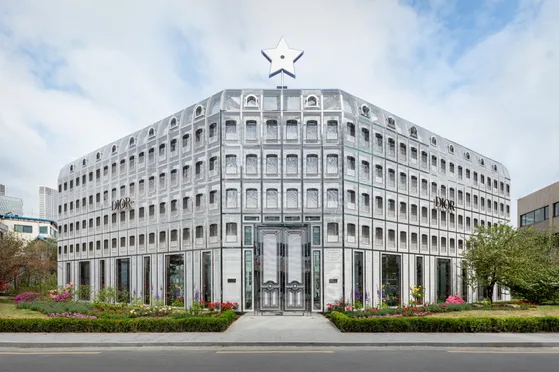
- Strong early performance from the new Beijing and Seoul flagship stores — LVMH singled out the Seoul store alongside Beijing as a headline success story on its Q2 earnings call
Business Impact — A True Bottom, or a Brief Bounce?
It would be premature to read this quarter's number as "a full return to high growth." In RIT's view, the point to watch for is the temptation to hastily read a single quarter's positive turn as a full trend reversal. H1 cumulative revenue and profit were both still down year over year, and currency remains a persistent drag on profit. Still, three things are clear.
First, the direction itself matters — the first positive quarter after seven straight quarters of organic decline is meaningful. Second, even at roughly 35%, the margin remains among the very best in the luxury industry — pricing power held up remarkably well even as revenue fell 10%. Third, the fact that Seoul was cited alongside Beijing as evidence of the rebound signals that Korea has been elevated within LVMH's strategic map — from a simple sales market into a hub for brand experience and ultra-high-end customer strategy. We'll dig into that in the next installment, on Louis Vuitton Korea.
✦RIT's Insights
The most striking thing in this three-year arc is that free cash flow kept rising even as revenue and profit fell together. That shows LVMH isn't a company that operates on the simple logic of "slower growth equals crisis." It kept up store investment and marketing spend while tightening inventory and working capital hard — and RIT sees that financial discipline as exactly the strength underpinning an attempted rebound like Q2 2026. In practical terms, anyone in investing or analyst work shouldn't judge this kind of trend from annual or half-year cumulative figures alone. There are inflection points — like the shift in organic growth from -2% in Q1 to +1% in Q2 — that are only visible once you break the numbers down by quarter. Anyone in luxury retail or MD work looking at this division also shouldn't miss the fact that its profit share (74.4%) dwarfs its revenue share (46.7%). A brand with this level of profit contribution is likely to keep the upper hand in negotiating leverage and allocation, even during a period of slowing sales.
It's also worth noting that the evidence cited for the Q2 rebound was the "130th-anniversary Monogram canvas" rather than a new product line. Reaching for the brand's oldest asset instead of pushing something new is a classic, proven card luxury brands play during a slowdown. Anyone working on brand strategy could use this approach — pairing a rediscovery of heritage assets with flagship investment — as a reference: in a period when sales are declining, reviving an asset you already own can be more effective than expanding into new products. Whether this turns out to be a brief spark or a genuine sign of a bottom, though, is something only Q3 numbers can confirm.
Finally, Seoul being named alongside Beijing shouldn't be dismissed as a throwaway PR line. A company the size of LVMH doesn't casually single out a specific country's store on an earnings call. In practice, a mention like this is often a signal that a market's strategic standing has shifted. Anyone covering Korean retail should read this mention not as simple publicity, but as a signal that the Korean luxury market has moved up the priority list at the global headquarters level. Once you see the channel realignment at Louis Vuitton Korea — exiting downtown duty-free while investing in an oversized department-store flagship — covered in the next piece, it will become much clearer why that mention happened.
Sources