A 3x Conversion Gap: What Walmart's ChatGPT Experiment Means for Emart
2026-07-15 9:29 PM
Overview
Walmart tested "Instant Checkout," a feature that completes payment directly inside ChatGPT, but its conversion rate came in three times lower than when customers were routed to its own website. The cause was not recommendation accuracy — it was a checkout structure disconnected from cart, membership, and delivery. Over the same period, its own agent Sparky posted the opposite result, with GMV up 150%, and Shinsegae Group is running a similar experiment, having swapped its partner from OpenAI to Reflection AI.
Get a product recommendation inside ChatGPT, and complete checkout right there. "Instant Checkout," unveiled by Walmart and OpenAI in October 2025, was one of the first real implementations of that vision. But a few months later, the numbers Walmart itself disclosed were unexpected: the conversion rate for products bought directly inside ChatGPT came in three times lower than when the same recommended products were bought after the customer clicked through to Walmart's website. Removing one click from checkout ended up selling less, not more. Looking at why this happened — and why Walmart's own agent posted the opposite result over the same period — reveals where the real battleground in agentic commerce actually lies. Shinsegae Group's experiment, run through Emart, is aimed squarely at that same battleground.
What Walmart Is Doing
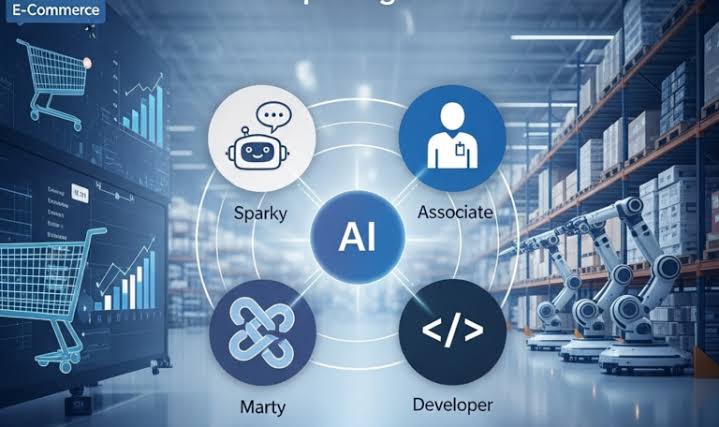
Since summer 2025, Walmart has organized its AI strategy around four "super agents": Sparky, a shopping agent for customers; Associate Agent, which assists employees with their work; Marty, built for suppliers and sellers to manage listings, orders, and advertising; and Developer Agent, which supports internal developers' build, test, and deployment work. Rather than letting individual departments spin up their own separate chatbots, Walmart chose to orchestrate multiple specialized agents underneath four entry points organized by user type.
Walmart's four AI agents — Sparky for customers, Associate Agent for employees, Marty for suppliers and advertisers, and Developer Agent for developers — split by user-type entry point
Of the four, Sparky is furthest along. Introduced into the Walmart app in June 2025, Sparky handles product search, review summarization, and contextual recommendations, and has since expanded into in-store repeat purchasing, meal planning, and Spanish-language support. Walmart says it uses not just general-purpose LLMs but retail-specific models trained on its own distribution data as well — a bid to make the most of its data assets in the fight for the customer touchpoint.
Key Insight #1 — The Real Cause of Low Conversion Wasn't "Distrust of the Recommendation"
Walmart didn't stop there. On October 14 last year, it formally announced its collaboration with OpenAI: a way to buy a product recommended inside ChatGPT without ever leaving for a separate shopping site, completing checkout on the spot. The service rolled out to a subset of users starting in November, covering roughly 200,000 products.
The results were underwhelming. Daniel Danker, who leads Walmart's AI acceleration, product, and design, disclosed that the conversion rate for products bought directly inside ChatGPT came in at roughly a third of what it was when customers were routed to the website. Taken at face value, that invites an easy interpretation: "consumers didn't trust the AI's recommendation." But the cause Walmart actually pointed to was something else entirely.
Instant Checkout was fundamentally designed for single-item purchases. There was a risk that every product a customer checked out through ChatGPT would trigger a separate order and separate delivery, and it was difficult to combine such a purchase with items already sitting in a customer's Walmart cart. Perks like Walmart+ shipping benefits, minimum order thresholds, bundled-delivery terms, and loyalty points simply didn't function properly within this checkout path. For a customer trying to buy several household staples at once and have them delivered together, "checkout inside the chat" turned out to be an inconvenience rather than a convenience. In the end, the real story behind the low conversion rate wasn't a problem with the AI model's recommendation quality — it was a checkout workflow disconnected from the rest of the shopping journey.
Key Insight #2 — OpenAI Reached the Same Conclusion and Changed Course
Walmart wasn't the only one to acknowledge this problem. In March 2026, OpenAI itself admitted that the Instant Checkout model "didn't offer the flexibility it was aiming for," and shifted its approach. Instead of completing checkout entirely inside ChatGPT, it expanded its Agentic Commerce Protocol so that ChatGPT focuses on discovering and surfacing products, while actual checkout stays under each retailer's own control within its own systems. Major retailers including Target, Sephora, Nordstrom, Lowe's, Best Buy, Home Depot, and Wayfair moved to this model.
Walmart introduced its own response around the same time. It embedded Sparky as its own app inside ChatGPT, so that even when a customer discovers a product through ChatGPT, login, cart sync, checkout, and membership benefits are all handled within an environment Walmart controls. As Walmart put it: "No matter where the journey starts, customers get the same Walmart assortment, value, and delivery speed." Rather than pulling back from external platforms, the direction is to bring its own transaction environment directly inside them.
Key Insight #3 — Over the Same Period, the Self-Controlled Agent Grew in the Opposite Direction
This is where an interesting contrast emerges. While Instant Checkout was underperforming, Sparky — the agent Walmart controls entirely on its own — was tracing a completely different trajectory. In fiscal Q1 2026 (ending late April), GMV flowing through Sparky rose 150% quarter-over-quarter, and the number of purchases made through Sparky more than quadrupled. Weekly active users (WAU) more than doubled within a single quarter, and the average order value of Sparky users ran roughly 35% higher than non-users. Roughly half of Walmart app users had already tried Sparky.
Why did the results diverge so sharply for the same category of AI agent? The decisive difference between ChatGPT's Instant Checkout and Sparky wasn't model performance — it was who controlled the transaction workflow. Sparky is fully connected from the start to a customer's Walmart account, existing cart, membership benefits, delivery options, and inventory data. Instant Checkout, by contrast, moved only the checkout button into ChatGPT, with none of those connections in place. In the end, what determined performance wasn't how smart the agent was, but how seamlessly it was connected to the actual order, payment, and delivery systems.
Key Insight #4 — The Google Partnership Follows the Same Logic
Walmart also partnered with Google on January 11, 2026. The deal lets Gemini users discover Walmart and Sam's Club products in the course of conversation and complete checkout inside the chatbot via Google's new Universal Commerce Protocol. Linking a Walmart and Gemini account enables personalized recommendations based on combined online and offline purchase history, and products found in Gemini can be merged with an existing Walmart cart.
What's notable is that this structure directly reflects the lesson learned from the ChatGPT failure. "Discovery happens on the external platform; account, cart, checkout, and delivery stay within Walmart's systems" — that principle now applies equally to the redesigned OpenAI arrangement and the new Google partnership. Instant Checkout's failure wasn't a one-off misstep; it's a standard lesson the whole industry is converging on.
Business Impact — Agents Are Becoming a Revenue Model, Not Just a Touchpoint
The payoff from Walmart's agent strategy isn't limited to the shopping agent. Marty, the supplier- and advertiser-facing agent, has been running in beta since January 2026 inside Walmart Connect, letting advertisers build and optimize sponsored search campaigns conversationally, with a company-wide rollout to all advertisers planned within the year. 97% of advertiser queries are unique, reflecting how individualized each advertiser's consultation is. In the same quarter, Walmart's ad revenue grew 37% year-over-year, and its retail media business overall grew 33% — six times the company's overall revenue growth rate.
In other words, for Walmart, the agent isn't simply a device for improving customer experience — it's becoming a dual engine generating revenue from both customers (Sparky) and advertisers/suppliers (Marty) at once. In the fight over agentic commerce, the question of "who controls the customer touchpoint" is really closer to "who controls the transaction and advertising systems well enough to turn that touchpoint into revenue."
The Domestic Case — Where Does Emart Stand Right Now?
This isn't a story that only applies elsewhere. Shinsegae Group, through Emart, is moving in a similar direction, and the pace has visibly picked up over the past few months. That said, it would be an overstatement to say "Emart has already commercialized a customer-facing AI shopping agent the way Walmart has." Laying out what's actually confirmed so far: Emart has prioritized putting less flashy internal-facing AI to work on the ground ahead of its customer-facing shopping agent, which remains at the planning stage and has already gone through a partner reshuffle.
The plan: end-to-end AI commerce from search to checkout — and a partner switched twice over
On April 6, 2026, Shinsegae Group announced it had signed an MOU with OpenAI for AI commerce business cooperation. Starting with Emart, the vision was to build, by 2027, a fully integrated AI commerce experience where a customer could type "put together tomorrow's family dinner" into a chat window and have the AI assemble the needed products, fill the cart based on purchase history and preferences, and complete checkout and delivery scheduling. It's a picture that closely resembles the meal-planning, product-assembly, and purchase-execution flow Walmart's Sparky is aiming for.
But just 11 days after that announcement, on April 17, Shinsegae Group announced it was halting discussions with OpenAI and concentrating its efforts on a partnership with US-based Reflection AI instead. Alongside a major project to build a 250MW AI data center domestically, the group reorganized its strategy around applying AI to six areas: sourcing, ordering, pricing, logistics, inventory management, and customer management. Emart was assigned a leading role within the group for this project, but the specific launch timeline and final technology partner for the customer-facing shopping agent have not yet been announced. The "we're going toward AI commerce" strategic direction has held, but the implementation approach and partner changed once within less than two months.
What's already running: unglamorous but genuinely operational on-the-ground AI
What took hold before the customer-facing shopping agent was, ironically, the less visible internal-facing AI. Emart buyers are using Microsoft Copilot to build their own task-specific agents — in the 2025 Copilot Agentathon, an "unpaid vendor-listing alert agent" built by Emart's buyer team won first place. Notably, it was frontline buyers, not developers, who designed the agent by connecting it directly to their own operational data. AI agents are already applied to repetitive tasks like fresh-food price forecasting and trade-area analysis, with plans to extend into food labeling, finance, and promotional operations.
There's already AI running at the customer touchpoint too. Every Emart and Traders location runs a unified digital consultation platform combining AI chatbot, agent chat, and phone support, and the AI chatbot handles more than half of all customer inquiries. At checkout, an AI camera system that detects scan omissions or checkout errors in real time is running on 923 units across 58 stores nationwide as of the end of April 2026.
The most concrete performance figures, though, come not from Emart itself but from its convenience-store affiliate, Emart24. Its "AI product recommendation service," introduced in January 2024, analyzes store-level sales data to find ten stores with similar characteristics, then recommends to franchise owners products that sell well at those comparable stores but aren't yet carried at their own. In a direct-operated-store test across 17 locations from August to November 2023, 90% of recommended products sold out and were reordered. That result was possible only by restructuring more than 6 billion daily transactions and over 80,000 product records down to the individual store level.
Compared with Walmart
To sum up: Walmart has already brought its customer-facing agent (Sparky) to market, gone through a failed experiment with checkout on an external platform, and is now adjusting its next strategy. Emart and Shinsegae Group, by contrast, are first embedding and validating AI in internal, consultation, and checkout use cases on the ground, while the end-to-end agent that would let customers hand off everything from search to checkout remains at the planning and partner-reshuffling stage. The sequence differs, but the direction is the same. So far, though, Emart has chosen the path of automating narrow tasks where the data is clear and results are easy to validate, ahead of a flashy customer-facing chatbot, and building up success stories from there.
To sum up, the practical lesson from this case is clear. Fewer checkout steps doesn't always raise conversion — especially in categories where customers buy multiple items at once, consistency across cart, delivery, and benefits matters more for conversion than trimming checkout steps. And agent competitiveness comes not from model performance but from system connectivity that reflects inventory, pricing, delivery availability, and membership benefits in real time. That means when partnering with an external AI platform, the first thing to check is whether the integration syncs cart, account, and order data bidirectionally, not just product exposure. External platforms like ChatGPT and Gemini are valuable as channels for discovering new customers, but the core lesson of this case is that handing over checkout, fulfillment, and membership along with that discovery means losing control. The principle — "discovery externally, transactions on our own systems" — needs to be written explicitly into partnership contract terms.
Walmart's Instant Checkout experiment failed, but reading the reason for that failure precisely turns it into a useful case study. The problem wasn't that the AI was inaccurate — it was that only the checkout button got moved over, without the cart, membership, and delivery systems that were supposed to come with it. The proof is that Sparky, under Walmart's own control over the same period, produced the opposite result: 150% GMV growth. In the end, the real battleground in agentic commerce isn't the AI model or the volume of data. It's who controls the transaction operating system that connects customer intent seamlessly through to actual orders, checkout, inventory, and delivery. Emart's choice to build out buyer operations, customer service, and checkout — areas that are easier to validate — ahead of a customer-facing end-to-end agent should be read as stemming from the same conclusion.
✦RIT's Insights
The most striking part of this case is that Walmart didn't hide its failure — it disclosed it with a concrete number, 3x. Rather than blurring the failure into "AI recommendations weren't good enough yet," it pinpointed exactly "a broken checkout workflow" — and that precision is what let it apply the same principle immediately to both the ChatGPT redesign and the Google partnership. It's a case study in how the resolution of root-cause analysis determines the speed of the next move.
Equally worth watching is Sparky's report card over the same period. 150% GMV growth and a 35% lift in order value push back against the notion that "agentic commerce is still premature." The issue was never the agent technology itself — it was which systems that agent was connected to. When Korean companies evaluate their own AI shopping assistants, the first question shouldn't be "how smart a model should we use," but "how deeply can this agent connect to our cart, membership, inventory, and delivery systems." Corporate planning teams need to rewrite their evaluation criteria too — don't judge agent adoption by "how natural the conversation feels"; manage it against metrics that show whether a transaction actually completed, like conversion rate, average order value, repeat-purchase rate, and rate of human-agent intervention. The opposite outcomes Instant Checkout and Sparky produced over the same period ultimately came down to exactly these metrics.
Lastly, Marty's turn into an advertising engine is worth flagging, since it's something Korean retailers tend to overlook. There's still a common tendency to view AI agent investment purely as a customer-experience cost. But Walmart applied the same technology to advertiser engagement and converted it into real revenue — 33% growth in retail media. When designing an agent strategy, don't look only at the customer touchpoint; a portfolio that also includes suppliers, advertisers, and sellers proves ROI far faster. Starting with repetitive, standardized tasks with clear rules — like campaign setup or billing inquiries — is the realistic entry point.
Emart's case calls for a slightly different read. One could see the 11-day switch from an OpenAI MOU to a Reflection AI partnership as "the strategy wobbling," but RIT reads it the opposite way: it shows Emart isn't dressing up a partnership announcement with a specific LLM vendor as an achievement in itself, and is willing to switch quickly when the execution partner isn't the right fit. The real concern lies elsewhere — no launch timeline or concrete metric has been disclosed yet for the customer-facing end-to-end agent. Walmart discloses even a failed experiment as a 3x conversion gap; Emart doesn't yet have any numbers at all — success or failure — for a customer-facing agent. Meanwhile, in a narrower area like Emart24's AI product recommendation, a fairly compelling result already exists: a 90% sell-through-and-reorder rate. What this contrast suggests is clear — what Emart needs right now isn't anxiety over "when will we ship a Walmart-grade shopping agent," but scaling its already-validated narrow wins into more operational areas, while using the data and integration infrastructure built along the way as the foundation for a future customer-facing agent. That pace of accumulation, not a flashy announcement, is what will actually determine the real gap.