The Eyewear Business That Grew Despite Gucci's Slump — Inside the Big Four's 23% Operating Margin
2026-08-26 8:15 AMSunglasses & Eyewear
Overview
A side-by-side comparison of the recent results from the global eyewear industry's Big Four — EssilorLuxottica, Kering Eyewear, Safilo, and Marcolin. EssilorLuxottica's revenue is nine times the other three combined, yet the top operating margin in H1 2026 belonged to Kering Eyewear (23.0%), home to Gucci and Saint Laurent. This piece examines why that one division alone posted record results while its parent group struggled, along with how VSP Vision's acquisition of Marcolin is reshaping the industry landscape.
The Kering group has been struggling for years now with Gucci's slump. Yet inside that same group sits a division that keeps setting new half-year records — Kering Eyewear, which makes glasses for Gucci, Saint Laurent, Cartier, and Balenciaga. In H1 2026, this division's operating margin was 23.0% — higher even than EssilorLuxottica (18.9%), the world's largest eyewear company. On the other side of the industry, the map is being redrawn entirely: in December 2025, Marcolin, the storied Italian eyewear house that private-equity firm PAI Partners had held for more than a decade, was sold into the arms of the American vision-insurance company VSP Vision. By revenue, EssilorLuxottica alone is nine times bigger than the other three companies combined — but a single sales table doesn't reveal who's actually winning in this market.
Four Different Business Models Among the Big Four
The way these four companies compete in the global eyewear market is fundamentally different.
EssilorLuxottica
Kering Eyewear
Safilo
Marcolin
Ownership
Public (Euronext Paris/Milan)
100% subsidiary of the Kering group
Public (Borsa Italiana)
Acquisition by VSP Vision completed (Dec. 2025)
Business model
Full vertical integration: lenses + frames + retail
House-brand-led luxury manufacturing and distribution
Pure design/manufacturing/distribution (B2B wholesale)
Pure licensed manufacturing/distribution (B2B wholesale)
House brands
Ray-Ban, Oakley, Persol, Oliver Peoples, Vogue Eyewear
Lindberg, Maui Jim, Zeal Optics
Carrera, Polaroid, Smith, Privé Revaux
WEB Eyewear, ic! berlin
Key licenses
Armani, Chanel, Prada, Burberry, Versace, Michael Kors, Ralph Lauren
Gucci, Saint Laurent, Cartier, Bottega Veneta, Balenciaga, Valentino, Alexander McQueen
BOSS, Kate Spade, Levi's, Under Armour, Missoni, Carolina Herrera
Tom Ford, Zegna, Guess, Max Mara, Christian Louboutin
Retail stores
17,750 (LensCrafters, Sunglass Hut, etc.)
None (wholesale)
None (wholesale)
None (wholesale)
EssilorLuxottica is the only one of the four to have completed vertical integration from lens manufacturing all the way to retail. The other three make frames — either under a brand-house model (Kering) or through licensing deals (Safilo, Marcolin) — and supply them wholesale to department stores, optical chains, and online retailers. This difference explains much of the margin gap we'll see below.
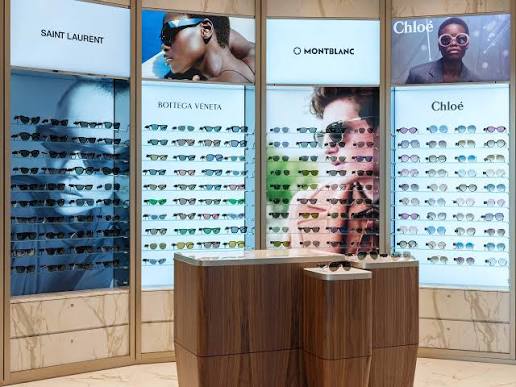
Kering Eyewear designs, manufactures, and distributes house brands in-house — including Gucci, Saint Laurent, Bottega Veneta, and Chloé
Key Insight 1 — EssilorLuxottica: From Eyewear Company to AI Wearables Company
The overwhelming No. 1 is still EssilorLuxottica. H1 2026 revenue reached €14.818 billion, up 9.7% year over year at constant exchange rates — a slowdown from Q1 (+10.8%) but still solid in Q2 (+8.7%). What stands out more is that net profit grew even faster than revenue: net profit of €1.921 billion (+13.3%), while adjusted operating profit rose 15%, pushing the margin up to 18.9%.
Year
Revenue
Notes
2023
€25.4B
+7.1% (constant FX)
2024
€26.5B
+6.0% (constant FX)
2025
€28.49B
+11.2% (constant FX)
H1 2026
€14.818B
+9.7% (constant FX)
Traditional fashion eyewear is no longer what's driving this growth. Myopia-management lens revenue rose 24% in Q2 alone, and AI smart-glasses sales from Ray-Ban and Oakley nearly doubled. A company that used to sell glasses is shifting its center of gravity toward healthcare lenses and AI wearable devices.
Key Insight 2 — Gucci Struggles, But Kering's Eyewear Division Just Had Its Best Half Ever
The most striking reversal comes from Kering Eyewear. The Kering group as a whole is in the middle of a Gucci rebrand and organizational overhaul, and its Fashion & Leathergoods division posted a comparable revenue decline of -1% in H1 2026. Yet over the same period, the eyewear division alone posted revenue of €965 million (+8% comparable, +5% reported) and an operating margin of 23.0% (up 2.9 points) — the best half-year result in the division's history.
Year
Revenue
Operating profit
Operating margin
2023
€1.5B
€0.276B
~18.4%
2024
€1.6B
€0.277B
~17.3%
2025
€1.6B
€0.252B
15.8%
H1 2026
€0.965B
€0.222B
23.0%
What stands out is that the margin, which had been steadily eroding over 2023-2025 (18.4% → 17.3% → 15.8%), suddenly rebounded in H1 2026. Kering attributes this to the Lindberg 40th-anniversary capsule collection, the relaunch of Maui Jim's optical category, and the newly launched Valentino Eyewear. CEO Luca de Meo cited "stronger brand differentiation and organizational simplification" as the drivers of growth. Within the Kering group, eyewear — alongside jewelry (+20% comparable) — is now one of only two divisions still growing, effectively functioning as a cash cow that partially offsets Gucci's weakness.
Key Insight 3 — Safilo: Revenue Fell, But Margin Held
Safilo tells a different kind of story. H1 2026 revenue came in at €512.0 million, down 1.9% at constant exchange rates (-4.8% at current rates), yet adjusted EBITDA reached €86 million as the margin jumped from 11.6% to 16.8% — a 5.2-point gain — and adjusted net profit rose nearly 47% to €49.4 million.
Adjusted EBITDA €0.086B (margin 16.8%); adjusted net profit €0.049B (+47%)
That said, 3.8 of the 5.2-point margin improvement came from a one-off US tariff refund. Even stripping that out, price/mix improvements (+2.3 points) still delivered a real gain in profitability — but it's premature to call this a full turnaround based on the headline number alone. Safilo's CEO explained that softening US and European demand led customers to place orders more conservatively, though core brands such as David Beckham, Carrera, Kate Spade, and Marc Jacobs held up relatively well.
Key Insight 4 — Marcolin Is No Longer a "Company's Results," It's Now "Part of VSP"
The fourth company's story isn't about earnings at all — it's about a wholesale change in ownership. Marcolin, which PAI Partners had been trying to sell since 2022, drew bids from EssilorLuxottica, Kering Eyewear, Safilo, FountainVest, and HAL Investments before ultimately being acquired by the American vision-insurance company VSP Vision in December 2025. The last publicly disclosed half-year figures (H1 2025 — separate disclosure ended after its integration into VSP) showed revenue of €0.2957 billion (+0.3% ex-FX, essentially flat) and an EBITDA margin of 17.7%.
Year
Revenue
Adjusted EBITDA margin
2023
€0.558B
14.0%
2024
€0.546B (-2.2%, license-mix effect)
15.6%
9M 2025
€0.417B (+2.1%)
16.4%
H1 2025 (last public figure)
€0.296B (+0.3%)
17.7%
There's a detail here that's easy to miss. VSP Vision has owned Marchon Eyewear — which carries Nike, Calvin Klein, Salvatore Ferragamo, and ZEISS, among others — since 2008. With this acquisition, VSP has effectively taken control of both of the industry's major independent manufacturers, Marchon and Marcolin. This is America's largest vision-insurance (eyewear benefits) provider vertically integrating into manufacturing and distribution — a completely different logic from EssilorLuxottica or Kering, built not on brand power or retail but on control of the insurance/benefits channel. It's a third axis now being built in this industry.
Business Impact — Not Scale, Not Licensing, But "Brand Density" Decides the Margin
Line up all four companies and the market's real battleground comes into focus. EssilorLuxottica wins on sheer scale (nine times the combined revenue of the other three), yet its operating margin (18.9%) still falls short of Kering Eyewear's (23.0%). Safilo and Marcolin share a heavy reliance on licensed brands, but Marcolin's margin (16-18%, anchored by ultra-premium names like Tom Ford, Zegna, and Christian Louboutin) is structurally higher than Safilo's (10-17%, with a heavier mix of lifestyle and mass-market brands). In other words, it isn't revenue scale but how expensive and scarce the brands in a portfolio are that decides margin. And Marcolin's change of ownership is a signal that this market has become an attractive battlefield not only for brand houses (Kering) or lens conglomerates (EssilorLuxottica), but also for players holding insurance and distribution channels (VSP Vision). What RIT is watching in this shift in the landscape is the Marcolin sale process itself: EssilorLuxottica, Kering, and Safilo — all industry insiders — placed bids, yet the actual winner was an American vision-insurance company. That means industry realignment can't be predicted by looking only at the traditional competitive set; a player from an adjacent industry, such as an insurance or benefits channel, can emerge as a new axis at any moment. Overlay these four scorecards, and the conclusion is clear — the next battleground in global eyewear has already shifted from "who sells the most" to "who holds the scarcest brands," and "who controls the distribution and benefits channel."
✦RIT's Insights
What stands out most in laying these four companies side by side is that Kering Eyewear's 23% margin reads less like a simple "luxury premium" and more like the outcome of a genuine organizational reset. While Gucci has spent years struggling to reset its brand, the eyewear division within the same group instead rebounded on new products and organizational simplification — evidence that weakness across a luxury group as a whole doesn't automatically mean weakness in every division. If anything, a division's execution tends to stand out more clearly precisely when the core business (fashion, in this case) is struggling. Anyone managing licensed brands can take a lesson from this rebound: Kering put resources not only into new acquisitions like Valentino Eyewear, but just as much into reviving brands it already owned, such as the Lindberg 40th-anniversary collection and the Maui Jim relaunch — something that's easy to overlook when a company is fixated only on landing new licenses. And buyers in Korea handling these companies' brands (Ray-Ban, Gucci, Carrera, Tom Ford, and others) should factor into their negotiations that the parent-level difference between a vertical-integration strategy and a licensing strategy flows straight down into domestic wholesale terms and inventory policy.
In RIT's view, VSP Vision's acquisition of Marcolin is an event anyone watching this industry needs to remember. In practice, a single acquisition like this can sometimes become the signal that redraws an entire industry's landscape, and this looks like exactly that case. Having already secured Marchon and now Marcolin as well, VSP has quietly become a hidden giant of the US market, spanning everything from vision-insurance benefits to manufacturing. Where EssilorLuxottica completed vertical integration through lenses + frames + retail, VSP is completing a different axis through insurance + manufacturing. Where these two vertically integrated giants collide going forward — particularly in the US eyewear distribution channel — is, in RIT's read, the next thing worth watching in this industry.
Finally, Safilo's case carries a particularly large lesson for analysts and investment teams. When revenue falls but margin improves, the market tends to read that immediately as a "turnaround" — but the story changes when, as here, 3.8 points of the 5.2-point margin improvement turns out to be a one-off tariff refund. Failing to separate that from structural factors like the 2.3-point price/mix improvement leads straight to mispricing next quarter's results. Separating the one-off from the structural, rather than taking the headline number in an earnings release at face value, is in RIT's view the first real step to reading this industry correctly — and it's exactly the part RIT scrutinizes most carefully every earnings season.