Hyundai Department Store Q3: Duty-Free Grew the Revenue, the Department Stores Made the Profit
2026-11-06 7:37 AMGeneral
Overview
Hyundai Department Store posted Q3 2026 consolidated operating profit of KRW 94.6 billion (+30.1%). Duty-free (+64.8%) supplied most of the consolidated revenue growth, but the department store division, at KRW 114.1 billion, produced virtually all of the operating profit. Duty-free stayed profitable for a fifth straight quarter, yet its operating margin slipped from 2.0% in Q2 to 0.9%, and net income fell 35.7% — the opposite direction from operating profit.
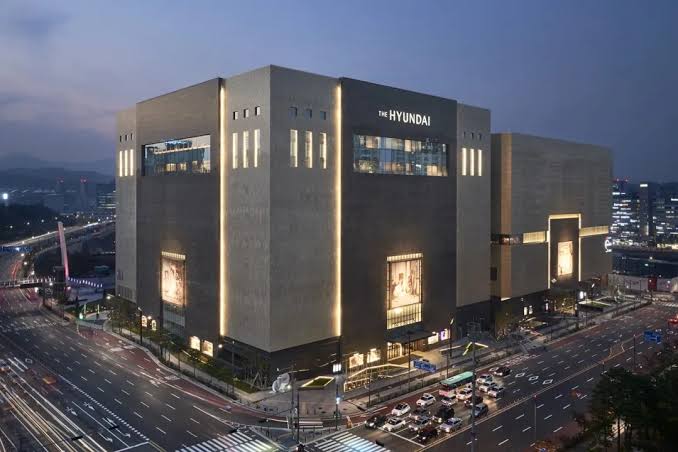
THE HYUNDAI exterior
Hyundai Department Store's preliminary consolidated results for Q3 2026, disclosed on November 4, show revenue of KRW 1,172.3 billion and operating profit of KRW 94.6 billion, up 16.0% and 30.1% year over year respectively. Recall that Q2 came with the contradictory headline "record department stores, but consolidated results moved backward"; this time the direction finally lines up. Break the numbers apart, though, and the division that grew revenue is entirely different from the one that produced profit. Duty-free accounted for most of the revenue increase, and the department store division for nearly all of the operating profit.
Note that these are preliminary K-IFRS consolidated figures and may change after the external auditor's review.
What Happened — Three Stories Overlap Across the Divisions
Here are the consolidated numbers first.
Division
Q3 net revenue
YoY
Q3 operating profit
YoY
Consolidated
KRW 1,172.3 billion
+16.0%
KRW 94.6 billion
+30.1%
Department stores
KRW 614.5 billion
+6.5%
KRW 114.1 billion
+27.8%
Duty-free
KRW 366.6 billion
+64.8%
KRW 3.2 billion
+145.6%
Zinus
KRW 225.2 billion
-6.8%
-KRW 12.5 billion
Operating loss
The department stores benefited from rising foreign-customer inflows and strong sales of fashion, luxury, and high-end jewelry. The operating margin was 18.6%, up 1.5 percentage points from Q2 (17.1%). Back-calculating the year-earlier figure from the growth rates puts the Q3 margin at around 15.5% a year ago (a back-calculated figure that may differ with rounding), so margin improved by more than 3 percentage points in a year. On a Q1–Q3 cumulative basis, revenue was KRW 1,890.8 billion (+7.7%) and operating profit KRW 360.0 billion (+40.7%), for a cumulative operating margin of 19.0%.
Duty-free revenue came to KRW 366.6 billion, up 64.8% from a year earlier. The company cited rising inbound and outbound travelers and steady growth at the Incheon Airport DF2 zone, which opened in April. Revenue was also 18% larger than Q2's KRW 310.4 billion. Operating profit was KRW 3.2 billion, a fifth straight profitable quarter, but that story is worth unpacking separately below.
Zinus posted revenue of KRW 225.2 billion (-6.8%) and an operating loss of KRW 12.5 billion. The company's explanation is weaker mattress demand from customers amid softer U.S. consumption. With Q2's operating loss at KRW 26.7 billion, the loss shrank to less than half on a quarter-over-quarter basis, and the company said customer order volumes are gradually normalizing and the effects of its profit-structure overhaul have begun to show. Even so, the Q1–Q3 cumulative operating loss is KRW 69.3 billion, of which KRW 56.8 billion came in the first half (backed out by subtracting Q3 from the cumulative figure) — so on a full-year view, this is a business just starting to climb out of a deep loss.
Key Insight ① — Duty-Free Revenue Up 65%, Operating Profit KRW 3.2 Billion
Duty-free's Q3 operating margin is 0.9%: KRW 3.2 billion divided by KRW 366.6 billion. In Q2 it was KRW 6.2 billion on KRW 310.4 billion, or 2.0%. So while revenue grew 18%, operating profit actually halved. It is true both that the profit streak has reached five straight quarters and that the size of the profit has shrunk.
This release doesn't explain why. Newly won airport zones often bring fast revenue growth but also fixed-cost-like burdens such as rent, so there is room to read this as a stretch where top-line growth runs ahead of profit. But that is only an inference about structure, not a cause the company has confirmed. Until the cost lines are disclosed in the Q3 report, it's better not to assert anything.
One thing is clear. Consolidated revenue rose by KRW 162.0 billion (from KRW 1,010.3 billion to KRW 1,172.3 billion), and duty-free revenue alone rose by KRW 144.1 billion (from KRW 222.5 billion to KRW 366.6 billion). Almost all of the consolidated top-line growth came from a business with an operating margin below 1%. The consolidated operating margin rose to 8.1% (7.2% a year earlier) because the department stores' margin gains outweighed the dilution from the larger duty-free share.
Key Insight ② — The KRW 21.9 Billion Rise in Operating Profit Is Essentially the Department Stores'
Consolidated operating profit rose KRW 21.9 billion, from KRW 72.7 billion to KRW 94.6 billion. Over the same period, department store operating profit — back-calculated from its growth rate (+27.8%) — went from roughly KRW 89.3 billion to KRW 114.1 billion, an increase of about KRW 24.8 billion (a back-calculated figure). Duty-free's improvement was just KRW 1.9 billion (KRW 1.3 billion to KRW 3.2 billion). A single division's gain exceeding the consolidated gain implies that the other divisions, Zinus among them, netted out to a small negative. That said, simply adding the divisions' operating profit gives KRW 104.8 billion against a consolidated KRW 94.6 billion, a gap of about KRW 10 billion; this is presumed to reflect other subsidiaries and consolidation adjustments, but the disclosure summary alone doesn't reveal the composition.
From where I sit in the business, a structure like this leads to one question: can the department stores keep pushing profit this hard? In Q2, department store revenue growth was +9.1% and operating profit growth +58.6%; in Q3 they came down to +6.5% and +27.8%. Profit is still growing at a wide margin, but the pace of growth visibly slowed within a single quarter. The fact that Chuseok fell in late September this year versus early October last year may also have affected the Q3 comparison, and could work in reverse in Q4. The company didn't mention this, though, so the size of any effect can't be confirmed.
Business Impact — Operating Profit and Net Income Diverged Again
What stands out again is the direction of operating profit versus net income. Q3 operating profit rose 30.1%, yet net income fell 35.7% to KRW 30.7 billion (KRW 47.7 billion a year earlier). On a Q1–Q3 cumulative basis, too, operating profit is KRW 272.7 billion (+0.2%) while net income is KRW 156.4 billion (-17.9%). In Q2, operating profit fell 8.7% while net income rose 11.7% — the exact opposite — so for two quarters running, the operating line and the lines beneath it have pointed in different directions.
The reason for the net income decline isn't confirmed in this coverage. Items below operating profit, such as non-operating gains and losses, income taxes, or results tied to subsidiaries and affiliates, could be responsible, but which one it is needs to be checked in the quarterly report. That's why the headline operating profit of +30.1% alone isn't enough to judge Q3.
There is one more thing. The gap between consolidated cumulative operating profit (+0.2%) and Q3 alone (+30.1%) is also a story about a weak first half. Operating profit rose KRW 21.9 billion year over year in Q3, yet cumulative growth is only 0.2% — which works out to first-half consolidated operating profit down roughly 10% from a year earlier (a figure back-calculated from the cumulative and Q3 growth rates, which may carry rounding error). That Q3's recovery only just made up for the first-half decline doesn't come through in the headline.
On shareholder returns, the company plans to retire 232,460 treasury shares on November 20. That is about 1.1% of total shares outstanding, with a book value of roughly KRW 21.0 billion. The shares were bought on the open market between February 12 and April 30 this year.
✦RIT's Insights
Whether the duty-free margin's slide from 2% to 0.9% is a temporary difference in cost recognition or the structural margin level of the new zone will be settled in Q4. If revenue holds in the mid-KRW 300 billion range in Q4 and the margin fails to return to the 2% range, DF2's business case has to be reassessed. It also matters whether the quarterly report explains why net income moved against operating profit for two straight quarters, and the quarter in which Zinus's operating loss drops below KRW 10 billion could signal another step up for consolidated results. For the department stores, the key is how the pace of slowing growth looks against the Q4 Chuseok base.
Year-earlier divisional operating profit and margins, the first-half consolidated operating profit change, and Zinus's first-half operating loss are back-calculated from the disclosed figures using growth rates and cumulative totals
DART electronic disclosure system (dart.fss.or.kr) — Hyundai Department Store Q3 2026 report (individual filing URL not identified; document name only)