Why Hyundai Department Store's Operating Profit Fell Despite Record Department Store Revenue and a Duty-Free Profit
2026-08-07 7:00 AMGeneral
Overview
Hyundai Department Store posted record second-quarter 2026 department store revenue (KRW 643.8 billion, +9.1%) and 58.6% operating profit growth in that division. Its duty-free business also stayed profitable for a fourth straight quarter. Yet consolidated operating profit fell 8.7% — and the culprit wasn't retail, it was subsidiary Zinus.
The second-quarter 2026 results Hyundai Department Store released on August 5 produced two entirely different headlines at once. Some outlets led with "record department store revenue." Others led with "operating profit down 8.7%." Both were correct. The department store division posted its highest-ever quarterly revenue, and duty-free, long plagued by losses, extended its streak to four straight profitable quarters. And yet consolidated operating profit came in at KRW 79.3 billion, down 8.7% year over year. That's the gap worth examining first in this release — two core retail businesses rebounding in tandem while the consolidated bottom line moved backward.
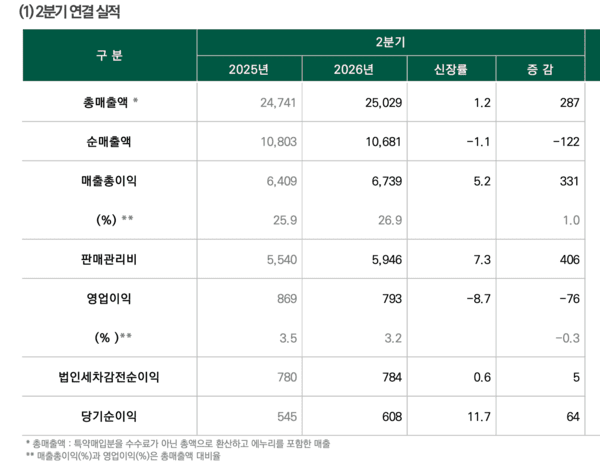
Hyundai Department Store's disclosed consolidated Q2 2026 results — operating profit fell, but net income actually rose
What Happened — Record Department Store Revenue, Duty-Free Turns Profitable
The department store division's Q2 net revenue came in at KRW 643.8 billion, up 9.1% year over year and a record for any quarter. Operating profit surged 58.6% to KRW 110.1 billion. On a first-half cumulative basis, net revenue reached KRW 1,276.4 billion (+8.3%) and operating profit KRW 246.0 billion (+47.7%) — also records for a first half. Core categories including luxury, watches, jewelry, fashion, and living all grew evenly, and foreign customers were at the center of it. Foreign-customer revenue rose 134% year over year at The Hyundai Seoul and 131% at the Trade Center branch. Both stores now draw roughly 20% of total revenue from foreign customers. The Hyundai Seoul, the company said, has broadened from its early base of Chinese, Japanese, and American tourists to shoppers from the UAE, Kazakhstan, and elsewhere, growing into a shopping destination visited by customers from over 180 countries.
The duty-free division (Hyundai Duty Free) also kept its recovery going. Q2 net revenue rose 5.8% to KRW 310.4 billion, and operating profit swung to a KRW 6.2 billion profit from a KRW 1.3 billion loss a year earlier. First-half cumulative operating profit also swung to a KRW 9.6 billion profit, a clear improvement from a KRW 3.2 billion loss in the same period last year. That marks four straight profitable quarters going back to Q3 of last year. The direct trigger for the turnaround was the launch of operations in Incheon International Airport's DF2 zone in April. On top of the luxury, fashion, and accessories categories already handled in its existing DF5 and DF7 zones, the company newly secured cosmetics and liquor categories, expanding its sales volume.
Subsidiary Zinus went the opposite direction. Q2 net revenue plunged 35.7% to KRW 147.5 billion, and the company swung to an operating loss of KRW 26.7 billion. Management attributed this to weakening mattress demand from major customers amid softening U.S. consumption. In the end, both the company and media coverage agree that the 1.1% drop in consolidated net revenue and 8.7% drop in consolidated operating profit trace back to Zinus alone, not to the department store or duty-free businesses.
Key Insight — A Turnaround at a Different Weight Class, and Where the Missing Operating Profit Went
Duty-free's swing to profitability is clearly welcome news, but the numbers reveal it's still a different weight class. The division's Q2 operating margin works out to roughly 2.0% (KRW 6.2 billion / KRW 310.4 billion). Department stores posted an operating margin of about 17.1% (KRW 110.1 billion / KRW 643.8 billion) in the same quarter — more than eight times higher. "Four straight profitable quarters" is a title that confirms the direction is right, not that duty-free has become as profitable a business as department stores yet. It's also worth noting that the driver of this quarter's expanded profit was DF2 — new store floor space, in other words, external expansion. First-half operating profit was KRW 9.6 billion, of which KRW 6.2 billion came in Q2, meaning Q1 contributed KRW 3.4 billion — profit jumped nearly 82% quarter over quarter, which does say the pace of improvement itself is fast. But it's worth separating whether this improvement is a demand-side factor (recovering foreign consumption) or a supply-side factor (the expanded category mix from joining DF2). If the company's own explanation for the turnaround leans toward the latter, sustaining this trend will require continuing to add floor space or categories going forward — a different kind of growth from the department store division's straightforward increase in demand at existing stores.
Another notable point is that operating profit and net income moved in opposite directions. Consolidated operating profit fell 8.7% to KRW 79.3 billion, while pre-tax income actually rose 0.6% to KRW 78.4 billion and net income rose 11.7% to KRW 60.8 billion. At the operating level, Zinus's loss was fully reflected and dragged profit down — but there was enough improvement below the operating line, in non-operating income and expenses, to more than offset it. The disclosure doesn't specify exactly what drove that gap, but the gap itself is a reason not to judge this quarter by the "-8.7% consolidated operating profit" headline alone.
Business Impact — Foreign Tourists as the Common Thread
The word that runs through both the department store and duty-free divisions this quarter is foreign customers. The 130%-plus rise in foreign revenue at The Hyundai Seoul and Trade Center, and duty-free's fourth straight profitable quarter, are the same trend showing up in different channels. The company said foreign customer spending is "expanding from overseas luxury goods into domestic fashion and beauty brands, across the board" — meaning foreign tourists aren't just opening their wallets at duty-free anymore, they're extending that spending into department stores in the city as well. That's the context behind the company naming three drivers for a second-half improvement: growing foreign customer numbers, growth at duty-free's airport stores, and new ODM orders at Zinus. The first two are extensions of an already-validated growth trend; the third is still an unconfirmed hope for a turnaround. Whether consolidated results improve again in the second half depends not just on the department store and duty-free businesses continuing to sail smoothly, but ultimately on how quickly the Zinus variable settles down.
Hyundai Department Store's second quarter of 2026 boils down to a somewhat contradictory sentence: core retail had its best quarter ever, while overall results moved backward. Two things are worth watching. One is that duty-free's profitability is still an early-stage recovery, with a margin nearly eight times lower than the department store division's. The other is that whether results improve in the second half depends less on the already-validated foreign consumption trend and more on the still-uncertain pace of Zinus's recovery.
✦RIT's Insights
The most interesting part of this release is that the company and the press both went out of their way to break results out by division. Usually, when overall results are strong across the board, companies lead with the consolidated number; when they're weak, they pin the blame on individual divisions. Here it's the reverse — Zinus was set up almost as a shield to emphasize that "core business is performing well." That reads as a signal that the company itself wants Zinus assessed separately from its retail results. Anyone on the investment or research side shouldn't take that signal at face value and should verify it directly — avoiding a misreading of "-8.7% consolidated operating profit" as retail weakness requires a divisional breakdown, and the divergence between operating profit and net income (driven by non-operating items) is also worth confirming separately in next quarter's disclosure. This case also shows that for anyone in group finance or IR, a stretch like this is exactly when communicating divisional results separately — rather than leading with consolidated operating profit alone — reduces the chance of misreading.
What RIT finds more worth watching is duty-free's margin structure. This isn't the moment to get swept up in the "four straight profitable quarters" headline. A 2% operating margin is thin enough to flip back into a loss with just a small shift in airport rent or labor costs. If this profitability was built on newly won DF2 floor space, the key thing to track is how resilient it stays through the next lease renewal or any reallocation of zones by the airport. For anyone handling duty-free MD or category management, the very fact that joining DF2 was the direct trigger for the turnaround means profitability still depends heavily on expanding floor space and category mix. Whether margins can improve at existing stores without adding new zones is, in RIT's view, the real test for the next stage. The department store division's 130% jump in foreign revenue is a purely encouraging number, but duty-free's turnaround still calls for watching rather than celebrating. The same goes for subsidiary Zinus — weak U.S. consumption is a macro factor that won't resolve quickly, so second-half guidance should be managed on the assumption that Zinus is likely to remain a swing factor in consolidated results until new ODM orders actually show up in revenue.
And the diversification of visitor countries at The Hyundai Seoul, extending into the Middle East and Central Asia, matters more than it might seem. It suggests a customer base forming that's different from Seoul's old duty-free and department store trade areas, which leaned heavily on Chinese group tourism. In RIT's view, if this trend holds, it could also lower the entire Seoul retail district's sensitivity to any single country's policy variables — visas, exchange rates, diplomatic relations. Anyone in department store MD or store operations should build out, starting now, a standing multinational customer-service infrastructure — language support, payment options, tax refunds — spanning not just China, Japan, and the U.S. but the Middle East and Central Asia too, rather than leaning on nationality-specific promotions. Next quarter, it will be worth checking revenue share by visitor country to see whether this diversification is a one-off or a structural shift.
DART electronic disclosure system (dart.fss.or.kr) — Hyundai Department Store and Zinus's Q2 2026 reports (cited by name where a specific filing URL could not be pinpointed)