Macallan's Incheon Airport Counter: Shilla Left DF1, Lotte Took It Over As-Is
2026-09-17 11:05 PMKorea
Overview
Incheon International Airport's DF1 zone has a standalone liquor boutique bringing together major whisky brands — Macallan, Johnnie Walker, Ballantine's. Shilla Duty Free, which ran it, surrendered its DF1 concession, and Lotte Duty Free was named the new operator; the existing boutique and Macallan's counter carried over under Lotte's management. The space and the brands stayed the same — only who runs it changed. Lotte already runs a large-scale liquor and tobacco duty-free operation, plus whisky pop-ups, at Singapore's Changi Airport. The question now isn't whether Macallan keeps selling. It's whether Lotte simply keeps the boutique Shilla built running as-is, or applies the pop-up, rare-spirits and experiential retail know-how it has built up at Changi to Incheon.
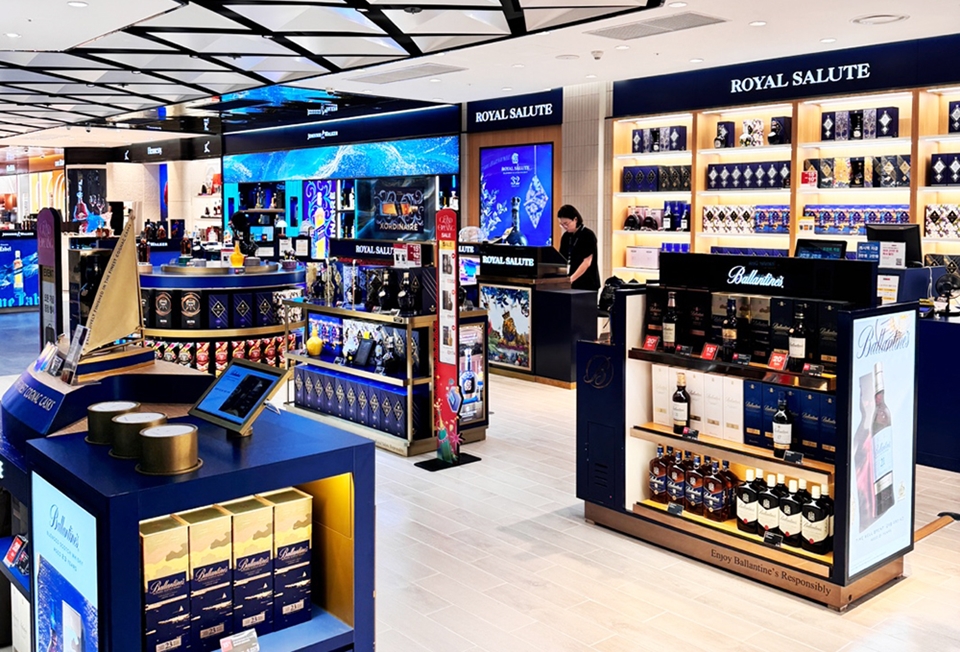
The standalone liquor boutique in Incheon International Airport's DF1 zone has long given Macallan, Johnnie Walker, and Ballantine's each their own branded section. Shilla Duty Free ran that space — but after Shilla surrendered its DF1 concession, operations passed to Lotte Duty Free starting in April 2026.
Hotel Shilla ended DF1 operations on March 17, 2026, and Lotte Duty Free began operating the zone a month later, on April 17. Coverage at the time confirms Shilla handed the store over to Lotte, the newly designated operator. This isn't a case of the existing whisky counter, Macallan included, disappearing and an entirely new store opening in its place — it's the same space, with the operating company switching from Shilla to Lotte.
That distinguishes this from a company handling Macallan for the first time and opening a fresh store. Lotte has run liquor and tobacco duty-free operations across Singapore Changi's Terminals 1 through 4 since 2020, running pop-ups with Macallan and a range of other global spirits brands along the way. What's forming at Incheon is a boutique Shilla built, now layered with the liquor operations experience Lotte accumulated overseas.
What Happened — Shilla and Shinsegae's Early Exit, and the Lotte-Hyundai Reshuffle
In September 2025, Shilla Duty Free decided to surrender its Incheon Airport DF1 concession early. A month later, in October, Shinsegae Duty Free decided to surrender DF2.
DF1 and DF2 are both major composite duty-free zones at Incheon authorized to carry both perfume/cosmetics and liquor/tobacco. Industry sources and some media outlets have nonetheless described DF1 as perfume/cosmetics-led and DF2 as liquor/tobacco-led, based on each operator's dominant category. The standalone liquor boutique housing the Macallan counter sat within the DF1 zone that Shilla operated.
Behind both surrenders was a combination of high per-passenger rent and a slower-than-expected duty-free market recovery. When Shilla won the DF1 concession in 2023, it bid KRW 8,987 per departing passenger; Shinsegae bid KRW 9,020 for DF2. Those bids reflected expectations, at the time, that international passenger traffic and duty-free demand would recover quickly post-pandemic.
But rising passenger numbers didn't translate one-to-one into rising duty-free sales. Under the per-passenger rent structure, rent is calculated by multiplying passenger count by the operator's bid rate, regardless of whether — or how much — any individual passenger actually buys. Rent climbs as passenger numbers climb, but if the duty-free usage rate and average spend per customer don't rise in step, an operator's profitability can deteriorate all the same.
Shilla and Shinsegae both sought rent adjustments but couldn't reach agreement with Incheon International Airport Corporation. In Shilla's case, a court-mediated settlement proposed cutting the per-passenger rent by roughly 25%, but the Corporation objected and the settlement fell through. In the end, both Shilla and Shinsegae surrendered their concessions with a substantial portion of their contract terms still remaining.
Shilla reportedly paid a penalty of roughly KRW 190 billion in the course of its withdrawal. It subsequently filed suit against Incheon International Airport Corporation in May 2026, seeking the return of KRW 106.5 billion of that penalty on unjust-enrichment grounds. Shilla's position is that, given it kept operating for roughly six months after deciding to surrender the concession and the space was handed to the new operator relatively quickly, the penalty was set at an excessive level.
The Retender: DF1 to Lotte, DF2 to Hyundai
Incheon International Airport Corporation ran the retender for both concessions. The Corporation announced the bid for new operators in December 2025 and ran proposal and price evaluations through late January 2026. It then notified the Korea Customs Service of Lotte and Hyundai Duty Free as the leading candidates; following the Customs Service's bonded-store license review, DF1 was finalized to Lotte and DF2 to Hyundai.
On price, Lotte bid KRW 5,345 per passenger for DF1 and KRW 5,310 for DF2. Hyundai bid KRW 5,132 for DF1 and KRW 5,394 for DF2. Lotte's DF1 bid came in above Hyundai's; Hyundai's DF2 bid came in above Lotte's.
If this were an airport buying goods from vendors, the lowest bid would win. But in a duty-free concession tender, operators are bidding the per-passenger rent they'll pay the airport — so, other things being equal, a higher rent bid can actually work in an operator's favor on the price-evaluation score.
Price alone doesn't decide the winner, though. Candidates also have to clear the Corporation's business-proposal evaluation and candidate selection, together with the Customs Service's bonded-store license review. In the end, Lotte and Hyundai each won the zone in which they'd bid a higher per-passenger rent than their competitor.
The new per-passenger rents came in roughly 40% below the prior contracts. Comparing Shilla's old DF1 rate of KRW 8,987 to Lotte's KRW 5,345 works out to about a 40.5% drop; comparing Shinsegae's old DF2 rate of KRW 9,020 to Hyundai's KRW 5,394 works out to about a 40.2% drop. That can be read as the new operators bidding more conservatively, with profitability in mind, after watching Shilla and Shinsegae's early exits play out.
Lotte began DF1 operations on April 17, 2026 — a return to Incheon Airport roughly three years after exiting in June 2023. Hyundai began DF2 operations on April 28. In adding DF2 to the DF5 (luxury) and DF7 (fashion/miscellaneous) zones it already ran, Hyundai expanded beyond luxury, fashion and miscellaneous goods into perfume, cosmetics, liquor and tobacco — becoming the only full-category operator at Incheon Airport.
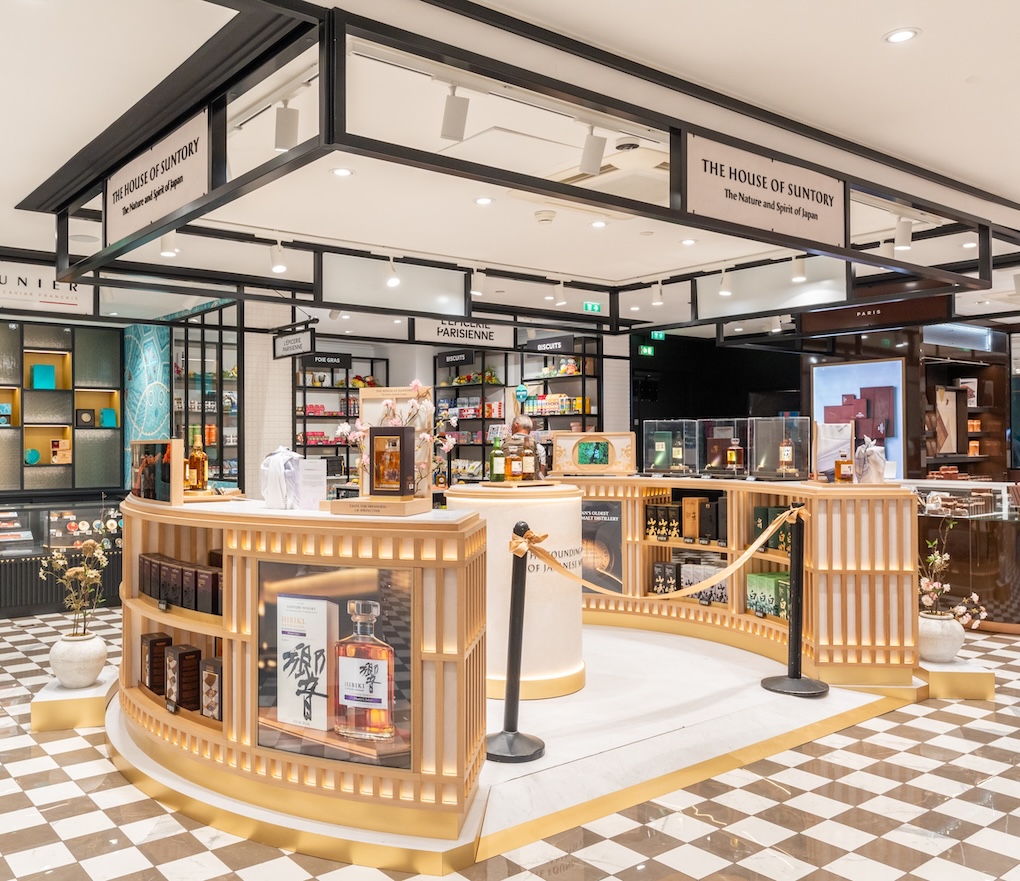
A duty-free liquor flagship store — a whisky boutique housing Royal Salute, Johnnie Walker, Ballantine's and other brands
Core Insight ① — Lotte Inherited the Whisky Boutique Shilla Built
Where the operator behind Macallan's counter actually changed is DF1, not DF2. Macallan sat inside the standalone liquor boutique in the DF1 zone Shilla operated, alongside Johnnie Walker, Ballantine's and other major whisky brands. When Shilla surrendered the concession, Lotte — the winning bidder for DF1 — took over operation of that existing store.
In other words, the direct operator handoff for Macallan's counter didn't run from Shilla to Hyundai. It ran from Shilla to Lotte. Hyundai does carry liquor and tobacco in DF2, but the operator that inherited the existing DF1 whisky boutique and Macallan's counter is Lotte.
That distinction reshapes how to read the operator switch. This isn't a case worth framing as "a company with limited liquor experience taking on Macallan for the first time." What's actually worth watching is how far Lotte — which has run dedicated liquor stores and whisky pop-ups at airports overseas — carries forward and builds on the store Shilla had been running.
Keeping the existing space and brand lineup intact secures early operational continuity. It minimizes the sales gap that store renovation and brand repositioning would otherwise create, and it preserves the shopping flow existing customers were already used to.
But continuity on its own isn't differentiation. If only the operator's name on the sign changes from Shilla to Lotte while the product mix and store experience stay identical, customers have little reason to notice the switch at all. What matters more than preserving Macallan's counter position and basic layout is what limited editions get secured going forward, what brand pop-ups and tasting events get brought in, and how rare, high-age-statement bottlings get presented.
What Lotte Has Built at Changi
Lotte's experience at Singapore's Changi Airport connects directly to this Incheon return. Lotte has run the liquor and tobacco duty-free business across Changi's Terminals 1 through 4 since 2020. As of 2025, it reportedly operated 18 stores spanning roughly 8,600 square meters across the four terminals, carrying around 430 liquor brands including Macallan.
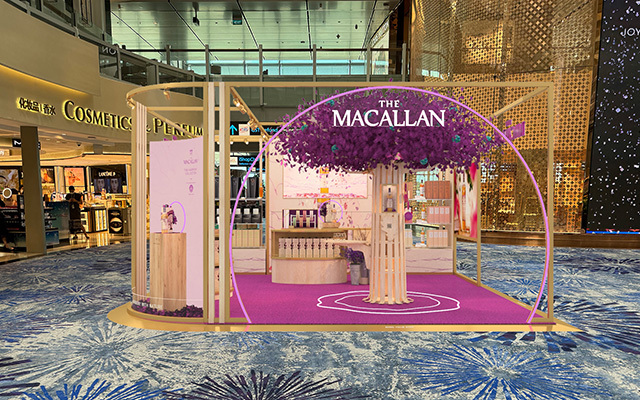
Lotte has also partnered directly with Macallan at Changi. In January 2025, it opened a pop-up store with Edrington, Macallan's parent, at Changi Terminal 3. That pop-up was built around introducing Macallan's Harmony Collection Guardian Oak. It marks the second confirmed Macallan pop-up Lotte has run at Changi, following one in 2023.
A Macallan pop-up store Lotte Duty Free opened with Edrington at Changi Airport Terminal 3 (January 2025)
In 2025, Lotte also ran pop-ups or experiential content with The Glenlivet, Macallan, Four Pillars, Bruichladdich, Suntory, Moët Hennessy, Dalmore, Johnnie Walker, and Martell, among others. Lotte's strength, then, isn't simply carrying a large number of brands — it's the track record of repeatedly running short-term stores built around introducing new products alongside a brand, combined with customer experience.
According to a Lotte representative, its ultra-premium wine and whisky event at Changi, "WOW," generated roughly KRW 1 billion in reservation-based sales in one instance. That figure reflects the event's combined ultra-premium wine and whisky sales, not Macallan alone — but it still demonstrates Lotte's experience running rare, high-age-statement spirits through a dedicated space with a reservation-based sales model.
At Incheon, Lotte has taken over the DF1 whisky boutique and Macallan's counter that Shilla built. The space and the brand to apply its Changi experience to are already in place. The question now isn't whether Lotte carries Macallan — it's how much it differentiates the store Shilla had been running.
Core Insight ② — Incheon Does Have a Macallan Counter; the Question Is Whether the Space Expands
Saying Incheon Airport has no Macallan store isn't accurate. DF1 already has a standalone liquor boutique with Macallan positioned alongside Johnnie Walker, Ballantine's and other brands, and that space carried over from Shilla's operation to Lotte's.
Still, the store format is worth distinguishing. The current DF1 store is a multi-brand liquor boutique that includes a Macallan section among several major whisky brands — not a standalone flagship boutique built solely for Macallan, with its own dedicated large-format space, entrance and brand-experience facilities. Those differ meaningfully in scale and how they operate.
So Incheon's real gap isn't the absence of Macallan product or a Macallan counter. More precisely, it's the absence, so far, of a large, freestanding experiential boutique that renders Macallan's history, spirit, casks and maturation philosophy across an entire dedicated space.
Edrington continues to build out Macallan's dedicated space and travel-retail-exclusive products across the global travel retail channel. In 2023, it launched the Colour Collection, a line built exclusively for global travel retail. In its fiscal year 2024 results, Edrington characterized the Colour Collection's early performance in global travel retail as excellent, and pointed to Macallan and the Asia-Pacific market as key drivers of the company's growth.
That said, care is needed not to conflate different revenue bases when describing Edrington's fiscal 2024 results. Public reporting puts revenue for the fiscal year ended March 2024 at £1.16 billion, up 11% year over year, with pre-tax profit of £411 million, up 6%. Macallan posted double-digit growth, with Asia-Pacific and global travel retail cited as the primary growth drivers.
Analyzing Macallan's global store strategy calls for distinguishing standalone boutiques, shop-in-shops inside multi-brand duty-free stores, and short-term pop-ups. Each differs in scale, contract structure, operating duration, and the customer experience it delivers. Lumping different formats together under a single figure — something like "six airports worldwide" — risks distorting the actual store strategy.
The same applies at Incheon. What matters isn't simply whether a Macallan counter exists, but how independent the current brand section actually is, how the floor space and product mix have changed since Lotte took over, and whether there's a realistic path toward a standalone pop-up or a larger shop-in-shop down the line.
Keeping the existing liquor boutique running steadily is one option. But if Lotte adds a standalone Macallan pop-up, travel-retail-exclusive product launches, displays for high-age-statement whiskies, reservation-based purchasing, and tasting or experiential programming — the way it has at Changi — the existing store could move into a different stage altogether.
Business Impact — What Matters More Than the Lower Per-Passenger Rent Is Upgrading the Existing Store
The per-passenger rent Lotte and Hyundai bid in this retender runs roughly 40% below the 2023 Shilla and Shinsegae contracts. The new operators aren't starting out carrying the same rent burden their predecessors did.
That said, the per-passenger rent structure itself remains unchanged. Rent still rises in step with departing passenger volume. A lower rate can free up room to invest in the store, but if actual purchase rates and average spend per customer don't recover, the profitability gain an operator actually feels could still be limited.
The DF1 liquor boutique housing Macallan starts from a relatively favorable position. Because Lotte began operating on top of an existing store, it can cut both upfront cost and operational downtime compared with designing and building a new space from scratch — and it can also draw on an already-established customer flow and brand awareness.
Inheriting an existing store doesn't, on its own, generate an investment return, though. Lotte has roughly three directions it could take.
The first is keeping the current multi-brand whisky boutique running steadily as-is. Customers can find familiar brands and products in the same location as before, which favors operational stability.
The second is strengthening individual shop-in-shops for Macallan and other core brands — expanding brand-specific sections and display space, and adding product storytelling, digital content, and dedicated cases for high-age-statement bottlings.
The third is combining airport-exclusive products with short-term pop-ups to keep evolving the store's lineup — following Changi's model of partnering with major brands to spotlight new releases and limited editions for set periods, using tastings and experiential programming to extend dwell time and lift conversion.
Whichever direction it takes, the investment itself comes down to negotiation between Lotte and the brand owners. A lower per-passenger rent doesn't automatically translate into the savings being redirected toward store renovation or pop-ups. Who bears the cost of store investment, how much volume and how many limited editions the brand owner allocates, and how much latitude the airport gives for changing the space will all shape how fast this actually moves.
So this operator switch shouldn't be judged purely on the fact that "Lotte took over the store." What Lotte has actually added to the store Shilla built is the real basis for evaluation.
✦RIT's Insights
What RIT finds most notable about this reshuffle is that Macallan's counter didn't disappear or move to an entirely different zone. The operator behind Shilla's DF1 liquor boutique changed to Lotte Duty Free, and Macallan's counter stayed in the same space.
A handoff of this kind sets a different task than opening a new store would. Lotte has to preserve the existing store's sales and customer flow. At the same time, it has to give customers a new experience they can actually notice as evidence the operator changed.
Simply swapping the sign while keeping the product mix and displays identical would secure operational continuity — but it wouldn't reveal the value of the liquor operations experience Lotte has built up at Changi. What matters for the assessment ahead isn't whether Macallan keeps selling. It's what Lotte adds to the existing store.
If Lotte applies the approach it has proven at Changi, DF1's liquor boutique could change fairly quickly — a standalone Macallan pop-up, travel-retail-exclusive products like the Colour Collection, displays for high-age-statement bottlings, airport-exclusive packages, reservation-based purchasing, digital content, and tastings, all layered onto the existing space.
Anyone in duty-free merchandising should start by checking whether Macallan's floor space and shelf position held steady after Lotte took over the store. Worth checking too: whether inventory and the product lineup have shifted from Shilla's era, whether new limited editions or high-age-statement bottlings have been added, and whether tastings and brand-experience elements have been expanded.
Whether Edrington and Lotte are discussing a standalone Incheon pop-up or an expanded brand space is also worth watching. Lotte has already run Macallan pop-ups with Edrington at Changi. Carrying that existing partnership over to Incheon is arguably the most realistic upside this operator switch offers.
That said, it shouldn't be assumed at this stage that Lotte will actually expand the Macallan boutique. What's publicly confirmed is that Lotte secured the DF1 concession and began operating it, and that the store and counter Shilla ran carried over under Lotte's management. Any expansion of the space or pop-up plans will require an official announcement from Lotte or Edrington, or further reporting.
The most accurate way to put it, in the end, is this: the DF1 whisky boutique Shilla ran at Incheon Airport now operates under Lotte, and Macallan's counter remains in the same space. What's at stake now is whether Lotte settles for a simple handover, or applies the pop-up, rare-spirits and experiential retail experience it has built at Changi to Incheon.