What Suntory's Paris Airport Strategy Reveals About Premium Whisky
2026-07-07 9:02 PMEurope
Overview
The House of Suntory opened its first pop-up and its first permanent store at Paris Charles de Gaulle Airport at the same time. But from Singapore's Changi to London Heathrow to Amsterdam Schiphol, whisky brands borrowing the experiential-store playbook once reserved for fragrance and fashion is already happening at multiple airports at once.
Mention the liquor aisle at a duty-free shop, and a fixed image comes to mind — a warehouse-style shelf stacked tight with oversized bottles wearing "buy-one-get-one" stickers. But the new House of Suntory store that opened at Paris Charles de Gaulle Airport on June 30 pushes back directly against that image. Unwrapping whisky from furoshiki cloth, telling pairing stories at a tasting table — this space lifts a grammar that used to belong exclusively to fragrance and fashion brands and applies it, wholesale, to the liquor category.
The Signal Suntory Sent — A Pop-Up and a Permanent Store at Paris Airport
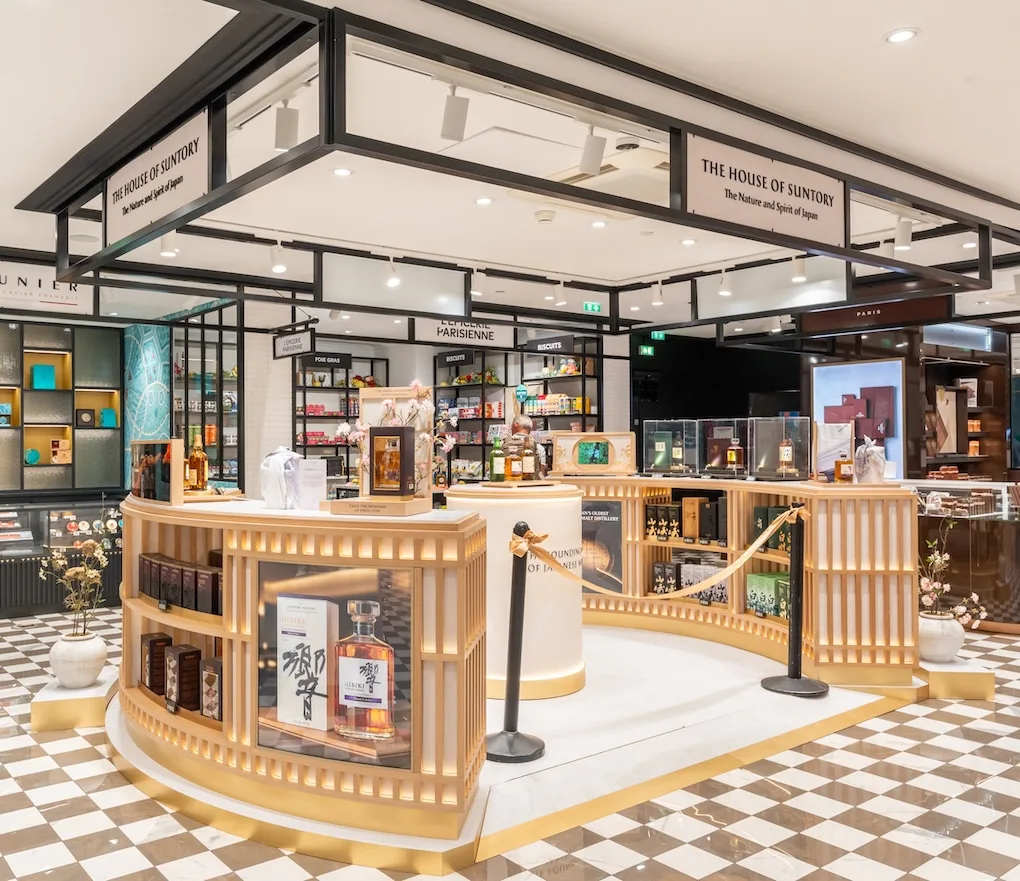
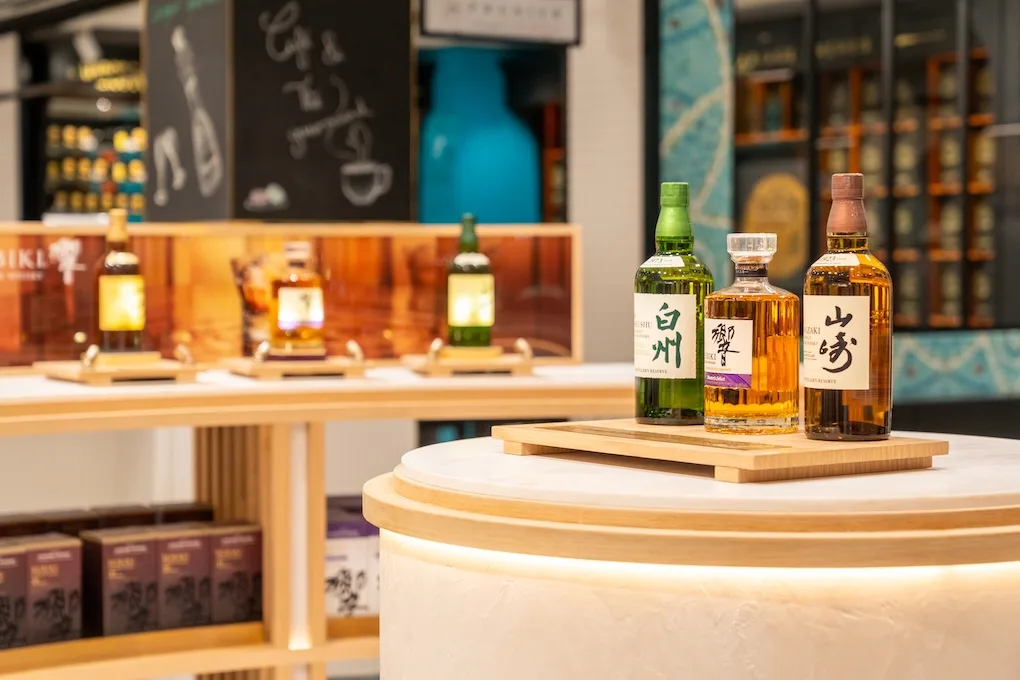
The House of Suntory, together with Lagardère Travel Retail and Extime Duty Free, simultaneously opened its first pop-up store in Terminal 1 and its first permanent brand space in Terminal 2 at Paris Charles de Gaulle Airport. The Terminal 1 pop-up is small — 5 meters by 3 meters — but is divided into three zones built around the Hibiki, Yamazaki, and Hakushu lines. It foregrounds prestige expressions like Hibiki 21 Year, Yamazaki 18 Year, and Hakushu 18 Year, and turns a demonstration of furoshiki — the traditional Japanese cloth-wrapping method — into experiential content in its own right, showcasing "how to gift" itself.
The House of Suntory, Extime · Paris Charles de Gaulle Airport (2026.6.30)
The Terminal 2 permanent space sits inside LSM4, one of the airport's highest-traffic stores. Organized into three zones, it's designed to guide shoppers naturally from discovery to purchase, with light-box displays highlighting new releases and limited editions. If the pop-up's job is generating buzz, the permanent space is the mechanism that converts that buzz into actual sales.
Hibiki, Hakushu, and Yamazaki tasting table, Paris CDG
Whisky Borrows Fragrance and Fashion's Grammar
What makes this store interesting isn't its layout — it's who started using this playbook. Building a multi-level store where the brand itself designs the space, the circulation, and the storytelling used to be the exclusive domain of luxury fashion and beauty houses like Louis Vuitton and Chanel. That grammar has already been proven in beauty. What's genuinely interesting lies elsewhere — Paris isn't the first, or the only, place liquor has borrowed it. At major airports including Changi, Heathrow, and Schiphol, whisky brands have already been running similar experiments for several years.
Why Liquor Brands Are Opening Experiential Stores Now
For a long time, the competitive axis for duty-free liquor was price — liter bottles, two-bottle bundle discounts, structures built to get travelers to load up as much as possible within their carry-on allowance. But that competitive axis is becoming harder and harder to differentiate from the everyday discounting at local hypermarkets and e-commerce. Suntory's answer runs the opposite way — shifting the competition from price to "an experience only available in this space."
Lead with a prestige lineup, add tasting, pairing, and gifting services, and the consumer is no longer just "buying cheap because it's duty-free" — they are "buying a brand experience only available at the airport." This shift matters because of margin structure. Price competition erodes margin for both operator and brand, while an experience-based premium line can lift average transaction value while protecting margin.
Already Underway at Multiple Airports Simultaneously
That this trend isn't confined to Paris airport becomes obvious the moment you look beyond it.
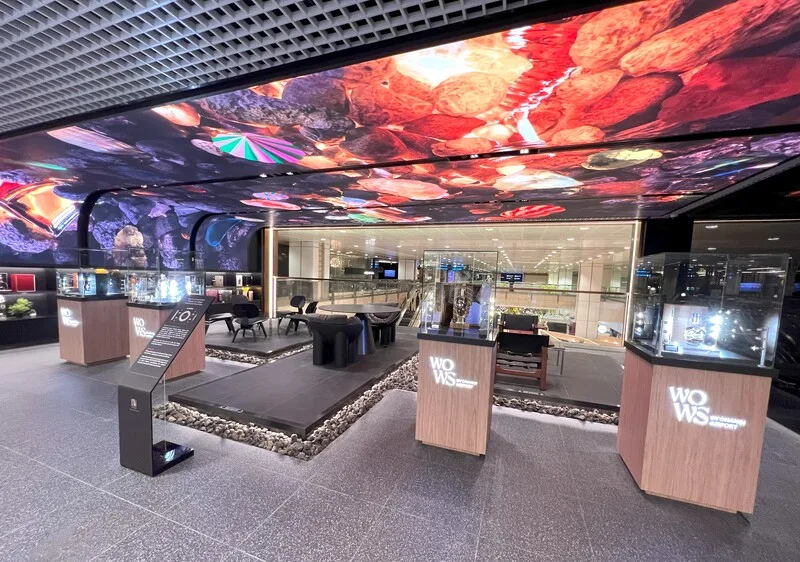
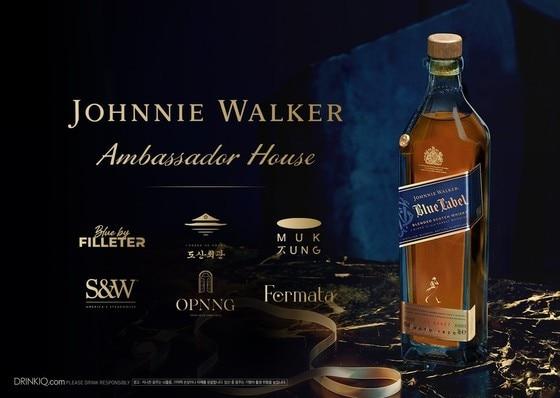
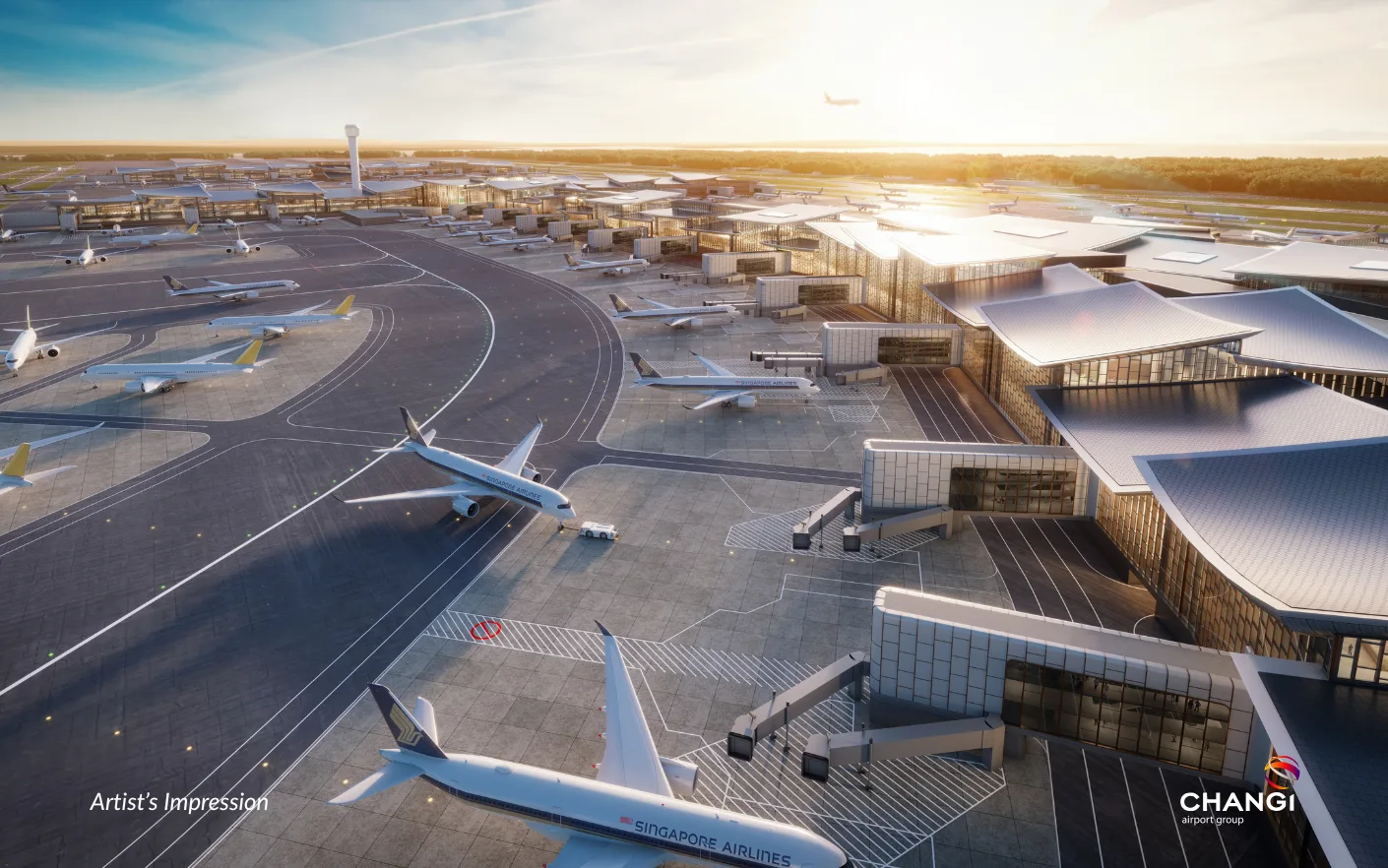
Singapore Changi Airport — Lotte Duty Free. The House of Suntory had already opened a 13.5-square-meter shop-in-shop at Lotte Duty Free's Terminal 3 location at Changi in March 2024 — more than two years ahead of the Paris store. It used displays modeled on kigumi (組み), traditional Japanese wood-joinery lattice work, and marumado (丸窓), circular windows, and sold an exclusive "Yamazaki & Hakushu Kogei Collection" created in collaboration with Chiso, a Kyoto kimono house. Suntory isn't the only brand doing this. Lotte Duty Free's Changi store hosted nine whisky pop-ups last year alone, debuting limited editions from Macallan and Johnnie Walker as world firsts; in December 2025, Macallan opened a 19-square-meter shop-in-shop, and in September 2025, The Dalmore ran an exclusive month-long pop-up. This year, a Hennessy pop-up built around a "Year of the Fire Horse" concept, in partnership with Moët Hennessy Travel Retail, is also running. Technology has entered the mix too — robot bartenders, smart dispensers, AI wine recommendations — and the ultra-premium whisky zone in the Terminal 2 duplex store (featuring items like Dalmore 43-Year) generated roughly KRW 1.0 billion in sales from a single "WOW" event alone.
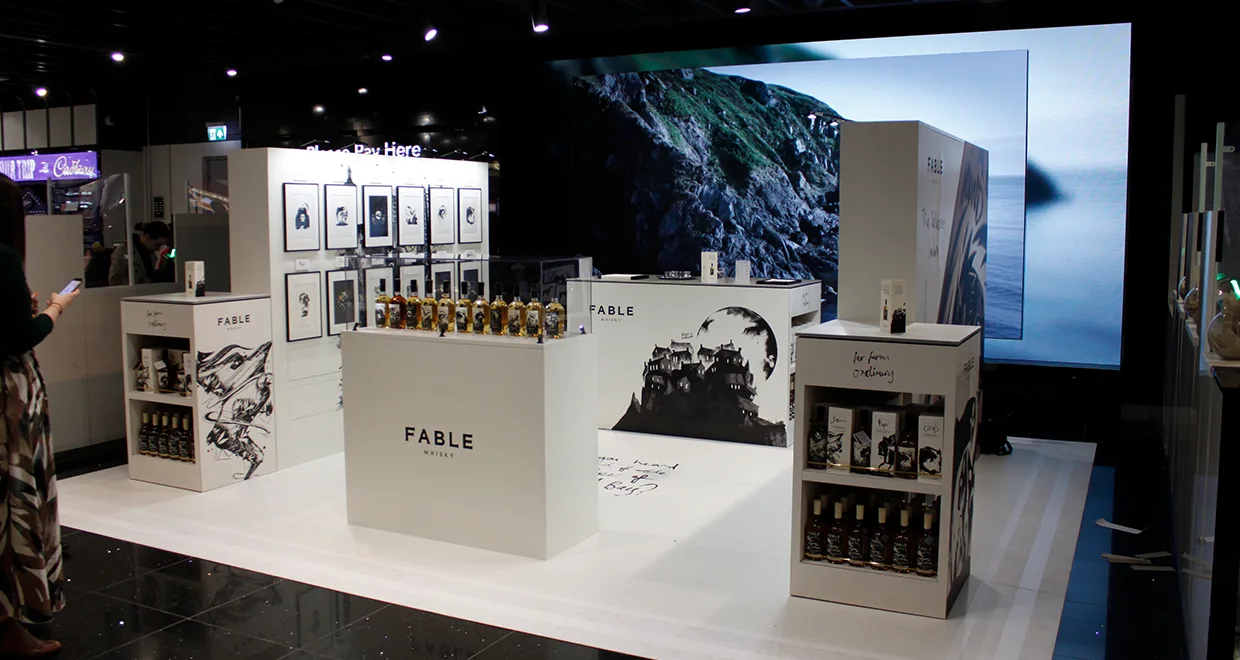
London Heathrow — World Duty Free. Independent Scotch whisky brand Fable opened a pop-up exhibition space with World Duty Free at Heathrow Terminal 5 in May 2024. Built around the "Ghost Piper of Clanyard Bay Collection," it exhibited illustrated artwork by artist Hugo Cuellar and hosted an artist signing on World Whisky Day (May 18). The goal, according to the team behind it, wasn't sales — it was "building a world you can immerse yourself in." The campaign extended, digitally and through advertising, to Gatwick, Glasgow, Edinburgh, and Aberdeen airports as well.
Fable Whisky pop-up, London Heathrow Terminal 5
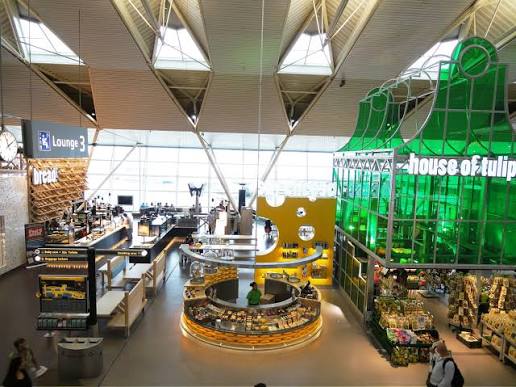
Amsterdam Schiphol — Schiphol Airport Retail (SAR). Schiphol's "Finest Spirits & Cigars" store in Lounge 3 has built an ultra-premium whisky lineup — closed-distillery bottlings, rare expressions, nothing under 25 euros — establishing itself as a shrine for rare single malts in Europe. In Lounge 1, a new 1,500-square-meter flagship store covering wine and spirits, "Today Duty Free," also opened in partnership with Lagardère Travel Retail.
Amsterdam Schiphol Airport, Lounge 3
In other words, what Suntory opened at Paris airport is not a new experiment. It is closer to a model that Changi, Heathrow, and Schiphol have each already validated in their own way, now landing in Paris. In RIT's view, this point still needs further confirmation — and if that's the case, the question that follows is why domestic airports haven't yet caught up to this density.
✦RIT's Insights
It's already been proven in beauty. And it's being proven in liquor too — not at one airport, but simultaneously across Changi, Heathrow, Schiphol, and Incheon. The fact that Suntory, Macallan, Fable, and Hennessy are each running experiments at different airports in parallel is a signal that this isn't a one-off event — it's an established category strategy.
In RIT's view, the homework for domestic operators isn't "whether to try this" — it's speed. Lotte (Changi) and Hyundai (Incheon) already have know-how running whisky shop-in-shops and pop-ups, so the real question is how quickly they can replicate Changi-level multi-brand, multi-pop-up density at domestic airports. The same goes for liquor brands. As shown by Suntory, Macallan, Fable, and Hennessy, running a single brand through different concepts at different airports simultaneously — shop-in-shop, exhibition-style pop-up, ultra-premium corner — has already become standard multi-location strategy, and there's still plenty of room to design different experiential formats by market.
For airport commercial planning teams, there are two reference models to draw on. One is Schiphol's approach — an ultra-premium corner with a price floor that simply doesn't stock anything under 25 euros. The other is Heathrow's approach — a pop-up that prioritizes brand exhibition over sales itself. Either way, the key point is that each airport can carry its own distinct positioning. For merchandising managers, Changi's three-tier structure — building buzz through pop-ups, converting that buzz through shop-in-shops, and pulling separate event-driven sales from an ultra-premium zone — is a useful reference model for designing different KPIs by category.
As shown by the liquor stores that Shilla Duty Free and Shinsegae Duty Free recently pulled out of at Incheon Airport, the foundation already exists domestically. Prestige whisky and cognac carry storytelling potential every bit as rich as beauty, and domestic consumer interest in premium liquor keeps climbing. From an operator's perspective, now looks like the time to benchmark the Changi and Heathrow cases together and pilot a two-track pop-up-plus-shop-in-shop model, brand by brand, at Korea's airport duty-free stores.