How Changi Terminal 5 Aims to Rewrite Airport Retail
2026-06-30 7:31 PMAsia Pacific
Overview
Singapore's Changi Airport broke ground on Terminal 5 (T5) in May 2025. Targeted for completion in the mid-2030s, the project is far more than a terminal expansion. Designed by KPF and Heatherwick Studio, T5 reframes the airport as "A Cluster of Neighbourhoods," previewing a next-generation model for airport retail where shopping, F&B, and culture converge. With Lotte Duty Free extending its Changi concession through 2029 and Shilla expanding its cosmetics and fragrance channel, Changi's positioning war for the T5 era has already begun.
At the T5 groundbreaking ceremony in Singapore in May 2025, former Prime Minister Lee Hsien Loong stood at the podium and said: "T5 is Changi's next chapter, and the future of Singapore's aviation hub strategy." The numbers back up the claim. Once complete, T5 will handle 50 million passengers a year — roughly half the capacity of Changi's current four terminals combined, packed into a single terminal.
"A Cluster of Neighbourhoods" — KPF and Heatherwick's Radical Design
T5's first shock comes from the architecture. Changi Airport Group (CAG) selected KPF and Thomas Heatherwick's Heatherwick Studio as co-designers. The concept the two firms put forward is unambiguous: "Airport as a City."
Conventional airport design has followed a grammar of efficiency: the shortest route to the gate, uniform lighting, repeating retail strips. T5 breaks that grammar. Curved roof structures called "Roof Leaves" overlap at varying heights, creating a different atmosphere zone by zone, with natural light filtering in differently depending on the angle. Each zone is designed as an independent Neighbourhood concept, so the experience of shopping, dining, rest, and culture is differentiated district by district.
Retail space design was handed to DP Architects. Changi Airport Group's decision to separately appoint DP Architects as T5's commercial-space designer signals that retail is being planned not as a simple revenue source but as a core layer of the spatial experience at T5.
What Is the Neighbourhood Design Philosophy
Conventional large airport terminals were designed as uniform space under a single massive roof — the shortest path to the gate, and the same lighting, height, and atmosphere everywhere. Efficient, yes, but not an environment people want to linger in.
T5's answer is to stack the roof as "Roof Leaves" — multiple curved, leaf-shaped canopies layered on top of one another. Each Roof Leaf differs in height and angle, and natural light streams in at a different intensity by zone. Rather than one giant warehouse, the effect is a continuous sense of small Neighbourhoods strung together.
Each Neighbourhood is designed with its own lighting environment, ceiling height, planting density, and mix of uses.
Departure curbside: curved roofs reflect light dynamically, translating "the thrill of flight" into physical space
Baggage claim hall: vertical gardens fill the walls, staging a "warm welcome" to arrival in Singapore
Retail and concourse plazas: large open spaces where shopping, dining, and entertainment naturally intermingle
This structure has a direct bearing on retail. Intimate Neighbourhoods get premium boutiques; plaza-style Neighbourhoods get mass-market brands and F&B — preventing the clash between luxury and dining at the design stage rather than after the fact. Put simply, it's an experiment in building, inside an airport, the kind of Neighbourhood fabric where people naturally spend time even without a destination in mind — the way they do in London's Covent Garden or Tokyo's Daikanyama.
Changi East — A 1,080-Hectare Aviation City
Understanding T5 requires understanding the broader Changi East development plan behind it. T5 sits at the center of the 1,080-hectare Changi East district, a mixed-use development that integrates aviation, logistics, and urban living infrastructure into a single footprint.
A cargo terminal, MRO (maintenance, repair, and overhaul) facilities, and the Aerospace Park business district will all connect to T5 via an automated people mover (APM). The goal isn't simply processing passengers — it's building a hub that houses the entire aviation industry ecosystem. What does this mean for airport retail? Where the shopper base used to consist of "passengers" alone, once Changi East is complete, business park employees, MRO workers, and logistics-hub visitors will all become potential customers for the commercial space.
Lotte Duty Free's 2029 Extension — A Bridge to the T5 Era
With T5 targeted for completion in the mid-2030s, there's already meaningful movement in Changi's current duty-free channel. In June 2026, Changi Airport Group extended Lotte Travel Retail's liquor and tobacco duty-free concession by three years, through June 2029.
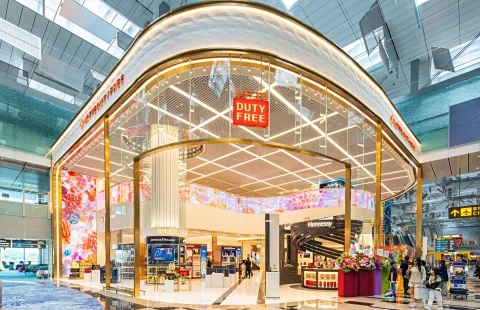
The numbers: four terminals, 18 stores, 8,600 square meters, 430 brands. In 2025 alone, 67.7 million passengers passed through Changi Airport. Lotte holds a position absorbing a substantial share of that traffic through a single category — liquor and tobacco.
Lotte Duty Free, Singapore Changi Airport
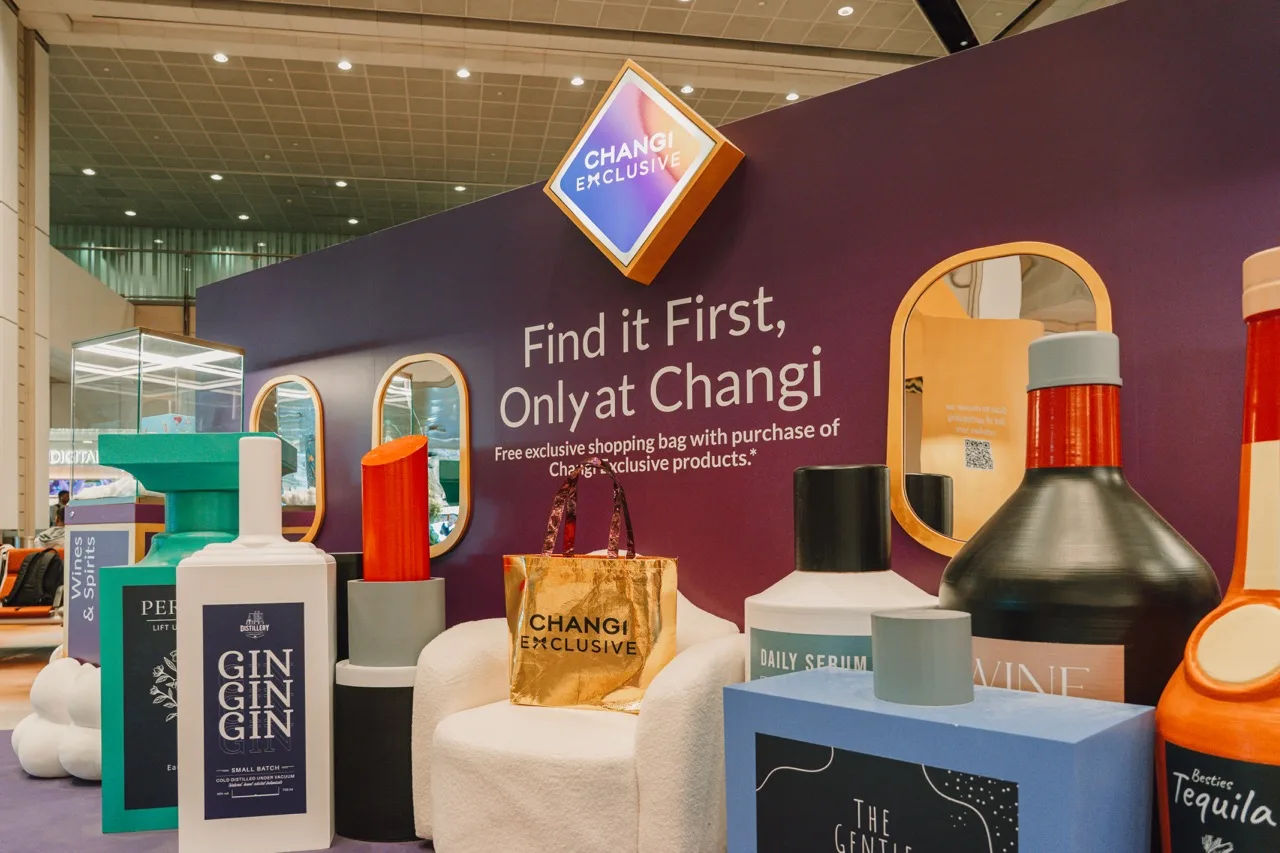
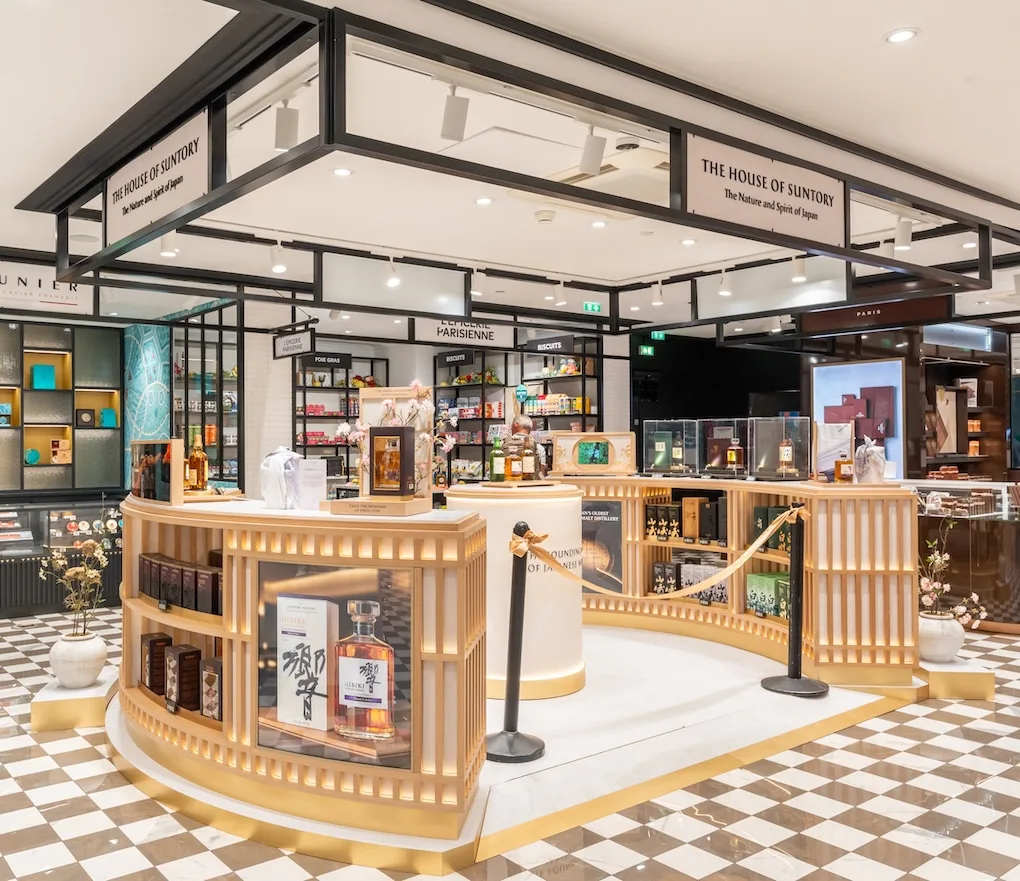
Alongside the extension, the evolution of Lotte's merchandising strategy is worth noting. Its flagship stores in T2/T3 now feature robot bartenders, large-format LED walls, and whisky-tasting bars. Limited-edition collaborations with global distilleries — Kavalan, Bruichladdich, Four Pillars Gin — keep rolling out, and Raffles Hotel's Singapore Sling RTD product has been added to the lineup. The direction is to reshape duty-free from "a place to buy" into "a place to experience." It reads as early positioning ahead of the T5 era.
Shilla Duty Free's Strategy — Doubling Down on Cosmetics and Fragrance
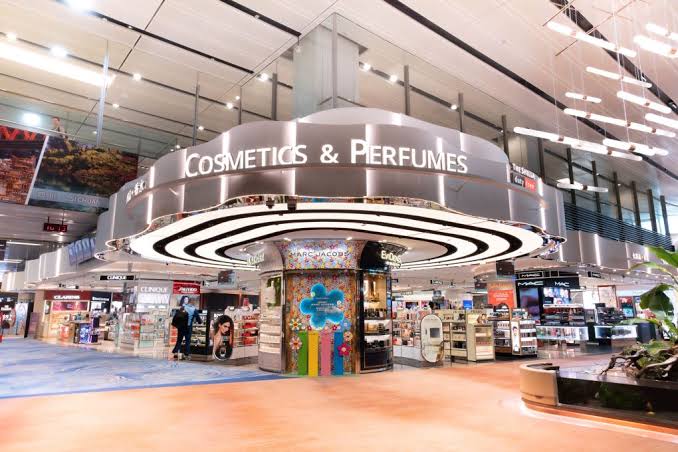
While Lotte dominates liquor and tobacco, Shilla Duty Free operates the cosmetics and fragrance channel across all four Changi terminals — a structure where global demand for K-beauty translates directly into Changi's cosmetics duty-free revenue.
The Shilla Duty Free, Singapore Changi Airport
For Shilla, T5 is a critical variable. How the new terminal's cosmetics and fragrance concessions are reallocated, and which position Shilla can lock in during T5's retail design phase, will determine Changi's revenue structure for the next decade. As the current concession cycle converges with T5's mid-2030s completion, Korea's duty-free industry is likely to face a fresh round of concession competition at Changi. In RIT's view, this timing isn't necessarily to Shilla's advantage — it means having to hold ground with a single category, cosmetics and fragrance, right as concession re-bidding across the board converges on the same window.
Comparison With Incheon — What's Different
Incheon T2's experiment in coexisting luxury boutiques and F&B, and Changi T5's strategy, point in the same direction but take different paths to get there.
Incheon attempted to blend "luxury plus F&B" within an existing terminal. T5, by contrast, embeds the Neighbourhood concept from the design stage. Rather than separating space by use, it organically weaves shopping, dining, and culture together around lifestyle zones. Unlike Incheon, where the clash between luxury brands and F&B has already surfaced, T5's approach is designed to prevent that clash upfront, through zone-specific Neighbourhood characteristics.
Another point of difference is the depth of sustainability integration. T5 is targeting Green Mark Platinum Super Low Energy certification and will feature Singapore's largest rooftop solar array, with that energy also powering the airport's commercial facilities. That lines up precisely with the tightening ESG requirements facing luxury retail.
Changi T5 is, for these reasons, shaping up to be a turning point in the history of airport retail. It marks the completion of an airport built with "experience" as the starting point of design, moving beyond terminals designed around the single value of "efficiency." By the mid-2030s, when T5 opens, Changi's annual passenger throughput will exceed 100 million. The fight over who controls the concessions in the commercial space those 100 million people pass through has already begun.
✦RIT's Insights
T5's real significance lies in its Neighbourhood design philosophy. Rather than dividing space by function, this approach organically weaves shopping, dining, and culture around lifestyle zones, which makes the clash between luxury and F&B disappear from the design stage onward. From a duty-free industry perspective, T5's key variables narrow down to two things. One is the broadening customer base once Changi East is complete — a structure in which not just passengers but business park and logistics workers become potential customers. The other is the market reshuffle that T5's concession reallocation will trigger.
From an operator's perspective, T5's concession bidding is not something to treat casually just because it's still years away. Duty-free operators need to build their relationship with CAG starting now and keep tracking the Changi East development timeline, so they aren't left behind once bidding intensifies in the early 2030s. The situation is similar for luxury brands. Because store location and size are effectively decided in the early conversations with DP Architects, T5's retail designer, moving only after space allocation is finalized is already too late.
What RIT is watching most closely is the ripple effect on K-beauty. If Shilla's cosmetics and fragrance channel is maintained or expanded at T5, the exposure of K-beauty to the full population of Asian travelers passing through Changi will step up another level from where it stands today. K-beauty and K-fashion brands would be wise not to prepare for this shift separately from Shilla, but to co-plan their T5 entry strategy with Shilla from the outset.
For Lotte Duty Free, the 2029 concession expiry is a tighter deadline than it might appear. The key variable in the negotiation won't simply be whether to extend the contract, but whether the T5 channel gets folded in. If Lotte rushes into a renewal without reflecting T5's direction, it risks a mismatch once T5 actually opens — newly secured space that doesn't fit the existing contract structure. The point where Lotte's 2029 contract expiry meets T5's opening will be the real turning point for Korean duty-free's Changi strategy.