Why Heinemann Brought Beauty Retailer MECCA to Sydney Airport
2026-07-24 10:35 PMAsia Pacific
Overview
Heinemann is bringing MECCA, Australia's largest multi-brand beauty retailer, into Sydney Airport's international duty-free store for the first time. Handing an entire store over to a multi-brand retailer that curates more than 200 brands on its own is a qualitatively different decision from signing up an individual brand. But the customer this bet is really aimed at may not be foreign visitors at all — it's likely Australians heading overseas who already know MECCA.
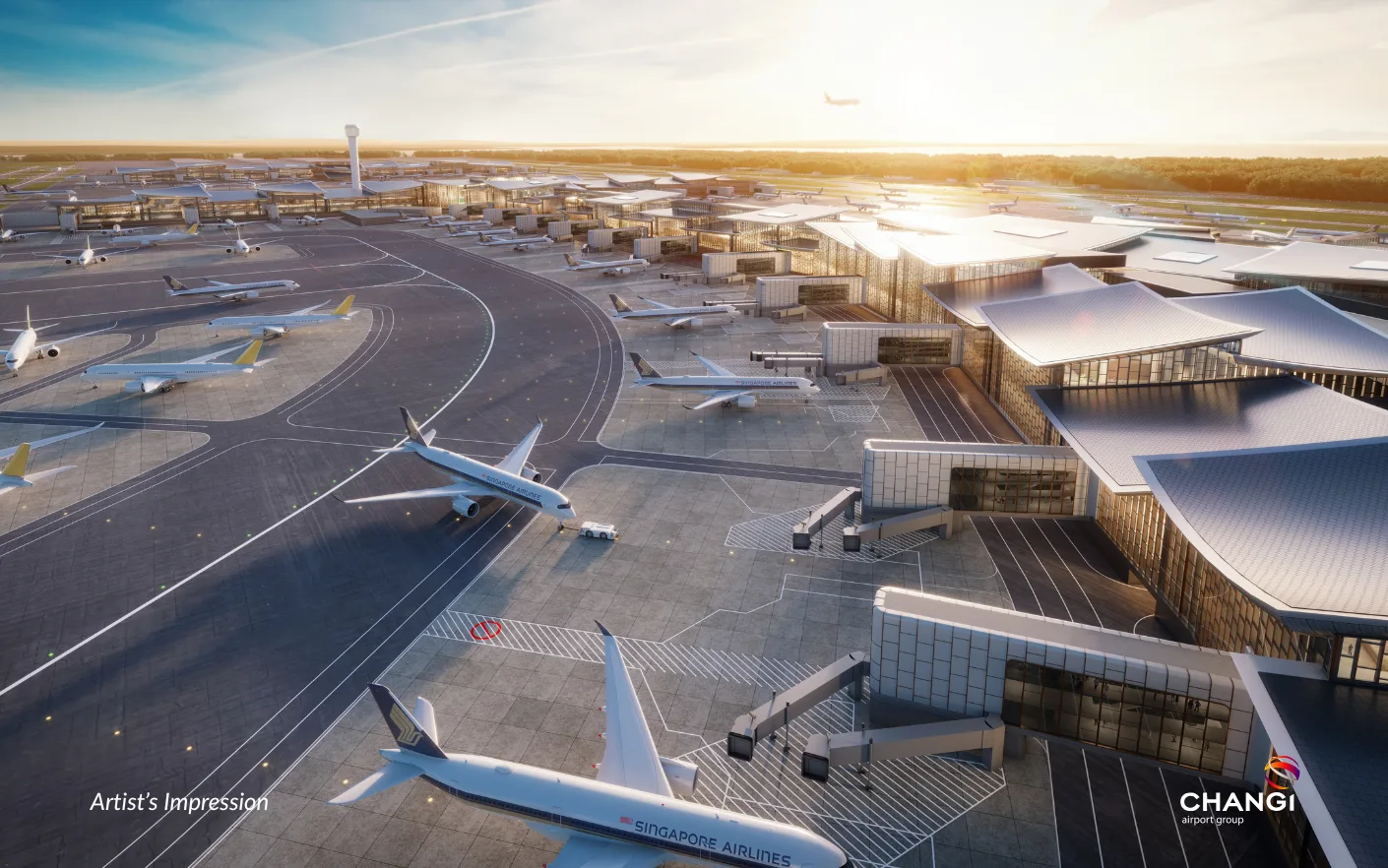
MECCA, Australia's largest multi-brand beauty retailer, is entering an international duty-free store for the first time in its 29-year history. It's part of an 18-month duty-free redevelopment plan that Heinemann and Sydney Airport announced on July 22. Most domestic trade coverage framed the news as "an Australian beauty brand's global debut." That's not wrong, but it misses the part actually worth watching. MECCA isn't a single brand — it's a curator that hand-picks and sells more than 200 brands directly. And the core function of a duty-free operator like Heinemann is exactly that: curating which of many brands goes on the shop floor. One curator has just handed an entire store over to another curator. That's a fundamentally different kind of decision than landing one more Hermès or Dior boutique.
What Happened — An 18-Month Full Overhaul
The redevelopment plan Heinemann and Sydney Airport announced breaks down as follows.
July 2026: Redevelopment construction begins, targeting completion by mid-2027 (18 months total)
May 2026: Aesop's duty-free debut, in a 73-square-meter store
August 2026: MECCA's standalone store opens — the first international duty-free entry for a multi-brand beauty retailer with 110-plus stores across Australia and New Zealand and more than 4 million customers a year
Victoria's Secret: Opening Australia's first international duty-free boutique, at 120 square meters
Hermès: A major expansion of its existing boutique
A full redevelopment of the wine and spirits, tobacco, and confectionery categories, along with a renovation of arrivals and gate shops
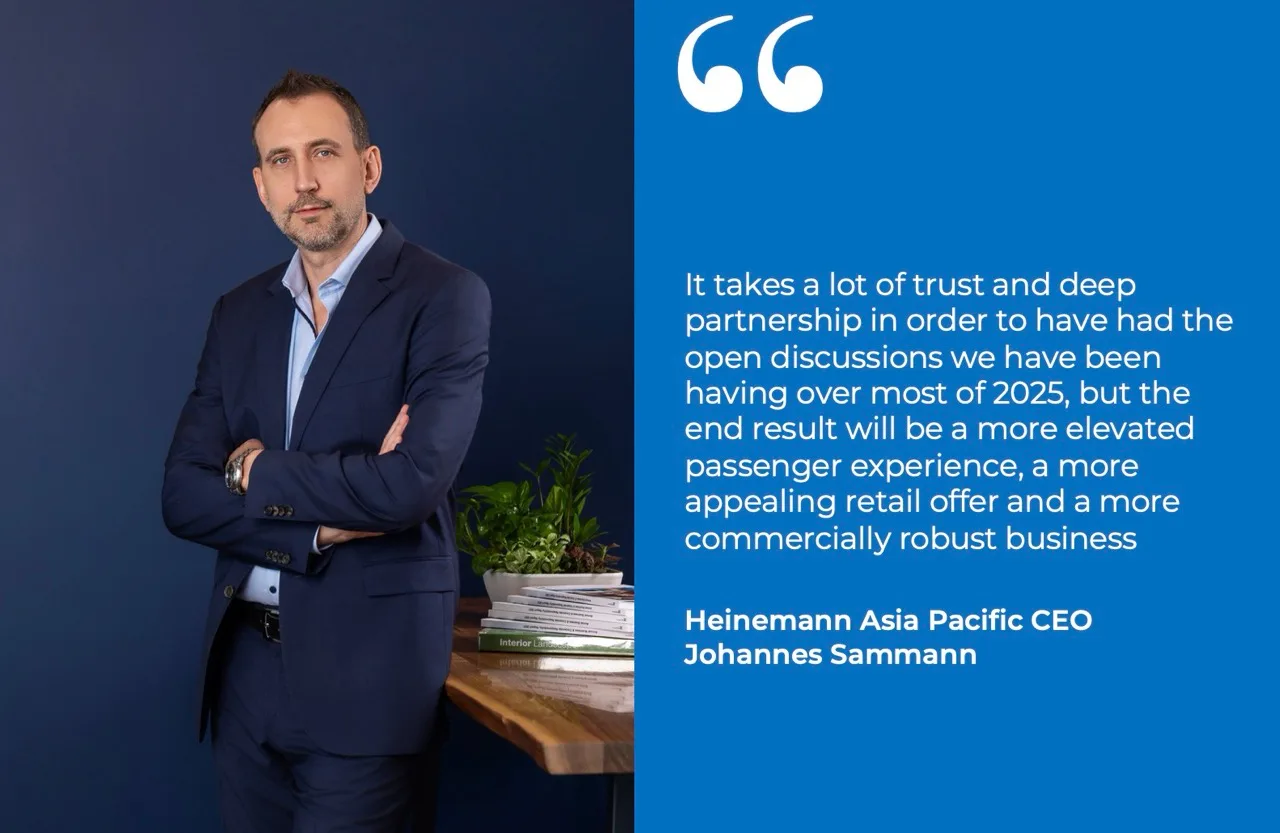
Johannes Sammann, CEO of Heinemann Asia Pacific, described the backdrop to the project this way: "It was significant trust and a deep partnership that made the candid discussions we carried on for most of 2025 possible. And the result will be an enhanced passenger experience, a more compelling retail offer, and a commercially stronger business."
Heinemann Asia Pacific CEO Johannes Sammann — 'It was significant trust and a deep partnership that made the candid discussions we carried on for most of 2025 possible'
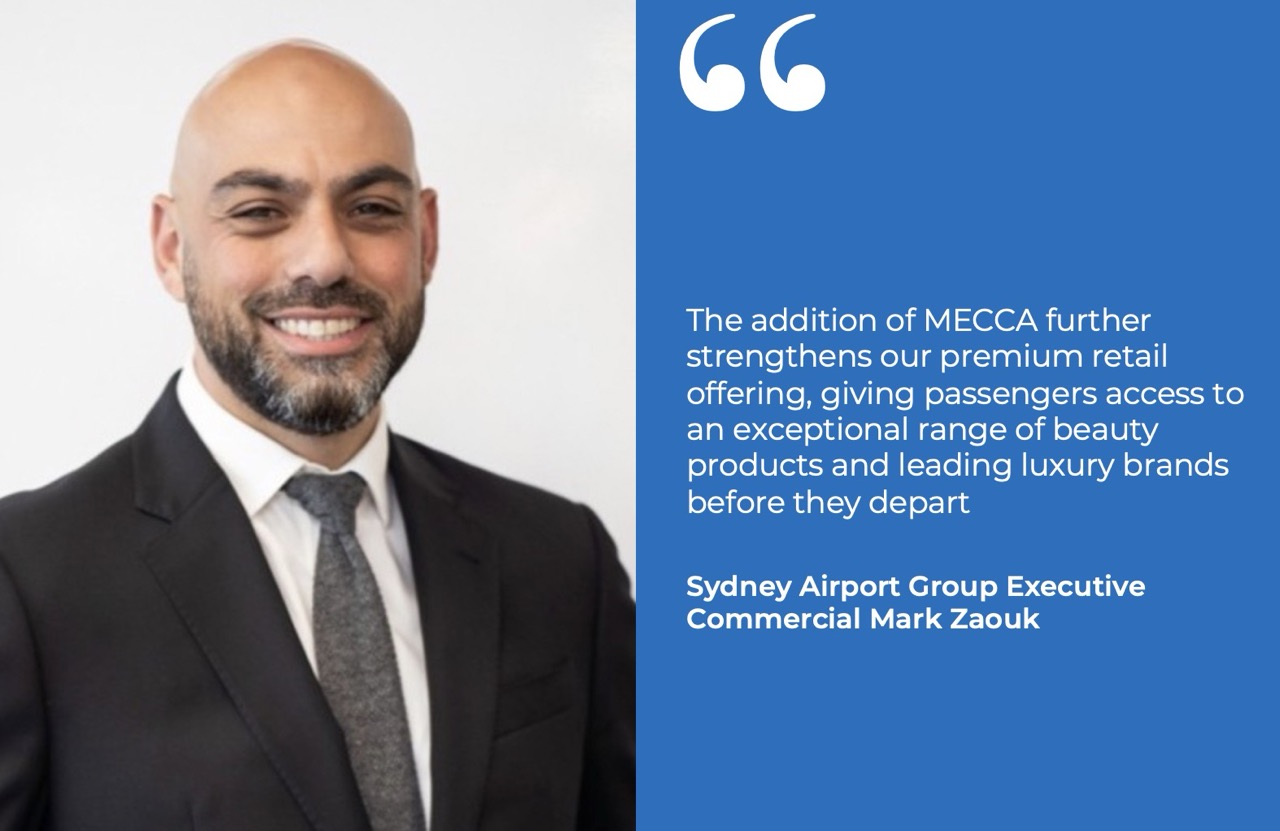
Mark Zaouk, Sydney Airport's Chief Commercial Officer, framed the significance of landing MECCA this way: "MECCA's arrival further strengthens our premium retail offer. Passengers will have access to outstanding beauty ranges and leading luxury brands before they depart."
Sydney Airport Group Chief Commercial Officer Mark Zaouk — 'MECCA's arrival further strengthens our premium retail offer'
MECCA's Maria Chaussis described the entry as "an opportunity to introduce the MECCA experience to international travelers." All three parties named "revenue growth" as the project's core metric, without disclosing specific targets.
Core Insight 1 — This Isn't Brand Acquisition. It's a Handover of Curatorial Authority
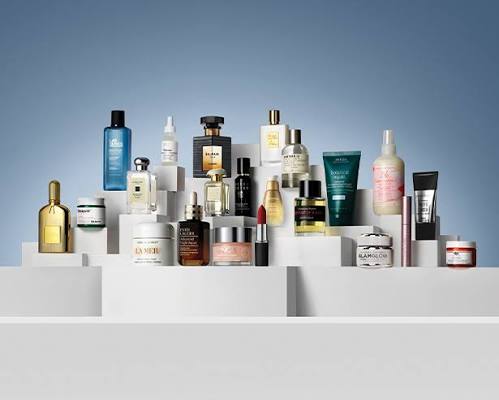
Hermès or Victoria's Secret opening a store is a familiar picture. They're single brands, and Heinemann remains the one deciding whether to put that brand in that spot at all. MECCA is different. Inside MECCA sits a portfolio it has already hand-picked for itself — everything from premium brands like Diptyque, Byredo, and Glossier to MECCA's own house brands (MECCA COSMETICA, MAX, kit:), more than 200 brands in all. The moment Heinemann hands MECCA a store, the decision over what actually gets sold inside it effectively passes to MECCA.
It's structurally similar to a department store subleasing an entire floor to another department store. Heinemann supplies the traffic and the real estate that is Sydney Airport, and in exchange borrows the brand portfolio and customer trust MECCA has already built and validated. The logic behind this decision is clear: in a market where duty-free's traditional weapon — "cheap because it's duty-free" — is losing its force, Heinemann chose to buy an already-completed layer of trust wholesale, rather than build it up brand by brand on its own.
Core Insight 2 — This Bet Targets Australian Outbound Travelers, Not Foreign Visitors
A more important question follows. MECCA is a purely domestic Australian and New Zealand brand. It has no overseas stores at all — this is its first international expansion. That means most inbound visitors arriving in Sydney from abroad are likely to walk right past the store without recognizing the brand. For Australians flying out, on the other hand, MECCA is a brand they've already run into countless times across 110-plus stores — one that needs little persuasion to open a wallet.
The classic formula that has driven duty-free growth has always been about capturing "foreign visitors in an unfamiliar airport, spending more freely than usual." Bringing in MECCA moves in exactly the opposite direction — it's a strategy to capture spending from outbound domestic travelers who already know and like the brand. Australian Bureau of Statistics data hints at why this pivot could be a rational move. As of April 2026, short-term foreign visitor arrivals stood at 644,770, while short-term Australian resident returns numbered 1,092,380 — far more. It's a national-level statistic that can't be mapped directly onto Sydney Airport specifically, but it does show that in a geographically isolated country like Australia, the number of outbound domestic travelers is naturally larger than inbound foreign visitors to begin with. Heinemann's decision to bring in MECCA looks like a direct play on exactly that structure.
Business Impact — Success Hinges on Who Actually Walks Past This Store
For this strategy to work, there's a precondition: the share and dwell time of Australian outbound travelers passing through Sydney Airport's international terminal need to be large enough. In RIT's view, this point still needs further confirmation — if the share of transit passengers or genuinely foreign visitors turns out to be larger than expected, the MECCA store risks being little more than one more unfamiliar brand on the floor. But if the share of Australian outbound travelers is large enough, MECCA can generate spending driven by "I already love this brand" rather than "it's duty-free" — a form of differentiation other airports can't easily copy. Unlike a strategy built around attracting foreign tourists, a domestic brand isn't something another country's airport can simply import wholesale.
This case isn't an isolated one. Istanbul Airport recently opened Balenciaga's first duty-free boutique, and several airports are pushing the boundaries of duty-free categories that used to center on luxury and spirits out into fashion and lifestyle. But where most of those cases represent a global brand entering a new channel, Sydney's MECCA case is different in kind — it's a domestic brand's first move abroad. The direction airports are reaching for differentiation is no longer singular; it's splitting into at least two distinct paths. Whether this bet pays off ultimately comes down to who actually walks past the MECCA store — a question of traffic composition, not brand power.
✦RIT's Insights
The most interesting thing about this case is that most media coverage framed it as a "global debut." But MECCA has no overseas stores at all, and this launch is happening inside Sydney Airport — a domestic airport. The truly "global" part hasn't even started yet. Miss that framing gap, and you also miss who this decision is really aimed at.
Another point worth noting: Heinemann took on the risk of sharing out its own core function — curation. Operators are typically reluctant to hand their core competency to an outside party. The fact that Heinemann did it anyway suggests it judged that, at this point, buying already-validated trust wholesale beats the pace of building brand-by-brand trust on its own. It's also a sign that confidence across the duty-free industry isn't what it used to be.
On the ground, the yardstick working teams need to apply when executing a decision like this is completely different from a single-brand signing. Anyone handling MD or brand acquisition needs to weigh upfront how much control over in-store assortment, pricing, and promotions they're handing over, and whether the brand trust and customer data gained in exchange offset the cost of ceding that control. Anyone doing customer-segment analysis needs to clearly identify, before onboarding a new brand, whether the brand's target customer is inbound visitors or outbound domestic travelers — because if the intended customer doesn't match the actual composition of airport traffic, sales can fall short regardless of brand awareness. And for anyone working with airport traffic and data, this case is a reminder that national-level entry/exit statistics alone can't accurately capture the customer mix at a specific airport. Gauging whether a new-brand strategy like this will succeed requires separate resident-versus-visitor ratio data broken down by terminal and route.
From a competitive-strategy standpoint, RIT sees one point as especially worth watching: bringing a domestic brand that local consumers already love into the duty-free channel becomes a differentiation asset that operators in other markets can't easily replicate. It's worth checking whether your own market has an "exportable domestic brand" of this kind. In RIT's view, if this experiment succeeds, other countries' airports are likely to follow with a similar move — pulling retail brands that are loved at home but not yet available abroad into the duty-free channel. But confirming that success will require actual revenue data a few quarters out; for now, only the direction is visible.