L'Oréal Posted Record Results, But Its Luxe Division's Growth and Profitability Slowed
2026-08-03 5:43 PMCosmetics & Perfumes
Overview
L'Oréal Group posted record first-half 2026 results — revenue of EUR 23.77 billion and an operating margin of 21.3%. Yet L'Oréal Luxe, the division that houses most of its duty-free and travel-retail brands, was the slowest-growing of its four divisions, and even its margin slipped slightly. The fallout from Hainan's duty-free market shrinking 30% in the first half alone hasn't fully cleared.
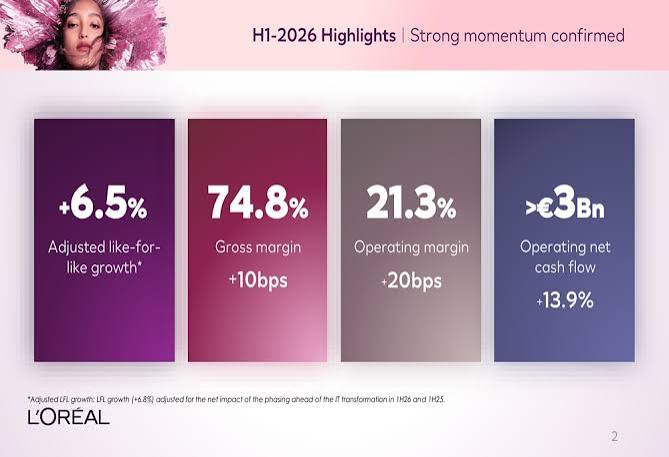
The headline numbers in the first-half 2026 results L'Oréal released on July 29 are hard to fault: revenue of EUR 23.77 billion (+5.8% reported, +6.8% like-for-like), an adjusted like-for-like growth rate of 6.5%, and an operating margin of 21.3% — an all-time high. Management called it "broad-based growth across every category, every division, every region." But inside that "broad-based growth," one division quietly fell behind everyone else — L'Oréal Luxe, home to the luxury fragrance, skincare, and makeup brands (Yves Saint Laurent, Armani, Prada Beauty, Valentino, Lancôme, and others) and the division that generates most of the company's duty-free and travel-retail revenue. While the company was celebrating record-high margins overall, the division that stocks the most duty-free shelf space posted both the slowest growth and a shrinking margin.
L'Oréal's officially reported first-half 2026 highlights — on paper, a flawless set of results
What Happened — Growth Diverged Sharply Across Divisions
L'Oréal reported the following adjusted like-for-like growth rates for its four divisions in the first half of 2026:
Division
Adjusted Like-for-Like Growth
Note
Professional Products
+11.6%
Fastest-growing of the four divisions
Dermatological Beauty
+10.6%
Dermocosmetics strength continues
L'Oréal Luxe
+5.1%
Slowest-growing of the four divisions
Consumer Products
+4.3%
Mass-market weakness
Luxe is L'Oréal's single largest division by revenue, generating EUR 8.0 billion — 34% of group sales. Yet its growth rate came in at less than half that of Professional Products and Dermatological Beauty, both of which posted double digits. Profitability is even more striking. Luxe's operating margin was 22.1%, actually down 0.2 points from 22.3% a year earlier. While the group's overall operating margin hit a record high, the margin at the group's biggest division went backward. In other words, this half's record profitability improvement was driven not by Luxe but by the other three divisions — particularly Professional Products and Dermatological Beauty.
Key Insight — The Culprit Is Travel Retail, and Specifically Hainan
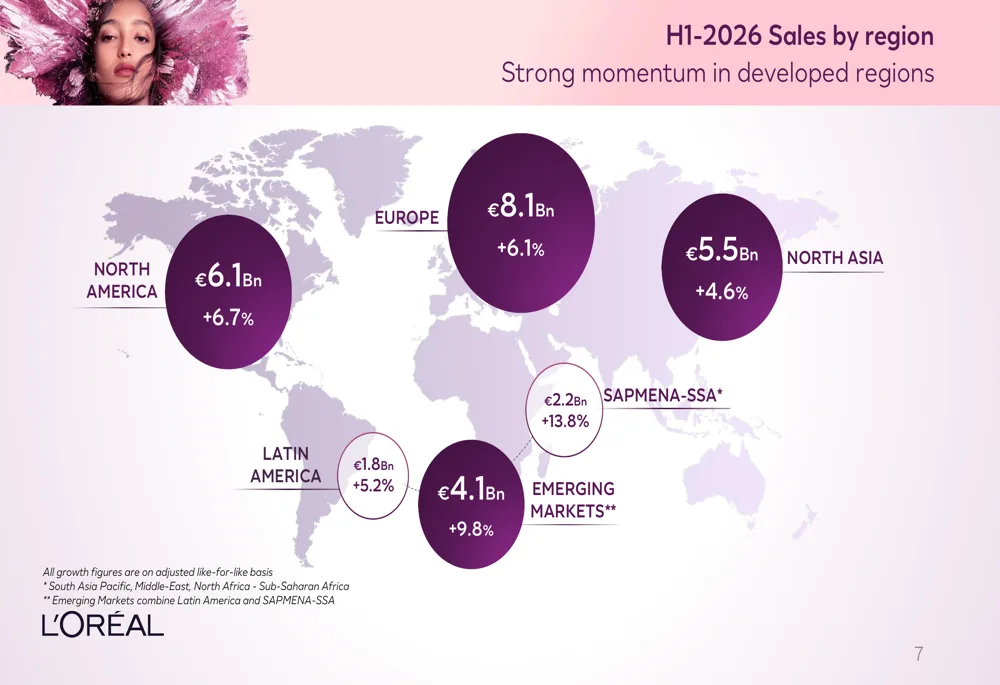
The reason for Luxe's underperformance shows up in the regional breakdown. L'Oréal's North Asia business posted adjusted like-for-like growth of +4.6% for the half. But the same set of results contains a more telling number: excluding travel retail, North Asia growth jumps to +6.1%. Travel retail alone shaved 1.5 points off the entire region's growth rate. Given that L'Oréal Luxe is the division most exposed to duty-free and travel-retail channels, Luxe's weakness and North Asia travel retail's weakness are, in effect, the same story.
The regional revenue map shows North Asia (+4.6%) alone lagging the other developed regions (Europe +6.1%, North America +6.7%) — a large share of that gap traces back to travel retail
The epicenter of the problem is Hainan. China's Hainan offshore duty-free market shrank by -30% in the first half alone. L'Oréal says it kept gaining share even in this contracting market and outperformed the market average — but "outperforming" a market that's down 30% still means falling revenue. What sharpens the picture is that Hainan visitor numbers actually rose. People are showing up, just not buying — this is a conversion problem, not a traffic problem. It's the same symptom Korea's own duty-free market has been dealing with lately: the number of foreign shoppers keeps hitting record highs, yet spending per visitor keeps falling. The fact that this pattern is repeating in Korea too suggests Hainan's slump isn't an isolated market issue, but closer to a structural symptom shared across Asian duty-free retail as a whole.
Layered on top of this was a change of operators at mainland Chinese airport duty-free stores. Operator handovers in Beijing (Sunrise to CDFG/Wangfujing) and Shanghai (Sunrise to CDFG/Avolta) at the end of 2025 created store-transition and re-entry disruption that weighed on first-half results. On the earnings call, CEO Nicolas Hieronimus summarized the travel-retail trend as "very negative in Q1, slightly negative in Q2," and said he expects the channel to "turn positive from Q3 onward." Put together, L'Oréal Luxe's slump isn't a case of demand disappearing — it's the product of two overlapping causes: (1) the structural contraction of the Hainan market, and (2) temporary channel disruption from the airport duty-free operator handovers. The company itself is framing this as a problem "in the process of recovering."
At the same time, there are signs Luxe hasn't weakened across the board. Fragrance remained "the division's best-performing category" this half, with new launches like Prada Paradigme and Yves Saint Laurent Libre driving double-digit growth. Looking at mainland China alone, Luxe outperformed the market average by 6 points, and Yves Saint Laurent posted double-digit growth in China. In other words, underlying consumer demand for Luxe brands themselves is intact — the problem is concentrated in the distribution channel, travel retail. The CEO added that "the mass market is weak, but we're seeing a return to premium in China," noting that Luxe and Dermatological Beauty are growing roughly 7% in China.
Business Impact — Betting on a Second-Half Rebound, With a Gucci Card in Hand
L'Oréal said it expects Asian travel retail to "return to normal" in the second half, particularly in the fourth quarter. It cites two reasons: disruption from the airport operator handovers is stabilizing over time, and a lower comparison base from June onward should provide a favorable base-effect tailwind. This, though, is still an expectation, not a confirmed rebound. If Hainan's offshore duty-free market is structurally contracting, then even once channel disruption clears, the market itself may not come back — no matter how much share L'Oréal gains, revenue will stay flat if the pie itself keeps shrinking.
Against this backdrop, one card stands out. L'Oréal has signed a licensing deal to exclusively operate Gucci Beauty for 50 years starting July 1, 2027. Gucci is among the strongest brands in duty-free and travel retail within the Kering portfolio. The deal isn't reflected in Luxe's results right now, but it can be read as L'Oréal securing a new growth lever for its Luxe portfolio ahead of time, timed for whenever the travel-retail channel normalizes. If the recovery of Hainan and China's airport channels lines up with Gucci Beauty's formal integration in July 2027, L'Oréal Luxe will effectively be holding two catalysts at once to make up for today's weakness. That said, since it isn't yet clear whether Hainan's contraction is a matter of channel disruption or a structural demand shift, whether L'Oréal Luxe actually rebounds shouldn't be judged from this quarter's results — it needs to be confirmed over the next one or two quarters, especially the fourth-quarter results the company itself has flagged.
✦RIT's Insights
The most interesting thing about this earnings release is that L'Oréal chose to disclose, on its own, the fact that "North Asia growth would be 6.1% excluding travel retail." Companies usually pull out numbers like that to brag when results are strong — here, it's closer to the opposite: a number produced to explain that "our core business is doing fine, travel retail is the drag." Put differently, L'Oréal itself is now treating the travel-retail channel as a headache that needs to be separated from group results when reading the numbers. Anyone managing a beauty group's portfolio can take a lesson from this case: don't take comfort in company-wide headline metrics (record revenue, record margin) alone — in a multi-division structure like L'Oréal's, one division's losses can be masked by another's outsized growth. The same applies on the investment and equity-research side — rather than stopping at company-wide figures like "+6.5% adjusted like-for-like growth, record margin," it's worth digging into why the group's largest division grew the slowest. Whether that gap traces to temporary channel disruption or structural demand erosion will determine how much trust to place in second-half guidance.
What RIT finds more worth watching is the character of the Hainan slump. Visitors are up but conversion isn't happening — that could be a sign not just of a soft economy, but of a real shift in how consumers are making purchase decisions. It's a carbon copy of what Korea's duty-free sector is going through. If tourists showing up without opening their wallets is happening simultaneously in Hainan and Seoul, this isn't a single country's policy or currency issue — it could be a much bigger story about duty-free shopping itself structurally losing power as a form of consumption across Asia. Anyone overseeing travel-retail or duty-free channels should use this as an opportunity to set aside the familiar equation "more visitors = more revenue." Channel strategy needs to be rebuilt on the assumption that revenue can stagnate or decline even as traffic metrics improve, unless conversion and spend-per-visitor improve alongside it.
What catches RIT's attention here is the operator handover in Beijing and Shanghai. This case reconfirms that a change of airport duty-free operators is an event that hits brand-side results directly too. Both brands and duty-free operators need to factor in, from the contract-negotiation stage itself, that an operator change can mean absorbing several quarters of revenue loss during store transition and re-entry. And the Gucci Beauty card is exquisitely timed. Right as L'Oréal Luxe is struggling in travel retail, the company has locked in a new brand it won't even integrate for another three years. If the travel-retail recovery lines up with Gucci's integration timeline, L'Oréal could get a doubled rebound effect. Anyone working in licensing or M&A should keep this case in mind — a long-term license secured ahead of time during a rough market patch becomes an asset that can convert directly into results once the channel recovers. Portfolio timing for the next cycle, not just current-period performance, should be a consideration from the business-development stage onward. But that only works if Hainan and China's airport channel truly "recover" rather than simply "stabilize at a lower level." Next quarter's results should tell us which of those two it is.