Duty-Free Prices Alone Aren't Enough — Why Changi Airport Is Doubling Down on Exclusivity
2026-07-16 4:51 PMAsia Pacific
Overview
Changi Airport handled a record 70.4 million passengers in FY2026, yet spending from Chinese travelers — its largest source market — still hasn't recovered to pre-pandemic levels. Rather than compete on price, Changi Airport Group is meeting the slowdown head-on with exclusivity: "you can only get this here." From the Changi 1st curation program and experiential campaigns like the BLACKPINK tie-in to country-by-country targeted marketing, this piece traces Changi's next move through a Moodie Davitt Report interview.
"Just being duty-free is no longer a guarantee of spend." That's how Hung Jean, Managing Director of Airside Concessions at Changi Airport Group (CAG), put it in an interview with the Moodie Davitt Report. Changi handled 70.4 million passengers in FY2026, up 2.9% year-on-year and a new all-time high. Yet behind that comment sits an uncomfortable number: spending by travelers from China — Changi's largest source market — still hasn't returned to pre-pandemic levels. Passenger numbers are climbing while per-head spending lags behind where it used to be. Changi's answer wasn't discounting. It was expanding the list of things you simply can't buy anywhere else.
What Changed — The Category Itself Has Lost Its Pulling Power
The old formula for airport duty-free was simple: a price stripped of tax was, by itself, the reason to buy. That logic has weakened as direct overseas online shopping, adjustments to national duty-free allowances, and shrinking information gaps among travelers have all chipped away at the appeal of "cheap because it's duty-free." Hung Jean's comment names this shift precisely. With Chinese traveler spending held down by macroeconomic and geopolitical headwinds, Changi Airport Group can't lean on price competitiveness — it has to lean on diversifying source markets and making the merchandise itself irreplaceable. The fact that its top five nationalities (China, Malaysia, Indonesia, Australia, India) spend so differently from one another reinforces the strategy: a single uniform promotion can't move a multinational passenger base all at once.
The Core Insight — A Curation Engine Built Around "Only Here"
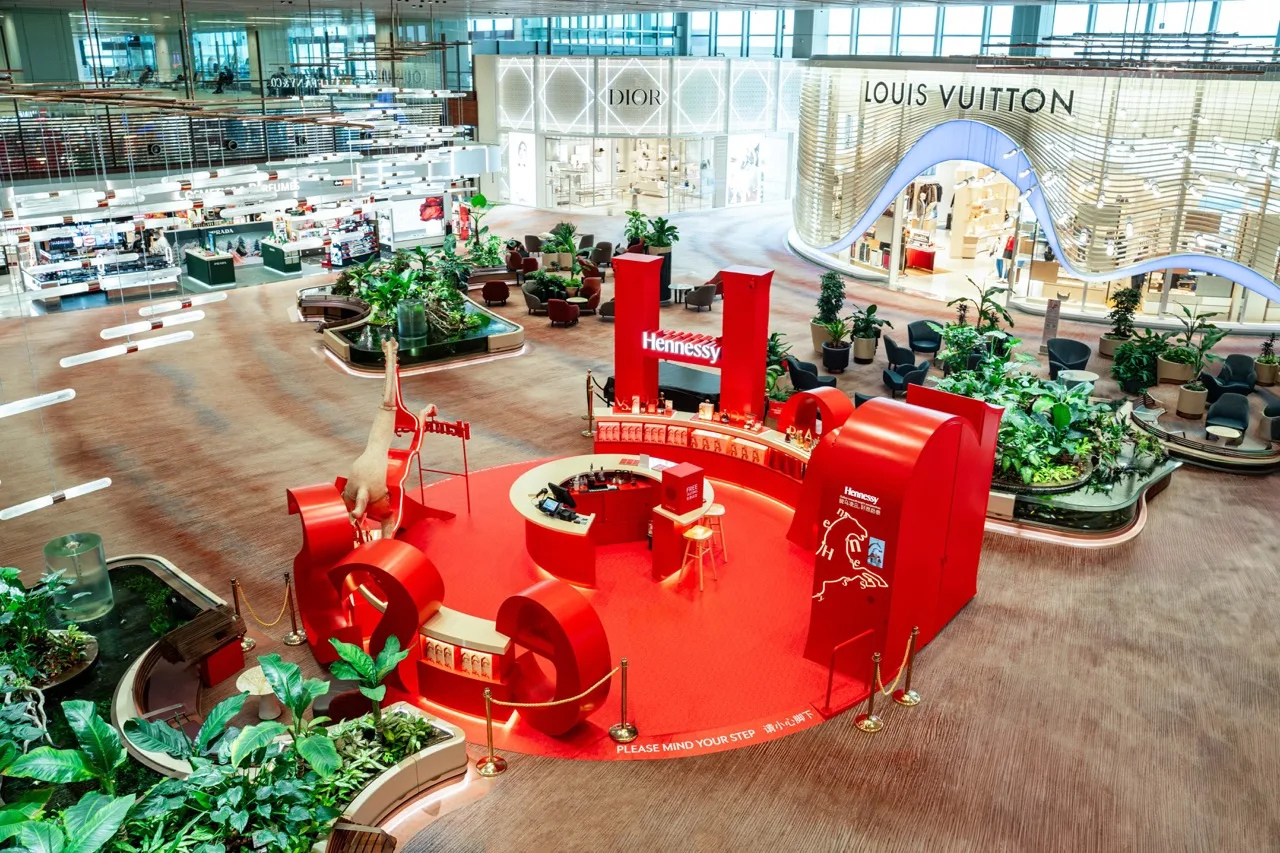
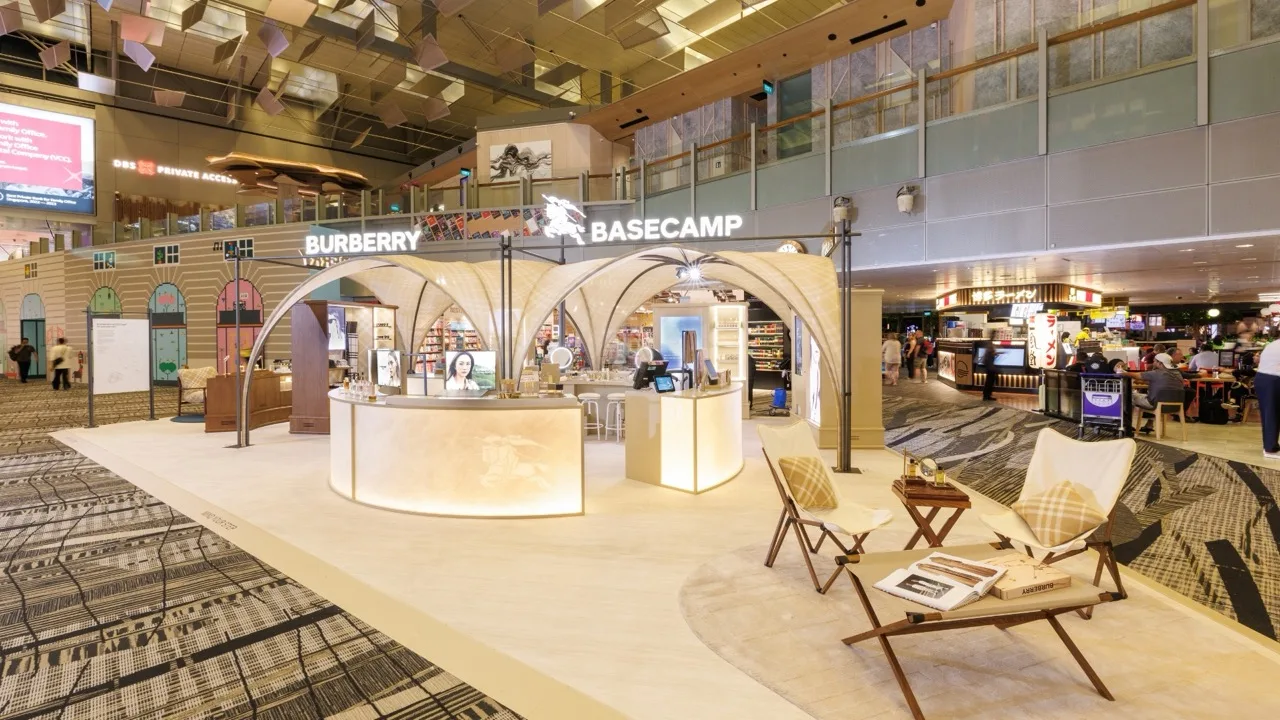
In its last fiscal year (ended March 2026), Changi Airport Group ran 16 "Changi 1st"/"Changi Exclusive" activations. The list includes Hennessy's "Year of the Horse" edition, a Glenfiddich collaboration with Aston Martin F1, Glenlivet's "Cask Masters Collection," and Burberry's "Basecamp" campaign. Toblerone leaned into scarcity as a marketing tool in its own right, producing just 4,000 units of a strawberry matcha limited edition and selling only 66 a day.
Hennessy's 'Year of the Horse' edition — a Changi-exclusive campaign under the 'Changi 1st' programBurberry's 'Basecamp' campaign — Changi's exclusive curation extending beyond spirits into fashion and luxury
Lease turnover tells a similar story. Of the 120 leases signed last fiscal year, 24 were new tenants, and many of those carried a "first" title of some kind. FIX Chocolate opened its first Asia-Pacific store at Changi, World of Tiger Beer opened its first store anywhere in the world there, and Lindt opened its first Asia-Pacific boutique there too. These numbers aren't really about landing new brands — they reflect a deliberate editorial strategy to raise the density of "things you can only see at Changi." Fast-rotating pop-ups and limited editions give even repeat visitors a fresh reason to stop in every time.
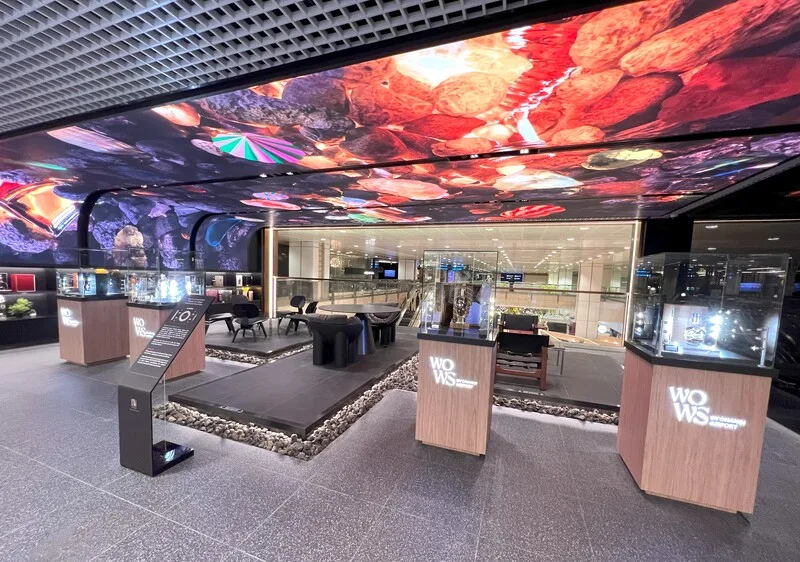
This strategy is most visible at the very top of the spirits category. "World of Wines & Spirits (WOWS) 2025," themed "Wonders Reimagined," showcased 63 ultra-premium bottles across 29 brands — Johnnie Walker's Bolt Couture edition, Martell's Zodiac edition "L'Assemblage du Cheval," and other eye-wateringly priced lines. Rather than mass discounting, Changi pushed the top of the category upward, selling bottles that are hard to find anywhere else in the world.
Changi Airport's 'World of Wines & Spirits (WOWS)' — a flagship example of selling scarcity through an ultra-premium lineup spanning 29 brands
It's Not Just About Merchandise — Experiential Campaigns Built to Drive Traffic
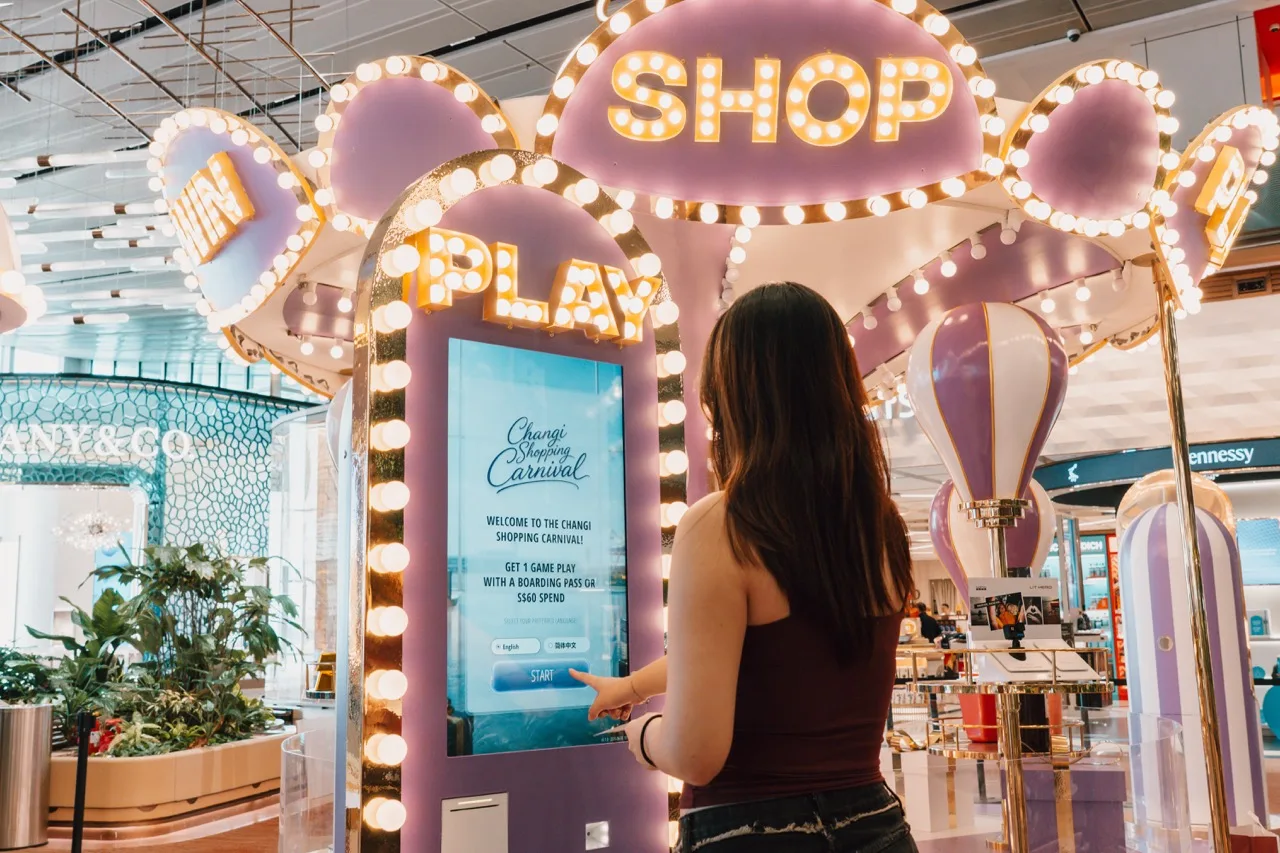
If curation is about selling the scarcity of the merchandise itself, Changi Airport Group is simultaneously running experiential, participation-driven campaigns to pull in traffic. The "Changi Shopping Carnival" is a gamified campaign where scanning a boarding pass unlocks discount vouchers, tenant-specific prizes, and entries into draws for Changi-exclusive merchandise.
'Changi Shopping Carnival' — a gamified campaign offering discounts, prizes, and sweepstakes entries via boarding-pass scans
When BLACKPINK played a concert in Singapore, Changi combined early-access ticket sales for members of its loyalty program, Changi Rewards, with a "spend-to-win" mechanism where higher spending unlocked more sweepstakes entries. Where curation creates a "you can only buy this here" reason inside the store, this kind of campaign creates a "you can only experience this here" reason outside it — driving both loyalty sign-ups and spend at the same time. The fact that K-pop plays such a central role in experiential campaigns at a global hub airport like Changi is another reminder that Korean content and brands remain a powerful lever for moving travel spending.
Changi Airport's campaign tied to BLACKPINK's Singapore concert — Changi Rewards members received early ticket access and spend-linked sweepstakes entries
Country-by-Country Marketing and E-Commerce Behind the Numbers
If curation is the in-store play, country-specific marketing is the mechanism pulling in demand from outside the terminal. Changi has partnered with MakeMyTrip, India's largest online travel agency, and is scaling a similar strategy in Indonesia. Consumer data shows Indonesian travelers lean strongly toward beauty and fashion, while Chinese travelers respond strongly to both beauty and F&B — particularly Changi's signature bak kut teh and deli items — and that data is being built directly into the marketing.
The approach is already showing up in results. Revenue on Changi's e-commerce platform, iShopChangi, grew 20% year-on-year; within that, the spirits category alone grew 7%. A structure that allows pre-orders from 30 days before arrival down to 12 hours before landing has become a channel that routes around the time and space constraints of physical stores. For categories like K-beauty and K-food, where shelf space is inherently limited, growth in this kind of pre-order channel represents a genuinely new form of exposure.
Where This Touches Korea's Duty-Free Industry — Lotte and Shilla's Position
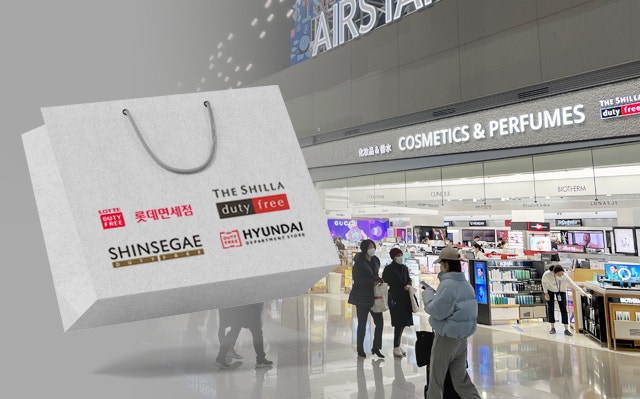
Korea's duty-free operators have a visible presence in this curation strategy. Lotte Duty Free extended its spirits and tobacco concession for three years, from June 2026 to June 2029, and renovated its T2/T3 flagship stores with robot bartenders and large-format LED screens. That's not a simple renewal — it's an upgrade of the store itself to fit the "experiential retail" grammar Changi is chasing. Shilla Duty Free runs experiential pop-up spaces in the perfume category, presenting Changi-exclusive localized fragrances and gift packaging. Both companies are adjusting their products and stores to match Changi's demand for "something you can only experience here."
T3 Is the Lab — A Bridge to T5
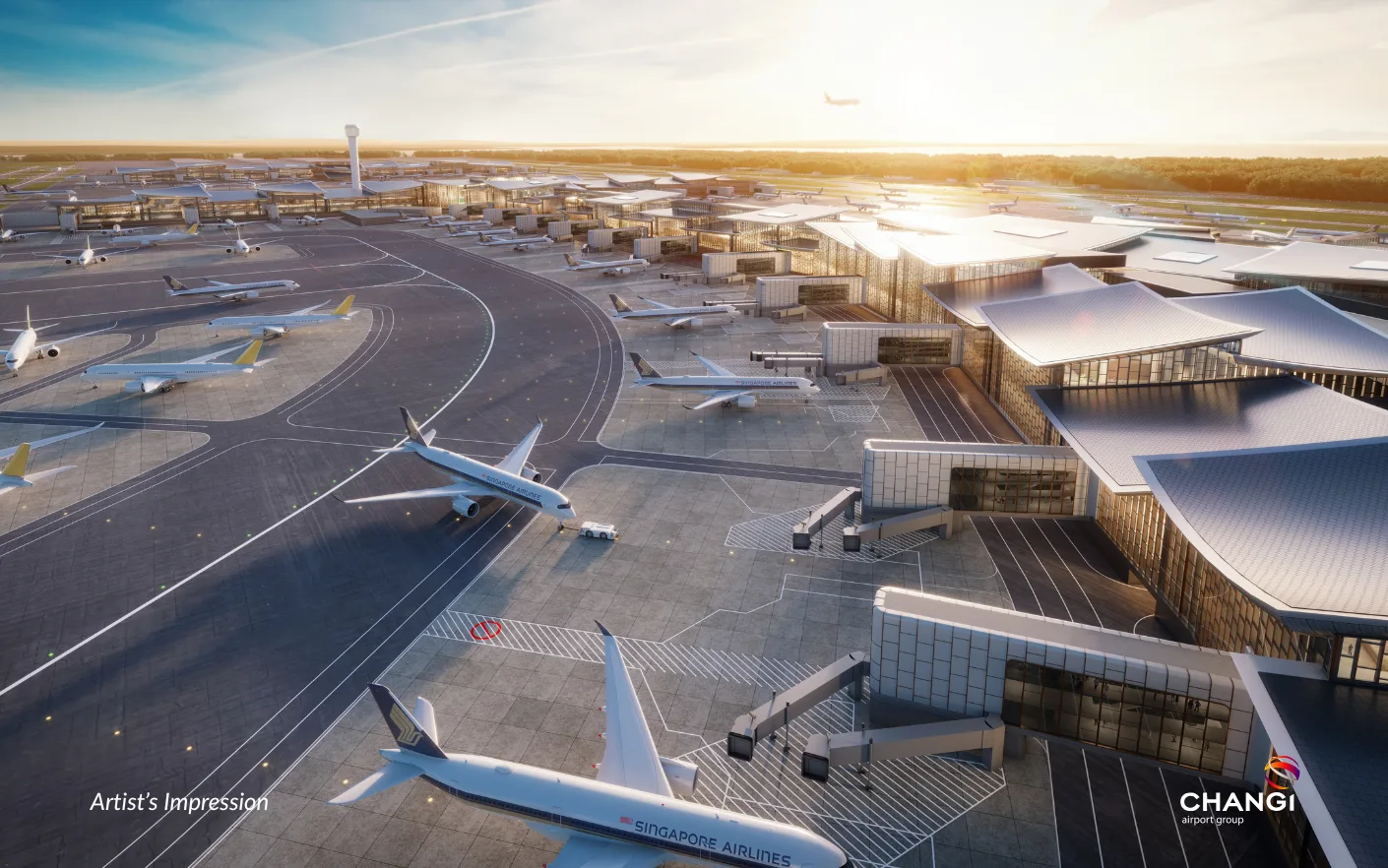
The most notable line from Hung Jean's interview concerns the Terminal 3 (T3) upgrade plan. Her comment that Changi "will pilot some of the concepts planned for T5 in the T3 retail area" means T3 isn't just getting a renovation — it's serving as the testing ground for T5, due to open in the mid-2030s. Large-format stores for luxury brands, double-height facades, and technology such as robotic delivery and shopping-concierge robots will all be validated in T3 first before scaling up to T5. Testing concepts live and filtering out what fails before rolling them into a major project is a risk-management model that other airports preparing large new terminals would do well to study.
This experiment carries clear practical implications too. What Changi wants isn't a concession store but a "Changi-exclusive experience," so for duty-free operators like Lotte and Shilla, negotiating leverage at every contract renewal increasingly hinges on whether the brand can propose merchandise and staging that exist nowhere else in the world — not just a store refresh. For K-beauty and K-food brands, this is actually an opportunity: Changi's pop-up turnover (24 new tenants out of 120 leases) signals a genuinely wide-open door for new brands, and if a brand has a limited-edition or exclusive product that could carry an "Asia-Pacific first" title, now is the time to pitch it. On the e-commerce side, iShopChangi's pre-order growth is worth watching closely — it's a sign that channels offering product exposure without shelf-space constraints are expanding, and Korean duty-free operators' own online pre-order channels have room to use the same structure to supplement categories like spirits and beauty, where offline shelf competition is fierce. For domestic airport operators, using T3 as a testbed for T5 is itself a model worth referencing — the process of validating new technology and store formats at small scale first is worth benchmarking for projects like Incheon Airport's T2 expansion, which is also preparing a large new terminal.
Changi's response is notable for choosing to redefine the category rather than cut prices in the face of softening spend. Where "you buy it because it's duty-free" has lost its force, Changi has filled the gap with "you buy it because you can only get it here." Whether the strategy works will ultimately show up in future earnings, but the approach itself is clear: the competition has shifted from discounting to curation.
✦RIT's Insights
The real thing to watch in Hung Jean's comment is the diagnosis itself — that duty-free status alone no longer sells. This isn't a problem unique to Changi; it's a structural shift the entire global duty-free industry is facing together. Korean duty-free operators recently engineering a turnaround through VIP services, and Changi competing on curation and exclusivity, are different answers to the same problem. Both point in the same direction: generating spend with a weapon other than price.
But in RIT's view, Changi's approach is more fundamental for a different reason: this isn't a service for a handful of VIPs, it's a merchandising philosophy applied to the entire shop floor. If Korea's VIP-treatment competition is a tactic aimed at capturing a single layer of top-tier customers, Changi's curation is a far more fundamental undertaking — redefining the category itself for every single passenger who walks through the store. From a practitioner's standpoint, this difference is what will determine the sustainability of the two strategies over the next several years. RIT expects elements Lotte and Shilla are testing at Changi — robot bartenders, perfume pop-ups — to eventually get re-imported into Incheon Airport stores. Changi shouldn't be treated as just an overseas case study; it's worth tracking now as a reference point for Korea's next store renovation.