Lotte Won on Revenue, Shilla Won on Profit — What Incheon Airport's Business Realignment Did to Profitability
2026-08-15 8:55 AMKorea
Overview
Line up the Q1 and Q2 2026 results of Korea's Big Four duty-free operators (Lotte, Shilla, Shinsegae, Hyundai) side by side, and a strange picture emerges. Lotte led Q2 revenue, but Shilla led operating profit — and Shilla and Shinsegae, which gave back their Incheon Airport zones, posted higher operating margins than Lotte and Hyundai, which won new ones. The same event, April's Incheon Airport DF1/DF2 reassignment, produced opposite results at every company.
All four of Korea's major duty-free operators have now reported Q2 2026 results. On the headlines alone, all four look strong — Lotte grew revenue 35% and extended its profitable streak to six straight quarters, Shilla's operating profit swung to a gain, Shinsegae's profit turned around from a loss the prior year to KRW 33.3 billion, and Hyundai kept its own streak alive at four straight profitable quarters. But line up all four companies' revenue, operating profit, and operating margin side by side, and an entirely different picture emerges. Q2's revenue leader is Lotte (KRW 904.3 billion), but its operating-profit leader is Shilla (KRW 36.4 billion) — a company with only the third-highest revenue. Rank the four by operating margin, and the order changes again: Shinsegae (6.1%) > Shilla (4.7%) > Lotte (3.5%) > Hyundai (2.0%). The operator whose revenue grew the most improved its margin the least; the operator whose revenue fell the most improved its margin the most. Behind this paradox is a single event from this past April: the reassignment of Incheon Airport's duty-free zones.
What Happened — Lotte and Hyundai Filled the Space Shilla and Shinsegae Left at Incheon Airport's DF1 and DF2
Back in January, Incheon International Airport ran a tender for its departure-hall duty-free zones DF1 (perfume and cosmetics) and DF2 (liquor, tobacco, and more). Both zones already had incumbent operators — Shilla ran DF1, Shinsegae ran DF2. Both companies, weighed down by high rent and falling revenue, saw profitability deteriorate and chose to hand back their zones before their contracts expired, sitting out this latest tender entirely. Lotte Duty Free won the DF1 zone Shilla gave up, returning to Incheon Airport roughly three years after exiting Terminal 2 in 2023. Hyundai Duty Free won the DF2 zone Shinsegae gave up, becoming a "full-category" operator by adding cosmetics and liquor to its existing lineup of luxury goods, fashion, and accessories. Shilla's existing operating term expired on March 17; Lotte's DF1 opened April 17, and Hyundai's DF2 opened later in April. In other words, Q2 2026 (April to June) is the first quarter in which this reassignment actually shows up in revenue.
Company
Metric
Q1 '25
Q2 '25
Q3 '25
Q4 '25
Q1 '26
Q2 '26
QoQ
YoY
Lotte Duty Free
Revenue
6,369
6,685
7,241
7,866
7,922
9,043
+14.2%
+35.3%
Lotte Duty Free
Operating Profit
+153
+65
+183
+115
+323
319
△4
+254
Lotte Duty Free
Operating Margin
2.4%
1.0%
2.5%
1.5%
4.1%
3.5%
△0.6%p
+2.5%p
Shilla Duty Free
Revenue
8,271
8,502
8,496
8,549
8,846
7,726
△12.7%
△9.1%
Shilla Duty Free
Operating Profit
△50
△113
△104
△206
+122
364
+242
+477
Shilla Duty Free
Operating Margin
△0.6%
△1.3%
△1.2%
△2.4%
1.4%
4.7%
+3.3%p
+6.0%p
Shinsegae Duty Free
Revenue
5,618
6,051
5,388
5,993
5,898
5,426
△8.0%
△10.3%
Shinsegae Duty Free
Operating Profit
△23
△15
△56
+20
+106
333
+227
+348
Shinsegae Duty Free
Operating Margin
△0.4%
△0.2%
△1.0%
0.3%
1.8%
6.1%
+4.3%p
+6.3%p
Hyundai Duty Free
Revenue
2,935
2,935
2,225
2,045
2,137
3,104
+45.3%
+5.8%
Hyundai Duty Free
Operating Profit
△19
△13
+13
+21
+34
62
+28
+75
Hyundai Duty Free
Operating Margin
△0.6%
△0.4%
0.6%
1.0%
1.6%
2.0%
+0.4%p
+2.4%p
Figures in KRW 100 million (억원) unless noted otherwise. For revenue and operating margin, QoQ/YoY columns show percentage change (%) or point change (%p); for operating profit, QoQ/YoY columns show the change in KRW 100 million. △ denotes a negative figure (loss or decline).
Key Insight — Margins Thinned at the Operators That Won New Zones, and Thickened at the Ones That Gave Them Up
Reorganize the table around revenue change and operating-margin change, and the pattern comes into sharp focus. The two operators that expanded their footprint at Incheon Airport (Lotte +35%, Hyundai +5.8%) saw their margins move by only 0.5 points down and 0.4 points up, respectively. The two that reduced their Incheon Airport exposure (Shilla -9.1%, Shinsegae -10.3%) saw margins jump 3.3 points and 4.3 points. Margin improved more at the operators whose revenue fell, not the ones whose revenue rose.
The paradox makes sense once you understand airport duty-free rent structures. Shilla and Shinsegae both cited the same reason for giving up their zones in the first place: "deteriorating profitability from high rent combined with falling revenue." Airport duty-free contracts are typically structured around minimum guaranteed (fixed) rent, so if passenger demand doesn't recover as expected, that fixed cost eats into profit regardless of revenue. Shilla's Q2 results show this mechanism directly — downtown store revenue rose 2.0%, while "airport and other" revenue fell 17.4%. In other words, Shilla's revenue decline reflects the exit of a high-rent airport channel and a growing share from its relatively higher-margin downtown channel, and that combination is exactly what produced the more-than-threefold jump in operating margin, from 1.4% to 4.7%. Shinsegae's structure tells the same story — giving up DF2 removed a channel with heavy fixed rent, and combined with an expanded luxury lineup in its remaining Incheon Airport space and rising foreign-customer revenue at its Myeongdong downtown store, operating margin jumped from 1.8% to 6.1%.
Lotte and Hyundai, by contrast, took on the opposite burden. A new zone concentrates rent, interior fit-out, and staffing costs in its early stage, so even as revenue grows, that revenue doesn't immediately convert into higher margin. Lotte's revenue growth actually accelerated, from +24% in Q1 to +35% in Q2, and yet its operating margin fell from 4.1% to 3.5%. Hyundai's margin improvement (+0.4 points quarter over quarter in Q2) was similarly modest relative to its revenue growth (+5.8%). In this round of Incheon Airport reassignment, at least in the first quarter, "winning a zone" and "making more money" turned out not to be the same thing.
Hyundai's Q1 is worth a closer look too. Before DF2 was reflected, Hyundai's own Q1 revenue fell 27.2% year over year — the exact same pattern Shilla and Shinsegae showed in Q2. That means Hyundai, too, had already been trimming low-margin volume before DF2 entered the picture, and it was DF2's arrival in Q2 that turned the company back toward expansion. In other words, all four operators passed through a phase of "shrinking to build profit" at some point — Incheon Airport's reassignment is the event that turned only Lotte and Hyundai back toward external growth.
Business Impact — There Are Two League Tables, Not One
What this quarter's results show is that which metric you use to rank the industry produces two completely different pictures. Rank by revenue (Lotte > Shilla > Shinsegae > Hyundai) and rank by operating margin (Shinsegae > Shilla > Lotte > Hyundai), and outside of Hyundai staying at No. 4, the two rankings flip entirely. In absolute operating-profit terms, Shilla — third in revenue — even overtook Lotte, the revenue leader (KRW 36.4 billion versus KRW 31.9 billion). "Won a new zone at Incheon Airport" is genuinely a signal that an operator's footprint is growing, but this quarter shows it isn't a signal that profitability improves right away. Conversely, "gave up an operating license" isn't simply a retreat either — Shilla and Shinsegae proved it can also be a choice to shed a low-margin channel and become leaner.
✦RIT's Insights
The most striking thing in this four-way comparison is that Shilla's absolute operating profit overtook Lotte's. Shilla's revenue is about 85% of Lotte's, yet it earned KRW 4.5 billion more in profit — an exception to an economies-of-scale logic that has functioned almost like an axiom in this industry. In practice, a reversal like this is hard to see from the revenue growth rate alone: without breaking out revenue and margin by channel (airport versus downtown), it's easy for the market to misread a company like Shilla or Shinsegae this quarter — whose revenue fell even as profit surged — as simple "negative growth."
Conversely, it's easy to default to optimism on news that Lotte or Hyundai won a new zone, but a new zone concentrates early rent, fit-out, and staffing costs, so revenue growth doesn't translate into margin right away. That means the key metric for judging whether this bet pays off isn't the revenue growth rate, but whether Lotte and Hyundai's Q3-Q4 operating margins climb back to Q1 levels. Without tracking the speed of reaching breakeven separately, it's easy to see a headline like "won a new zone" and mistakenly assume the company is already earning more.
What concerns RIT about this data is the tendency to dismiss Shilla and Shinsegae's profit improvement as simply the payoff of shrinking their footprint. This isn't a case of the numbers happening to improve because the business got smaller — it's the result of deliberately choosing to shed low-margin channels carrying heavy fixed costs. That makes it a case study in selective shrinkage worth studying even for companies that are currently expanding. The fact that Shilla's downtown revenue growth (+2.0%) didn't come close to offsetting its airport-channel decline (-17.4%), and yet total profit still surged, shows on its own that the margin gap between channels dwarfs the difference in revenue volume. A single headline like "won a new Incheon Airport zone" or "gave up its license" shouldn't be read as the company's whole direction — tracking revenue, operating profit, and operating margin together is what keeps the real underlying strength from being missed.
There is, however, one more variable worth factoring into this Lotte-versus-Shilla comparison. Both companies report their domestic and overseas operations bundled together under a single "duty-free division" or "TR division" line, and neither discloses profit and loss split by domestic versus overseas. Yet both have a meaningful overseas airport footprint — Lotte runs around ten overseas stores, including Japan's Kansai, Vietnam's Da Nang, Nha Trang, and Hanoi, Australia's Darwin, Brisbane, and Melbourne, New Zealand's Wellington, Singapore's Changi, and Guam, while Shilla also operates several overseas hubs including Singapore's Changi Airport and Hong Kong.
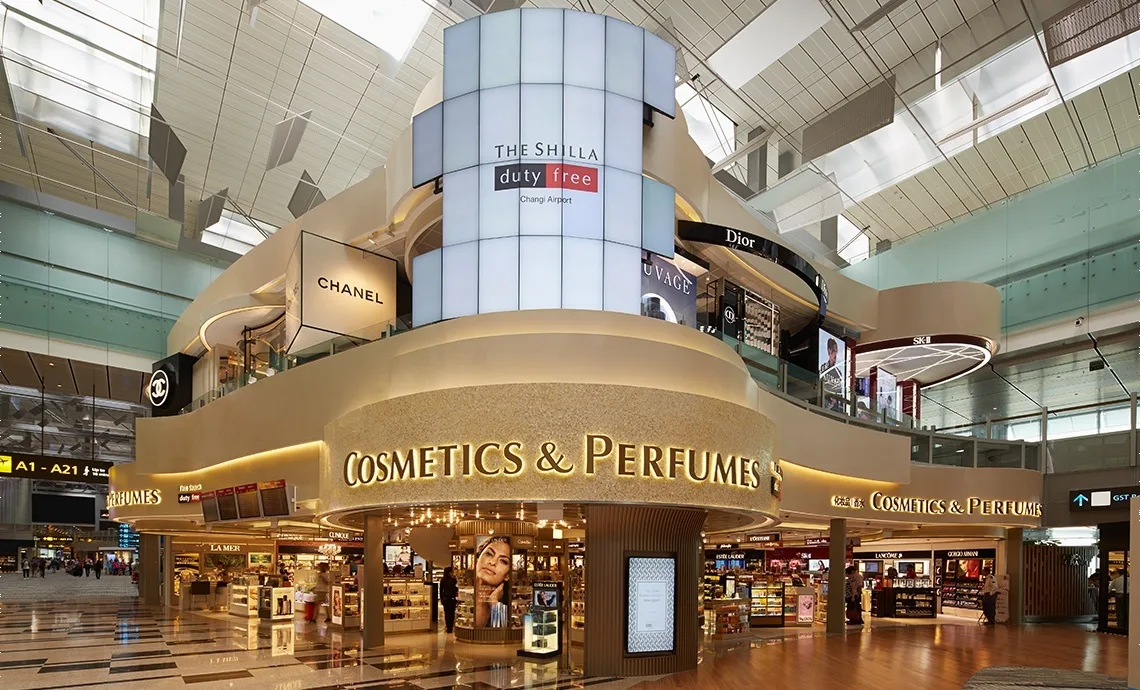
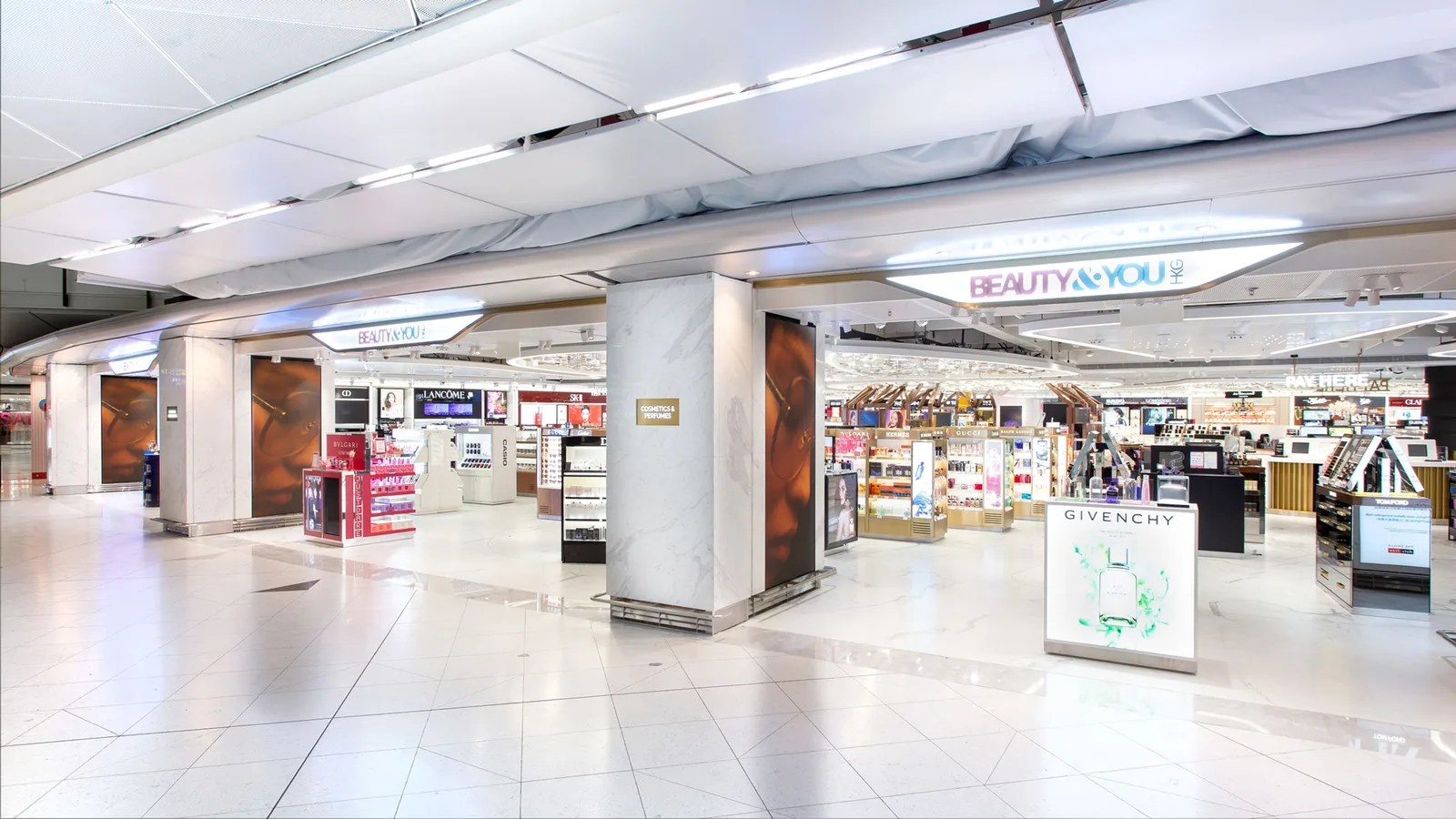
Shilla Duty Free — Singapore Changi AirportShilla Duty Free — Hong Kong Airport
This matters because Lotte's overseas business has, in recent years, actually posted heavier losses than its domestic business. In 2024, the domestic operating loss was KRW 143.2 billion, while Lotte's four core overseas subsidiaries — Singapore, Australia, Guam, and Japan — posted a combined operating loss of KRW 243.5 billion, larger still, with Changi Airport alone accounting for KRW 151.6 billion of that. Shilla, by contrast, saw its Macau International Airport store's contract expire in November 2025 and chose not to re-bid — trimming a low-margin overseas channel where rent outpaced revenue recovery, and doing so even before Incheon Airport's DF1 (which wound down in April 2026).
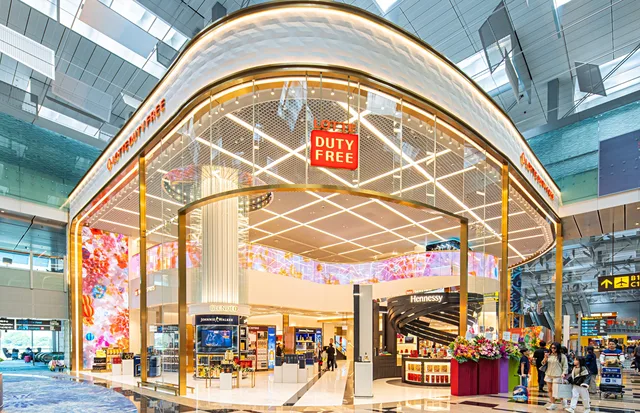
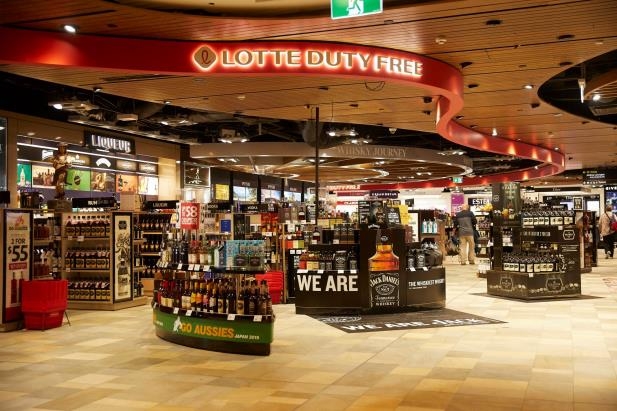
Lotte Duty Free — Singapore Changi Airport. This single location posted a KRW 151.6 billion operating loss in 2024Lotte Duty Free — Melbourne Airport, Australia
What's interesting is that both companies landed different negotiating outcomes overseas than they did at Incheon Airport. Talks with Incheon International Airport Corporation over the rent cuts Shilla and Shinsegae sought broke down, ultimately leading both to give up their zones — but Lotte succeeded in extending its liquor and tobacco license with the Changi Airport Group (CAG) in Singapore by three years, through 2029. Lotte lost ground at home while holding its line abroad.
How much of this overseas dynamic is reflected in the Q2 results can't be known from disclosures alone, but directionally, Lotte still appears to be carrying a relatively rent-heavy overseas airport portfolio, while Shilla's overseas footprint has likely gotten lighter after exiting Macau. If that's the case, part of the Lotte-Shilla gap visible here may be coming not from Incheon Airport's DF1 at all, but from the difference in their overseas portfolios — and viewed on a domestic-only basis, the real strength gap between No. 1 Lotte and No. 2 Shilla could be smaller than this table suggests, or conversely, larger. Until both companies disclose domestic and overseas results separately, this piece has to remain an estimate.
In RIT's judgment, Lotte and Hyundai's next two to three quarters are the key thing to watch. If margins climb back to Q1 levels once the new zones' initial cost burden clears, that will prove this bet paid off; if margins keep hovering in the low 3% range, it will mean growth that added bulk without adding strength. Shilla and Shinsegae shouldn't get too comfortable either — margin built through shrinkage only lasts as long as there are low-margin channels left to shed, and finding the next growth engine once that's exhausted is a new challenge of its own.
It's also worth noting that Shinsegae voluntarily gave back the DF2 zone it held and sat out the re-tender entirely in this reassignment. While Lotte and Hyundai jumped into the scale race, Shinsegae stepped back, and ended up with the highest operating margin of the quarter (6.1%) as a result. This quarter's numbers show, precisely, that stepping back from the market-share race can be the very path that gets you ahead in the margin race.
DART electronic disclosure system (dart.fss.or.kr) — Lotte Shopping, Hotel Shilla, Shinsegae DF, and Hyundai Department Store's 2025–2026 quarterly reports (cited by name where a specific filing URL could not be pinpointed)