[Where Foreign Tourists Flock in K-Beauty, Part 2] Could Dermatology's MSO Model Also Work for Duty-Free?
2026-07-11 7:46 PM
Overview
Dermatology now accounts for more than half of foreign nationals' medical spending in Korea, and Myeongdong's entire commercial district is being reshaped around clinics. Unlike the pharmacies covered in Part 1, dermatology already has a proven capital-participation model in the MSO (management service organization). Yet duty-free — the operator best suited to the MSO's core function — still hasn't played this card.
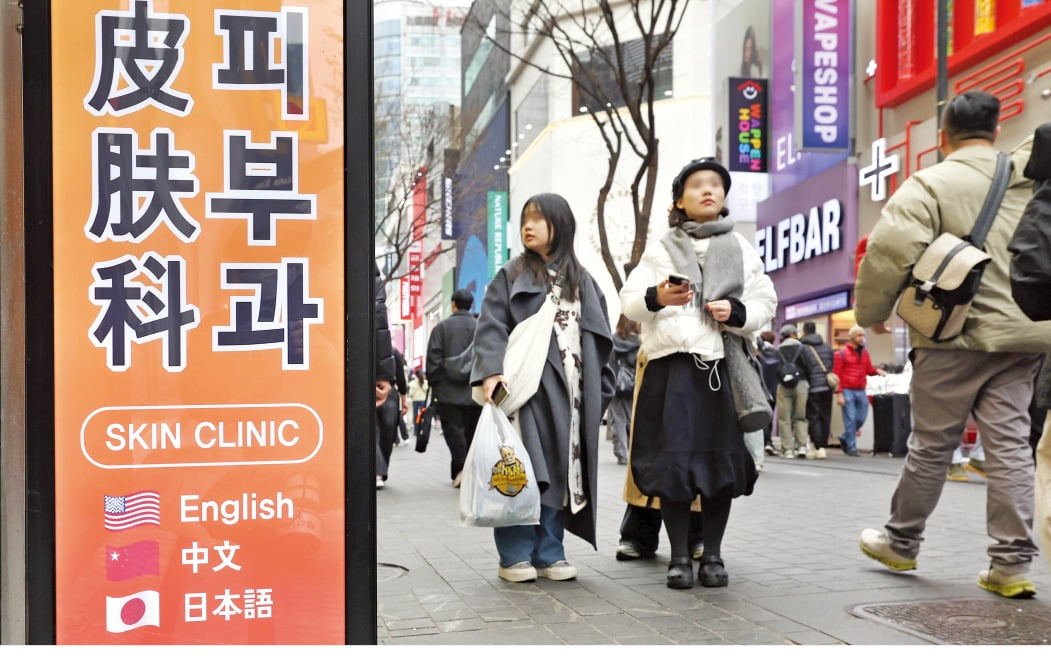
Along the main boulevard of Myeongdong, where cosmetics road-shops once lined the street, "dermatology" and "plastic surgery" signs now stand in their place. Tourists queue outside clinics with Japanese- and Chinese-language signage, waiting for their turn. The share of medical businesses in the Myeongdong commercial district quadrupled from 5% at the end of 2023 to 20% at the end of 2024, and the number of dermatology and plastic surgery clinics grew to 99. Transaction value in the Myeongdong area rose 45% year-over-year in the first quarter of this year, and 63% of that came from dermatology alone. If the "K-Pharmacy Tour" covered in Part 1 turned pharmacies into tourist attractions, dermatology has gone a step further and taken over the district itself.
A dermatology clinic sign on a Myeongdong street, with English, Chinese, and Japanese signage as standard
What's Happening — This Isn't Medical Tourism Anymore, It's "Dermatology Tourism"
The numbers show this has already moved past medical tourism into what is effectively dermatology tourism. From January to May this year, foreign nationals' medical spending in Korea reached KRW 942.3 billion, up 54.9% from the same period last year (KRW 608.5 billion), and dermatology accounted for 54.51% of all foreign medical spending last year. Of the KRW 251.2 billion spent on medical tourism in May alone, KRW 142.5 billion went to dermatology. The number of foreign patients surged 73.8% last year to reach 1.98 million, marking four consecutive years of growth above 70%. Average spending per procedure was KRW 1,446,515, up 37.2% year-over-year — meaning both price and volume are growing at the same time.
The backdrop is clear. The "Korean skin" image built by K-pop and K-dramas is converting directly into procedure demand. Plastic surgery's share began surging in 2022, followed by dermatology in 2023, and the two categories have held the top two spots ever since. Clinics in the Hongdae district already staff Chinese, Japanese, English, and Thai interpreters full-time and run their booking systems in multiple languages. Large buildings in Myeongdong are now being designed — from the ground up, at the new-construction and renovation stage — to accommodate medical tenants. The district has reached the point where it is reshaping itself to attract clinics.
Key Insight #1 — The Structure Is the Same Again: One Practitioner, One Clinic
The same structure covered in Part 1 for pharmacies — "one pharmacist, one pharmacy" — exists on the medical side too. Article 33, Clause 8 of the Medical Service Act states that "a medical professional may not establish or operate two or more medical institutions under any pretext" — language that reads almost as if the pharmacist law amendment copied it directly. In fact, the relationship runs the other way. This "one practitioner, one clinic" principle was established first, following the 2000s UD Dental scandal (in which multiple dental clinics were run under a single brand, sparking controversy over overtreatment), and the recent amendment to the pharmacist law is, if anything, playing catch-up to this medical-law framework.
The outcome is the same either way. Capital cannot own and operate dermatology clinics as a chain; a single licensed physician must establish and run each individual clinic. The 99 dermatology clinics in Myeongdong and Hongdae are entirely separate businesses, each run by a different doctor.
Key Insight #2 — But This Industry Already Has a Proven Playbook
This is where the story diverges from Part 1. MSO and network regulation on the pharmacy side only tightened in April 2026, with further follow-up regulation announced for July — a line only just now being drawn. The MSO model on the medical side, by contrast, has long been an established vehicle for capital participation. Korea's Supreme Court has judged whether a non-medical entity effectively controls a medical institution using four criteria — who provides the financing, who bears the profit and loss, who exercises operational authority, and who bears responsibility — and within that framework, MSOs that maintain "transactional substance" (concrete services, reasonable fees, independence between contracting parties) have consistently been recognized as legal. Dermatology clinic networks in Gangnam and dental hospital alliances have already spent more than five years consolidating marketing, payroll, facilities management, and joint purchasing through MSOs to cut costs, and the use of this model has grown roughly 180% over the past five years.
That said, there are limits. At the 2025 National Assembly audit, cases were flagged in which foreign capital acquired a medical corporation and effectively ran it as an unlicensed "sajang hospital" (a hospital controlled by a non-physician operator) to extract improper profits, and violations of the one-practitioner-one-clinic rule are still routinely caught and lead to clawbacks of national health insurance reimbursements. And as this piece is being written, another related regulation is moving — starting later this year, general practitioners (as opposed to board-certified specialists) who newly open or relocate a clinic will no longer be allowed to display specialty names like "dermatology" or "plastic surgery" on their signage. In a market where tourists show up carrying a list saved from social media and simply look for a sign that says "dermatology," newly opened clinics will lose the ability to display that trust signal on their storefront at all. The standing of already-established specialist brands gets stronger, and it becomes clearer that any capital looking to enter the market must secure a board-certified physician as the clinic's founder.
Key Insight #3 — Yet the Operator Best Suited to This Hasn't Played the Card
The core function of an MSO ultimately comes down to marketing — sourcing foreign patients, managing repeat visits and referrals through CRM, and curating procedure packages to raise average spend per customer. Foreign-patient recruitment agencies like Mediround already perform this role, connecting patients to clinics through multilingual call centers and booking systems so the clinic itself doesn't need to hire its own overseas marketing staff.
But the operator best positioned to do this well isn't in the market yet: duty-free. Duty-free operators have spent decades accumulating foreign customer data, already run multilingual concierge staff, and have beauty and luxury category marketing as their core business. As covered in Part 1, the duty-free industry is currently pursuing a diversification strategy built around "extending dwell time" amid crises like the closure of the Busan store and the return of the Incheon Airport concession. A dermatology MSO points in exactly the same direction — placing a consultation and aftercare lounge in taxable space extends dwell time, and that dwell time converts into cosmetics and luxury sales. And unlike pharmacies, dermatology has no established nationwide chain like Onnuri or Medipharm — so duty-free has no particular reason to remain a mere landlord handing space to someone else's brand. The incentive to build and run its own MSO is much stronger.
The physical setup isn't difficult either. Just as large Myeongdong buildings are already being designed at the construction and renovation stage to accommodate medical tenants, duty-free operators can place consultation and treatment facilities in taxable leased space rather than in bonded, license-restricted sales areas. The clinic's founder must still be a board-certified physician, and duty-free must stay within the boundaries of an MSO role — providing marketing, CRM, and space services — without becoming the actual party responsible for financing, profit and loss, operational authority, or liability.
Business Impact — What the Untapped Opportunity Is Worth
The reason this opportunity remains open is simple: duty-free operators have always treated "clinical care" as outside their business. But more than half of dermatology revenue comes from non-reimbursed (elective) procedures, and pricing for those procedures is effectively determined by marketing and curation — which is fundamentally the same thing duty-free already does with luxury goods and cosmetics. The party most likely to seize this opportunity first isn't a pharmaceutical company or an existing hospital MSO operator — it's retail capital that already has foreign customer data and multilingual infrastructure in place. In RIT's view, among that retail capital, duty-free is the frontrunner candidate right now.
Business Case Summary
Demand fit — High: The foreign tourists who crowd duty-free stores and the medical tourists seeking dermatology treatment are largely the same customer base
Timing — High: The Myeongdong district is already being reshaped around clinics, and this aligns directly with duty-free's "extend dwell time" diversification strategy
Legal feasibility — High: Medical MSOs have a long body of case law, so the "transactional substance" standard is relatively clear. That said, the clinic's founder must be a board-certified physician, and the signage regulation taking effect later this year must also be factored in
Economics — High: Unlike pharmacies, there is no established chain like Onnuri or Medipharm in dermatology, so duty-free has no reason to stay a mere landlord. Participating directly as an MSO captures both marketing/CRM fees and the category sales lift from longer dwell time
Conclusion: This is the mirror image of the pharmacy case in Part 1 — it makes more sense for duty-free to jump in directly as an MSO operator rather than as a landlord. The key is structuring contracts that respect the physician-founder requirement and the case-law standards for sajang hospitals (financing, profit/loss, operational authority, liability)
With the Myeongdong district reshaping itself around clinics right now, this opportunity won't stay open for long.
✦RIT's Insights
Part 1 concluded that for pharmacies, duty-free "just needs to hand over space to an existing chain." Dermatology needs to be written the opposite way. The reason is simple — pharmacy has complete nationwide chains like Onnuri and Medipharm, but dermatology has nothing like that. Instead, it has the MSO, a proven playbook already settled by case law. In RIT's view, there's no reason for duty-free to sit this one out. For a duty-free business development or new-ventures team, the shape of the opportunity to evaluate right now is clear — place a consultation and aftercare lounge in taxable space, and sign an MSO agreement bundling marketing, CRM, interpretation, and booking services with a nearby physician-founded dermatology clinic. Unlike pharmacy, this segment has no established franchise chain, so the payoff from direct participation outweighs the payoff from simply staying a landlord.
What's especially interesting is that duty-free is already good at this. Foreign customer data, multilingual concierge staff, beauty marketing organizations — these are all assets that translate directly into a dermatology MSO. Building a pharmacy MSO would require duty-free to learn an unfamiliar business adjacent to dispensing and medication counseling, but a dermatology MSO is simply an extension of what duty-free already does well. In practical terms, what a duty-free marketing/CRM organization needs to do now isn't build a new unit — it's extend its existing capabilities, carrying its foreign customer data and multilingual concierge operation straight over into MSO service offerings like procedure-package curation and repeat-visit management.
Two things need to be flagged clearly, though. One is that the founder must be a board-certified physician — factoring in the signage regulation taking effect later this year, any clinic duty-free chooses as a partner needs unambiguous physician-founder status. Dermatology clinics and medical institutions, for their part, should sort out their physician-founder status ahead of this regulation and prepare ways to supplement trust signals through channels other than signage — multilingual reviews, certification marks — so they don't lose tourists' trust once the new rule takes effect. The other is the foreign-capital-driven sajang hospital cases already flagged at the National Assembly audit. For duty-free to avoid crossing that same line, its legal/compliance team needs to verify, under the most conservative possible standard, exactly who the contract designates as the party responsible for financing, profit/loss, operational authority, and liability. With enforcement of the one-practitioner-one-clinic rule and the signage regulation tightening at the same time, policy teams should build a routine of periodically rechecking whether these MSO contracts still fall within the bounds of legality. The opportunity is clearly open, but how well it's captured will ultimately come down to the details of the contract.
#Insights#Dermatology#K-Beauty#Medical Tourism#Foreign Tourists#MSO#Management Service Organization#Medical Service Act#One Practitioner One Clinic Rule#Duty-Free#Taxable Space
![[K-Beauty Hotspots, Part 1] K-Pharmacy Tourism Is Growing, but Regulation Is Tightening](/images/factory-phamacy.webp)