[K-Beauty Hotspots, Part 1] K-Pharmacy Tourism Is Growing, but Regulation Is Tightening
2026-07-11 9:38 AM
Overview
Pharmacies posted the fastest growth of any category in foreign card spending this May, at 206%. As the "K-pharmacy tour" spreads, the National Assembly passed a Pharmacy Act amendment in April banning multi-pharmacy operation outright, and a follow-up bill targeting "warehouse-style pharmacies" was announced for July. A struggling duty-free industry could enter this market through its taxable space — but only on the condition that it brings in an existing franchise as tenant and resists the temptation of revenue-linked rent.
Foreign tourists line up outside ordinary neighborhood pharmacies in Myeongdong and Hongdae. They're not there for cold medicine. They come with acne ointments, skin-barrier creams, and scar-repair balms — items pulled straight from a "Korean pharmacy must-buys" list saved on their phone before the trip. In May, foreign card spending in Korea hit KRW 2.12 trillion for the first time ever, and pharmacies posted the fastest growth of any category, at 206%. Skincare and massage services (154%) and dermatology clinics (86%) followed. Yet this explosive demand isn't flowing to chains like Daiso or Olive Young — it's flowing to independent pharmacies that are, by law, blocked from ever becoming a chain. And in a striking coincidence, the National Assembly passed a law during this same period that tightens that block even further.
What's Happening — Pharmacies Have Become a K-Beauty Shopping Destination
The Instagram hashtag #약국화장품 ("pharmacy cosmetics") has passed 20,000 posts, and "Korean pharmacy must-buy" videos on YouTube and Xiaohongshu rack up tens of thousands of views. Tourists save this content before they ever land in Korea, then walk straight to the register with it. A tourist from Hong Kong said, "You can't get spot patches this cheap back home." A tourist from Japan said, "Korean products are cheaper than Japanese ones and work better."
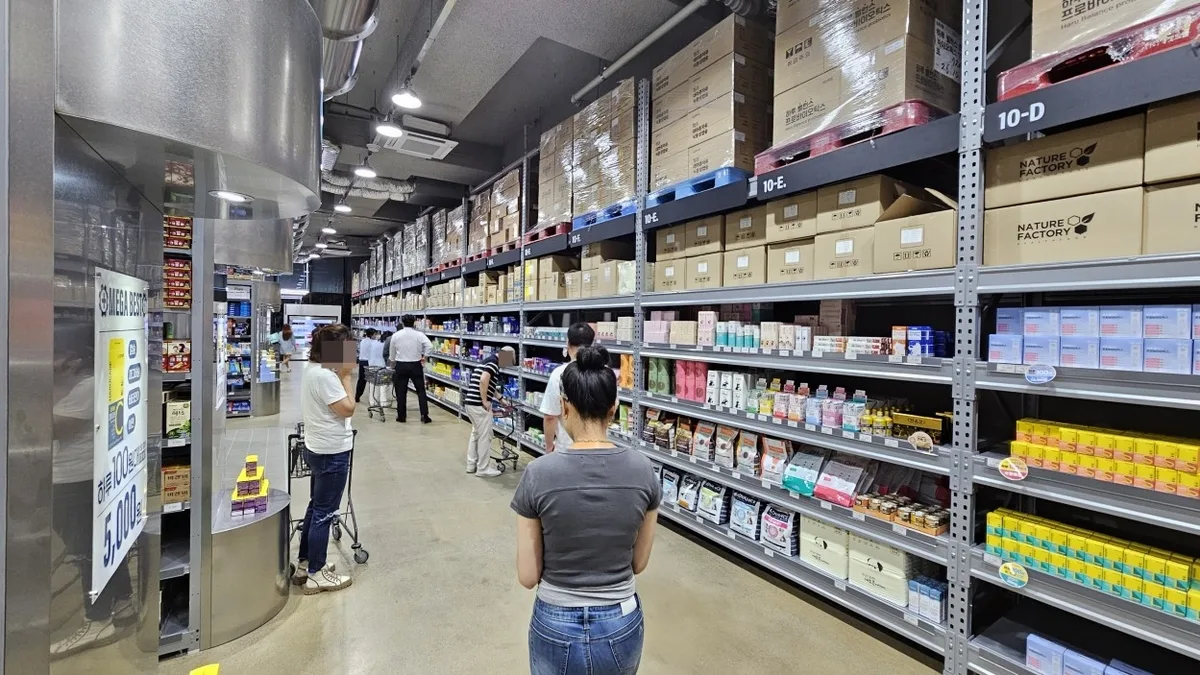
A large warehouse-style pharmacy — topical skin treatments and functional cosmetics sought by tourists displayed front and center on the shelves
The numbers back this up. Foreign medical and healthcare spending rose from KRW 223.3 billion in H1 2023 to KRW 889.6 billion in H1 2024, with pharmacies accounting for as much as 60% of that. As of this May, foreign medical spending hit an all-time high of KRW 251.1 billion (up 74.6% year over year), and 7 out of every 10 medical-spending transactions (69.8%) took place at a pharmacy. Sales of Dong-A Pharmaceutical's three topical skin-treatment brands (Noscana, Acnon, Melitoning) jumped from KRW 18.4 billion in H1 2022 to KRW 35.5 billion in H1 last year. Lee Eun-hee, a professor of consumer science at Inha University, explains that "pharmacy-brand cosmetics give consumers the same sense of trust as a dermatologist's prescription." Add in the overlap with post-procedure recovery and soothing products bought at pharmacies, and dermatology treatments and pharmacy shopping are merging into a single travel itinerary — the dermatology side of this boom and duty free's response strategy are covered separately in Part 2.
Key Insight #1 — By the Usual Playbook, This Boom Should Be Turning Into a Chain
When demand for a specific retail category explodes this fast, the normal next step is chain consolidation and standardization. That's how Olive Young came to dominate the H&B market, and how Daiso absorbed low-price retail — standardize multilingual staffing, expand store count around tourist zones, and build out tax-refund infrastructure all at once.
Pharmacies can't take that path. The Pharmacy Act's "one pharmacist, one pharmacy" principle blocks it. Only a licensed pharmacist can open a pharmacy, and in principle, one pharmacist can open and operate only a single pharmacy. The intent of this rule is to keep capital from infiltrating pharmacy operations and eroding their public-interest function — a safeguard meant to keep a pharmacist's individual expertise and judgment from being subsumed by capital logic. As a result, the "hot" tourist pharmacies of Myeongdong and Hongdae are all completely separate businesses, each run by its own individual pharmacist. Tourist-service manuals, tax-refund registration, multilingual signage — every one of these has to be built out pharmacy by pharmacy, individually.
Key Insight #2 — And Right at This Moment, the National Assembly Tightened That Block Further
This is where the real core of this issue lives. On April 23, the National Assembly's plenary session passed an amendment to the Pharmacy Act. The existing law already contained a clause stating a pharmacist "may open only one pharmacy," but the amendment rewrote that to: a pharmacist "may not open or operate two or more pharmacies under any name." The change closes off not just opening a second pharmacy but effectively operating one too — and by adding "under any name," it explicitly shuts down workaround structures as well. The trigger was the recent spread of "network pharmacies" — not official franchises, but groups sharing a brand and functioning, in practice, as a single system through a shared management-support entity. This amendment takes effect six months after promulgation.
In other words, at the exact moment foreign tourist demand is exploding at the level of individual pharmacies, the National Assembly targeted and shut down the one channel that could have organized that demand at scale — a structure combining capital and organization into a network. These two policy directions didn't collide by design; they're two currents moving toward entirely different goals — protecting pharmacist expertise for patient safety versus stimulating tourism spending — that happened to cross paths, moving in opposite directions, at the exact same moment. No coverage has connected these two threads until now.
Key Insight #3 — The Legal Workaround That's Still Standing: MSO
That doesn't mean capital is shut out of this market entirely. The hospital and dermatology-clinic industry found a path years ago — the MSO, or Management Service Organization. Gangnam dermatology clinic networks and dental-hospital alliances have long consolidated marketing, payroll, facility management, and joint purchasing under an MSO entity to cut costs, and use of this structure has grown roughly 180% over the past five years. The same principle applies to pharmacies. Rather than "opening or operating" a pharmacy, an MSO is a service entity that handles non-pharmacy work — HR, accounting, marketing and PR, facilities and inventory management — so the pharmacist who holds the license can focus on the actual pharmacy work: dispensing and patient counseling. What the Pharmacy Act blocks is "opening or operating a pharmacy," not "providing management-support services to a pharmacy" — and that gap is, right now, the one legal scale-up route still standing.
But that gap is narrow, and it collapses the moment it's crossed. The instant an MSO takes a share of pharmacy profits (revenue-sharing), directly funds pharmacy operating capital (capital provision), or decides on hiring and firing pharmacy staff, this is no longer "management support" — it's treated as de facto "operational control," and becomes subject to criminal prosecution as an illegally capital-controlled pharmacy, commonly known in Korea as a "front-operator pharmacy." For an MSO to function legally, its arrangement has to be strictly a fixed-fee service contract, avoiding any form of compensation tied to the pharmacy's revenue or profit.
And this gap keeps narrowing further. Following the April amendment's broadened definition of "opening and operating," Democratic Party lawmaker Jeon Jin-suk plans to introduce a follow-up bill (July 10, 2026) targeting so-called "warehouse-style pharmacies." The bill would let local government heads examine contract details with landlords, capital providers, and other financially interested parties as part of pharmacy registration review, and reject an application outright if the contract contains clauses on "allocation or distribution of operating performance" or "restrictions on independent business conduct." If an MSO contract has structured its fee as revenue-linked, this single provision could be enough to block the pharmacy's registration entirely.
Business Impact — Blocked From Chains, Capital Routes Through "MSO and Brand" Instead
With chain consolidation blocked by law, capital and pharmaceutical companies have found two workarounds. One is product branding. Dong-Kook Pharmaceutical has rolled out its pharmacy-exclusive brand "Madeca Pharmacia," and Il-Yang Pharmaceutical its "Dr. Frimetic," starting to tie individual pharmacies together under a shared brand identity. The other is the MSO. A duty-free operator can't own or operate pharmacies directly, but setting up an MSO entity to provide multilingual staffing, tourist-zone location analysis, tax-refund registration on the pharmacy's behalf, and joint marketing and purchasing — all for a fixed fee — can tie individual pharmacies together into a de facto network effect through contracts. It's capital building economies of scale not through "store ownership" but through "SKUs and service contracts."
The infrastructure gap is widening too. Tax refunds only work once an individual pharmacy applies for foreign duty-free retailer status with its local tax office and signs a separate contract with a refund agent. That inevitably creates a tourist-revenue gap between pharmacies already registered, like those in Myeongdong and Hongdae, and those that haven't even applied yet — and this registration process is exactly the kind of service an MSO can attach itself to first. But once the amended Pharmacy Act takes effect (six months after promulgation) and, if Rep. Jeon's bill passes, registration review gets stricter at the same time, even the loosely structured MSO contracts running today will need re-examination. Meanwhile, tourist demand keeps growing, even as the legal organizational infrastructure needed to capture it demands increasingly narrow and precise design.
Key Insight #4 — Why Duty Free's "Taxable Space" Could Be the Next Stage
The capital most ready to move first into this market may, surprisingly, be duty free. The industry is right now in the middle of a structural crisis. Shinsegae Duty Free closed its Busan store (January 24, 2025), and Shilla and Shinsegae both returned their Incheon Airport T1 DF1/DF2 concessions, each on the hook for roughly KRW 190.0 billion in penalty fees. Lotte Duty Free has bet on diversification as its way out of this crisis — reasoning that payback-driven perks alone can't hold customers for long, and operating on the judgment that "the longer people stay, the more likely they are to buy," it has kept adding experiential elements. Its renovation of the downtown Ginza duty-free store in Tokyo, which doubled the taxable, non-bonded floor space so local residents could shop there too, follows the same logic.
Layer K-pharmacy-tour demand onto that trend and the picture lines up. Duty-free stores already draw large volumes of foreign tourists who spend real dwell time on-site. Bring in a pharmacy tenant, and there's another lever for converting that traffic into sales. The catch is location — a pharmacy can't operate inside a duty-free store's bonded sales area (the space licensed by Korea Customs specifically for duty-free goods). Pharmaceuticals aren't a duty-free category to begin with, and the bonded-area license itself separately regulates floor area and business mix. But duty-free store buildings already coexist with taxable, non-bonded leased space outside the bonded zone. Incheon Airport T2's "Gourmet Bridge" food court is the clearest precedent — operating as a regular taxable leased space rather than a duty-free-licensed zone, and driving dwell time and revenue as F&B. A pharmacy leasing space in that same taxable zone runs into no obstacle under customs law or bonded-sales-area regulation.
Of course, the Pharmacy Act's constraints apply to duty-free operators just as much as anyone else. A duty-free operator can't open or operate a pharmacy directly — it can only act as a landlord leasing taxable space, or, as covered above, as an MSO-style service provider handling multilingual support, tax-refund registration, and marketing on the pharmacy's behalf. And this is exactly where a familiar retail-industry habit becomes a trap. The method large marts and malls currently use to land oversized pharmacies as anchor tenants is revenue-linked rent. Cheongnyangni MBB (a 58-pyeong, roughly 192 sqm pharmacy inside a 1,100-pyeong, roughly 3,636 sqm mixed complex), Homeplus Geumcheon, Starfield Village Unjeong, Yongsan Jeonja Land's warehouse-style pharmacy — commercial landlords desperate to rebuild foot traffic are competing on aggressive terms to land these tenants. But within the pharmacy industry, revenue-linked rent has already become the center of debate over whether it counts as "rent" or "involvement in management." A structure where the landlord's income rises alongside the pharmacy's revenue is open to interpretation as external capital having a direct economic stake in the pharmacy's operating performance — and if Rep. Jeon's bill passes, any contract containing a clause on "allocation or distribution of operating performance" becomes, by itself, grounds for rejecting the pharmacy's registration. This is exactly why duty-free operators can't simply copy the tenant-acquisition formula they use in other categories and apply it to pharmacies.
Key Insight #5 — So the Answer for Duty Free Is "Lease, Not Build"
The question duty-free operators should be asking here is "build a new MSO, or just lease the space?" In the pharmacy channel, the answer is relatively clear — because the "off-the-shelf" solution already exists in the market.
There are eight pharmacy franchises registered with Korea's Fair Trade Commission (Onnuri, Medipharm, Optima, Hubase, Chamyaksa, Heaps, Parangmun, Megafactory), covering 5,405 affiliated pharmacies as of 2024 — Onnuri leads with 2,073, followed by Medipharm's 1,133 and Optima's 879. These chains have already built out multilingual service manuals, standardized SKUs, and POS and inventory systems on their own. For a duty-free operator, the simplest move is to bring in one of these as a tenant in its taxable space and collect a fixed rent — done. There's no reason for a duty-free operator to build its own MSO from scratch to develop multilingual service or inventory standardization when a proven, already-scaled brand can simply be seated in place. Even so, it's worth being explicit that a franchise headquarters' royalty structure with its affiliated pharmacies and a duty-free operator's rent from a tenant pharmacy are entirely separate contracts — and the duty-free operator's own rent still has to stay strictly fixed-fee to avoid the front-operator-pharmacy risk discussed above.
In RIT's view, the maturity of the regulation supports this call too. MSO and network regulation for pharmacies only tightened in April 2026, with a follow-up rule due in July — this is a space where "the enforcement line is still actively being drawn." Rather than building a brand-new MSO from scratch in a space this regulatorily unsettled, taking a tenant slot in an already-established chain brand is the more risk-adjusted choice for duty-free operators. (The dermatology channel is the opposite case — there's no nationwide registered franchise there, and MSOs are a far more mature industry practice, giving duty-free operators a much stronger incentive to build and run their own MSO directly. That's covered in Part 2.)
Business Case Summary
Demand fit — High: Foreign tourist traffic is already captured inside duty-free stores. It's the same customer base as K-pharmacy-tour demand, so there's no new customer-acquisition cost
Timing — High: This moment lines up exactly with duty free's push, amid a structural industry crisis, to make "extending dwell time" the core of its diversification strategy
Legal feasibility — Medium-high: Using taxable space rather than the licensed bonded sales area removes any obstacle under customs law — a precedent already exists in F&B leases like Gourmet Bridge. But the Pharmacy Act's one-pharmacist-one-pharmacy principle still applies in full, so duty-free operators have to stay in a landlord or MSO role
Economics — Medium: With revenue-linked rent off the table, rental income on its own is more limited than the retail-industry average. A more realistic model instead compensates through the resulting lift in cosmetics and luxury sales from longer dwell time, plus the buzz and PR value of "there's a K-pharmacy inside the duty-free store"
Optimal structure — Lease, not a proprietary MSO: Registered franchises (Onnuri, Medipharm, Optima, and others) already run 5,405 stores between them, so duty-free operators don't need to build a new MSO — bringing in an existing chain as a tenant and collecting fixed rent is the more efficient path
Bottom line: The opportunity is real. But there's exactly one condition for success — structure the contract on fixed rent or a fixed fee, and resist the temptation of a revenue-linked structure
The winner in this market's next phase won't be whoever adds the most stores — it will be whoever can legally manufacture economies of scale, through brand and infrastructure, on top of a fragmented structure of individual pharmacies. Whether duty-free operators can apply this same taxable-space strategy to dermatology clinics too — and why the answer flips to the opposite conclusion (build your own MSO) in that case — is covered in the following Part 2.
✦RIT's Insights
Plenty of outlets have already covered pharmacies becoming a tourist destination. But nobody has pointed out this angle: right as this boom is peaking, the National Assembly passed a law moving in the exact opposite direction. The line barring "operating two or more pharmacies under any name" came out of an entirely different context — patient protection — but the practical effect was to shut down the one channel capable of organizing tourist demand at scale.
This isn't a story about anyone doing something wrong. The intent behind the Pharmacy Act amendment — keeping capital from encroaching on pharmacy operations — is valid on its own terms. What's interesting is simply that this valid regulation collided, at the same moment, with a tourism boom that happened to be exploding — and together they're producing a distinctive market structure.
Still, for capital that wants to enter this market seriously, the answer has already been shown by the hospital and dermatology-clinic industry: the MSO. Take the same approach Gangnam dermatology clinics have used to cut costs by consolidating marketing, payroll, and facility management under an MSO, and carry it straight over to pharmacies — rather than trying to buy or directly operate a pharmacy, set up a service company that handles multilingual support, tax-refund registration, joint purchasing, and inventory standardization for a fixed fee. This isn't a loophole; it's a legitimate approach the hospital industry has already validated for more than five years, and corporate planning teams across pharma, retail, and investment capital should treat this model as the default channel-expansion strategy — it's effectively the only legal scale-up path left standing right now.
Cross the line here, though, and it immediately becomes a front-operator pharmacy. The moment a fee gets structured as revenue-linked, operating capital gets injected directly, or hiring and firing decisions get made for pharmacy staff, the picture changes completely. And, as it happens, while writing this piece we confirmed that Rep. Jeon Jin-suk is preparing a follow-up amendment targeting "warehouse-style pharmacies" — one that would let regulators examine a contract's financial and operational relationships starting from the registration-review stage. The path to an MSO is clearly still open, but every line of the contract has to be built on the fixed-fee principle. Legal teams designing an MSO need to strip out any clause that departs from that principle right now, and teams handling policy response need to finish reviewing, within the six-month grace period, how the amended Pharmacy Act's "under any name" clause and Rep. Jeon's proposed rejection criteria apply to existing contracts. Miss that balance, and this stops being market entry — it becomes criminal exposure.
In RIT's view, the most interesting angle here is duty free. The industry is already at the edge — a closed Busan store, a returned Incheon Airport concession — and Lotte's "we survive by extending dwell time" diversification strategy lines up remarkably well with K-pharmacy-tour demand. And with a precedent like Gourmet Bridge already bringing F&B into taxable space outside the bonded zone, bringing in a pharmacy isn't even a new experiment under customs law. There's exactly one problem: the revenue-linked rent that retail habitually reaches for when landing an anchor tenant. Apply that same structure to a pharmacy, and it runs straight into the front-operator-pharmacy risk covered in this piece. From a duty-free business-development or merchandising standpoint, there's no reason to build a new proprietary MSO — seating an already-established franchise like Onnuri, Medipharm, or Optima, with its multilingual manuals and inventory standardization already in place, as a tenant in taxable space and collecting fixed rent is enough. If duty-free operators are serious about playing this card, it should be legal counsel who understands the Pharmacy Act reviewing the contract first — not the leasing team. There's one more way for pharma marketing and sales teams to ride this trend: folding brand standardization — display guidelines, multilingual point-of-sale materials, ingredient-recommendation scripts — into the MSO's service menu, tying brand strategy and MSO infrastructure together as one.
In RIT's view, this point still deserves a closer look: the individual pharmacies and pharmacist associations actually standing at the front line of all this remain slow to prepare. Pharmacies in tourist zones like Myeongdong and Hongdae need to move quickly on tax-refund business registration and adopting immediate-refund terminals — registration status alone is already widening the gap in tourist revenue between pharmacies. Shared infrastructure that individual pharmacies can't build alone — multilingual pharmacy maps, translated ingredient and efficacy materials — is something local governments and the tourism authority should ultimately step in to support; in a fragmented market like this, that kind of public infrastructure becomes, alongside MSOs, another way of manufacturing economies of scale.
One more thing worth flagging: the answer that works for pharmacies shouldn't be copied straight over to dermatology clinics. Pharmacies already have registered franchises like Onnuri, Medipharm, and Optima running 5,405 stores between them, so there's no reason for duty-free operators to build a new MSO there. Dermatology is a different story. Why it's different — and why duty-free operators should flip to building their own MSO in that case — is what the next installment covers.
For the figures on Shinsegae Duty Free's Busan store closure and the KRW 190bn penalties Shilla and Shinsegae paid to hand back Incheon Airport's DF1/DF2 zones, see the Sources section of the Shinsegae Duty Free Incheon T1 renewal article
![[Where Foreign Tourists Flock in K-Beauty, Part 2] Could Dermatology's MSO Model Also Work for Duty-Free?](/images/clinic.jpg)