APR reported its Q2 2026 results on August 5. Revenue came in at KRW 767.5 billion and operating profit at KRW 190.6 billion, up 134.2% and 134.5% year over year respectively — both record highs for the company. Operating margin reached 24.8%. Cumulative H1 revenue hit KRW 1.3609 trillion, closing in on the company's entire prior-year revenue (KRW 1.5273 trillion) in just six months. On the numbers alone, this reads like just another "K-beauty smash hit" story. But break the results down by region, and something more consequential emerges: the growth formula that has governed the K-beauty industry for the past decade or so is being turned on its head.
Company Background — From a Basement Startup to a KOSPI Heavyweight
APR's beginnings were nothing like its current glamour. Kim Byung-hoon, born in 1988, tried a string of ventures while studying business at Yonsei University — an alert app, a couples app, a campus dating app — all of which failed one after another. He then founded a low-irritation cosmetics brand called "April Skin" from a basement apartment on October 10, 2014. First-year revenue came to just KRW 200 million.
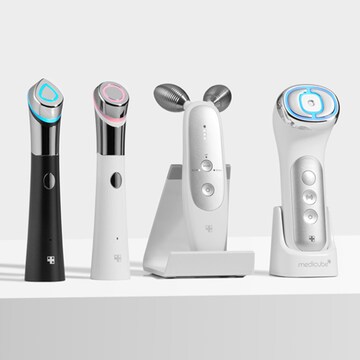
What followed was a steady run of brand expansion. In 2016, the company launched dermo-cosmetic brand Medicube; in 2017, it renamed the corporate entity itself to "APR," borrowing the English spelling of April Skin, and expanded into brands like Photogray and Forencos. The decisive turn came in 2021 with the launch of home beauty device brand "Medicube AGE-R." A string of core devices — Booster Healer, Booster Pro — became hits one after another in 2022–2023, completing the two pillars, cosmetics and devices, that support APR today.
The company's February 27, 2024 KOSPI listing was itself an unusual event — the first time a startup less than 10 years old had listed directly on Korea's main board rather than going through KOSDAQ first. The listing process wasn't smooth, either. Around 2,000 institutions took part in book-building, producing a 663:1 subscription ratio with more than 97% of bids at or above the top of the indicated range — yet the final offer price was set at KRW 250,000, a full 25% above the top of that range (KRW 147,000–200,000), drawing accusations that the company had "inflated the offer price." Retail subscription was similarly frenzied, with a 1,112.54:1 ratio and KRW 13.91 trillion in margin deposits — but on listing day the stock spiked as high as KRW 467,500 intraday (+87% over the offer price) before giving back most of those gains to close at KRW 317,500 (+27%), falling short of the "quadruple" first-day pop (4x the offer price) the market had been hoping for at the time. Even so, the listing made Kim Byung-hoon Korea's wealthiest stockholder in his 30s.
The trajectory since the listing has climbed upward past that controversy. On August 6, 2025, APR's market cap overtook Amorepacific's to become the largest Korean beauty company by market value, at KRW 10.29 trillion. A year later, APR has proven that standing again in the numbers, with record Q2 2026 revenue of KRW 767.5 billion and a 24.8% operating margin.
What Happened — The Results, by the Numbers
Start with the full H1 picture.
| Category | Q1 | Q2 | H1 Total |
|---|
| Revenue | 5,934 (+123.0%) | 7,675 (+134.2%) | 13,609 |
| Operating profit | 1,523 (+179.0%) | 1,906 (+134.5%) | 3,429 |
| Operating margin | 25.7% | 24.8% | 25.2% |
Figures in KRW 100 million (억원) unless noted otherwise.
Breaking down Q2 revenue by region:
| Region | Q2 revenue | YoY |
|---|
| North America | 3,763 | +264.6% |
| Europe | 1,451 | +380.3% |
| Asia | 1,211 | +14.5% |
| Other overseas | 617 | +325% |
| Domestic (Korea) | Remainder (~8% of total) | — |
Figures in KRW 100 million (억원) unless noted otherwise.
Overseas revenue now makes up 92% of the total. And here's the number that matters most: North America and Europe combined went from 40% of revenue in the same quarter last year to 68% this quarter. Europe's share has grown large enough that the company began breaking it out as its own separate region starting this quarter.
Core Insight #1 — The "K-Beauty Growth Comes From China and Asia" Formula Has Broken Down
For roughly the past decade, the growth story of Korea's cosmetics industry has been written almost without exception around Chinese and broader Asian tourists and consumers. Korea's duty-free industry, its department stores, even its K-beauty export statistics — none of them have really escaped the "China boom" and "Asian tourist" frame. APR's latest results show, in hard numbers, that this ranking has flipped, at least within one company. Asia revenue grew just 14.5% year over year, while North America grew 264.6% and Europe 380.3% — a gap of 20 to 25 times in growth rate.
This reversal isn't an accident; it's the result of deliberate execution. In North America, APR expanded its presence at Target and Walmart, with a Costco listing planned for the second half of the year. In Europe, it opened official Amazon storefronts in the UK, France, Germany, Italy and Spain late last year; compared to January, revenue in each country rose an average of more than 8x, and June's Amazon Prime Day drove the company's highest-ever monthly revenue. Layer on a TikTok Shop presence and a March 2026 Sephora listing, and Europe's H1 revenue reached KRW 228.9 billion (+363%, 17% of total revenue). The company also grew the number of SKUs it carries by more than 5x year over year, spreading demand across the whole brand rather than leaning on any single hit product. APR has set a 2026 target of KRW 500 billion in European revenue.
Core Insight #2 — Offline Expansion Creates a Margin Dilemma
This growth comes at a cost. Much of APR's roughly 25% operating margin to date has come from a D2C (direct-to-consumer)-centric structure built around its own online store and Amazon. But the more the company expands into large offline retail networks like Target, Walmart, Costco and Sephora, the heavier the distribution-fee burden gets. Revenue scale grows, but the margin on that revenue is structurally lower than what D2C delivers. Securities analysts, in fact, flag exactly this as a risk factor — offline channel expansion helps revenue growth, but it can gradually dilute margin.
There's a category-competition risk layered on top. APR's other pillar, beauty devices under the AGE-R brand, posted H1 revenue above KRW 130 billion, alongside Medicube cosmetics' own H1 revenue above KRW 130 billion — together the company's two growth engines. But the barrier to entry in the home beauty device market isn't especially high. Industry watchers worry that if large appliance makers or cheap late entrants flood in, holding onto the mid-20s operating margin APR currently enjoys will get harder. In short, APR is now managing margin defense on two fronts at once: "where it sells" (margin pressure from offline expansion) and "what it sells" (intensifying competition in the device category).
Business Impact — The Valuation Already Prices In High Growth
Despite these risks, securities analysts remain broadly bullish on APR. Kiwoom Securities has set a target price of KRW 310,000 (Buy rating), while LS Securities applied a target P/E of 32x to arrive at a fair market cap of KRW 15.058 trillion (target price KRW 400,000). Some forecasts see APR crossing KRW 2 trillion in annual revenue in 2026 while holding margin around 25%. The issue is that this valuation already assumes substantial continued high growth. A P/E of 32x is hard to justify without assuming profit keeps growing in the 30%-plus range. In other words, the market has already bet on a scenario where North America- and Europe-driven high growth continues — which means that from next quarter on, the real variable for the stock isn't the growth rate itself, but how long this high growth can continue without eroding margin.
When judging next quarter's results, the more accurate gauge won't be how flashy the revenue growth rate looks, but whether APR holds its 25% operating margin under three simultaneous pressures: margin pressure from offline expansion, competition in the device category, and a valuation that has already priced in continued high growth.
✦RIT's Insights
The most meaningful number in this release isn't the 134.2% revenue growth rate — in RIT's view, it's the gap in regional growth rates, 14.5% in Asia versus 380.3% in Europe. Korea's cosmetics industry has long been told that dependence on China and Asia is a structural risk, to the point where people joke that "when China coughs, K-beauty catches a cold." What APR has shown is that breaking free of that dependence isn't impossible. Whether this is an industry-wide shift, though, or an exceptional case created by this one brand's product strength and marketing execution, can only be judged by looking at other K-beauty companies' regional results alongside it. In RIT's view, anyone handling K-beauty exports or overseas business should take this case as evidence that an Asia/China-centric strategy isn't the only path to growth — the numbers already make a case for considering a "North America/Europe first" approach that targets online channels like Amazon and TikTok Shop alongside offline curated retailers like Sephora and Target at the same time.
Second, how APR navigates the margin dilemma created by its offline expansion is a genuinely interesting thing to watch. A company that built a mid-20s operating margin around D2C is now continuing to expand into Target, Walmart, Costco and Sephora — channels with far higher distribution fees. Whether it can capture both revenue growth and margin protection at once, RIT's read is, depends on just how much real negotiating leverage its brand power has actually bought it with these retailers. For anyone handling the home beauty device category, the low barrier to entry in this market isn't a problem unique to APR — it's a risk for the category as a whole, and it's worth proactively monitoring how large appliance makers and cheap new entrants move into the space. Investors and analysts should recognize that offline distribution expansion is a structural trade-off that drives both revenue growth and margin dilution at once, and should track revenue growth and channel-level margin separately starting next quarter. A valuation at a 32x P/E assumes continued high growth, so it's bound to react sharply to any sign of a slowdown.
Finally, from the perspective of Korean retail, the fact that APR's domestic revenue share has fallen to around 8% shouldn't be waved away lightly. It's a case study in how, for a brand that started in Korea and then scaled rapidly, domestic channels naturally get deprioritized once growth accelerates. This isn't just APR's story. Beauty MDs at Korean department stores and duty-free operators should factor this structural backdrop in first when negotiating placement and volume, and every time a similarly hyper-growth brand emerges going forward, they should be asking upfront: how long does this brand actually have an incentive to keep allocating resources to our channel?
Sources
- APR's Q2 revenue hit KRW 767.5bn — overseas sales now 92% of the total (Money Today, 2026-08-05, Q2 2026 results and regional revenue breakdown)
- "APR," this year's first KOSPI debutant — what kind of company is it (Newspim, 2024-02-26, the KOSPI listing and IPO-pricing controversy)
- "Surprise earnings" push APR past Amorepacific to the top of Korea's cosmetics stocks (Global Economic, 2025-08-06, the market-cap overtake)
- APR's Q1 earnings outlook rises on global growth momentum — target price raised, LS Securities (Money Today, 2026-04-09, analyst target prices)
- DART electronic disclosure system (dart.fss.or.kr) — APR Co., Ltd. quarterly reports and securities registration statement (cited by name where a specific filing URL could not be pinpointed)