APR's Growth, LG H&H's Pivot, Cellreturn's Collapse — Three Currents in the Beauty Device Market
2026-08-23 3:00 PMCosmetics & Perfumes
Overview
Korea's home beauty device market grew from KRW 500 billion in 2018 to KRW 1.6 trillion in 2023 — more than tripling in five years. But within that one market, companies' fortunes have split in opposite directions. APR is posting record results on twin engines of cosmetics and devices, while LG Household & Health Care, its cosmetics revenue faltering, is belatedly pivoting into devices, and Cellreturn, once the market's #1 player, saw revenue evaporate 90% after a false-advertising crackdown and still hasn't recovered five years later.
Korea's home beauty device market grew from KRW 500 billion in 2018 to KRW 1.6 trillion in 2023 — more than tripling in five years. Globally, the market is projected to grow from $1.32 billion in 2024 to $4.81 billion in 2034, a 13.8% CAGR. Behind this growth is the "at-home-ification" of aesthetics — procedures once available only at dermatology clinics and aesthetic studios are being miniaturized into home devices. But within this single growing market, companies' fortunes are splitting in opposite directions. APR keeps setting record quarterly results on the twin engines of cosmetics and devices; LG Household & Health Care, once Korea's #1 cosmetics company, is belatedly shifting its center of gravity toward devices as its core business falters; and Cellreturn, once the #1 LED mask maker, saw revenue evaporate 90% after a single regulatory crackdown and still hasn't recovered five years on.
Mapping the Market — Home Beauty Devices Split by Technology
Home beauty devices fall into several categories that differ completely in character depending on the underlying technology.
Technology
Mechanism
Claimed Benefits
Representative Brands
Price Tier
RF (radio frequency)
Delivers heat to the dermis to stimulate collagen production
Firmness, lifting, wrinkle reduction
Medicube AGE-R, Dualsonic, TriPollar
Premium
LED phototherapy
Stimulates cell activity with wavelength-specific light
Collagen production (red), reduced acne bacteria (blue), calming (yellow)
LG Pra:L, Cellreturn, CurrentBody
Mid
EMS / microcurrent
Induces muscle contraction via micro-current
Immediate contouring, reduced puffiness
NuFACE, Medicube EMS
Mid
Ultrasound
Delivers energy via ultrasonic vibration
Improves product absorption, skin texture
—
Mid-low
Electroporation
Electrical stimulation opens micro-channels for ingredient penetration
Ampoule absorption, hydration, brightening
—
Mid
IPL / laser hair removal
Suppresses hair follicle growth with light energy
At-home hair removal
Philips Lumea, Braun Silk Expert
Mid-high
Scalp / hair-loss devices
Improves scalp environment via LED, laser, vibration, microcurrent
Improved scalp blood flow, hair-loss support
—
Mid
Of these, RF lifting devices — a home adaptation of the dermatology clinic procedure Thermage — command the highest price tier and best repeat-purchase rates, making them the market's most premium category. LED masks are the most mass-market category, being nearly painless and simple to use, and scalp/hair-loss devices are the fastest-growing emerging category, driven by an aging population and rising rates of hair loss. Layer on top of all this the recent addition of AI-based skin diagnostics, app connectivity and usage-data analytics, and the category is evolving into "smart beauty devices."
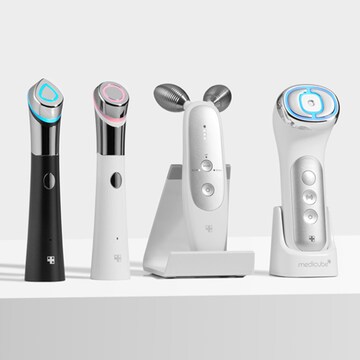
RF-based home beauty devices are considered the market's highest-priced, highest-margin category
Core Insight #1 — APR Is Flying on Twin Engines: Cosmetics and Devices
The clearest winner in this market is APR. Medicube cosmetics and AGE-R beauty devices each generated more than KRW 130 billion in H1 2026, serving as the company's two growth pillars (APR's company-wide Q2 revenue was KRW 767.5 billion with a 24.8% operating margin — RIT covered the regional growth story behind that number in a separate earlier piece). AGE-R's RF-class devices, like the Booster Healer and Booster Pro, sit in the highest-price, highest-margin category of the home beauty market, and APR has established itself as one of the few companies with both cosmetics brand power and device technology at once in that category. Being able to cross-sell cosmetics and devices under one brand functions as a structural advantage over single-category specialists.
Core Insight #2 — LG H&H Pivots to Devices as Cosmetics Falters
On the other side sits LG Household & Health Care, the traditional powerhouse of Korea's cosmetics industry. LG H&H's 2025 annual revenue came to KRW 6.3555 trillion (-6.7%) and operating profit to KRW 170.7 billion (-62.8%), a sharp deterioration in the profitability of its core cosmetics business. Against that backdrop, the company took direct ownership of its device business last June, taking over the "Pra:L" trademark and associated social-media channels from LG Electronics. It has since accelerated its beauty device push, launching the roughly KRW 100,000 "Pra:L Superform Galvanic Booster." Industry commentary has gone as far as saying "Pra:L instead of Whoo" — meaning a company long defined by its Whoo cosmetics brand is now looking for a new growth path in devices, a category it entered as a latecomer, as its core business wobbles. The company did in fact post a Q2 2026 rebound — revenue of KRW 1.6574 trillion (+3.3%) and operating profit of KRW 102.8 billion (+87.5%) — though how much of that rebound is attributable to device expansion isn't separately disclosed and hard to confirm. Still, the fact that the company itself is emphasizing Pra:L as a core growth pillar is telling on its own. What makes this particularly interesting is the timing: this shift coincides, as it happens, with the moment in August 2025 when APR overtook LG H&H by market cap to become Korea's largest beauty company. The company that lost the top spot in Korean cosmetics appears to be belatedly following the growth formula (cosmetics + device hybrid) of the very company that took that spot from it.
Core Insight #3 — Cellreturn Shows How Regulatory Risk Can Topple a Market Leader
The third face is closer to a warning. Cellreturn (operated by STG24), the company that pioneered the LED mask market, was the #1 player with KRW 128.5 billion in revenue in 2019. That same September, Korea's Ministry of Food and Drug Safety flagged 48 LED mask products for false advertising — the problem being that they were marketed with claims like "wrinkle improvement," "facial lifting" and "reduces blemishes and acne" without medical device approval. Reports of side effects followed — itching, redness, acne, and even retinal damage and risk of blindness — serious enough that a victims' community sprang up on Naver. Revenue crashed nearly 90% to KRW 14.9 billion in 2020, and even five years later, in 2024, revenue was still just KRW 4.1 billion (-67.7% year over year), with an operating loss of KRW 4.75 billion (widening 82.7%) — deterioration, not recovery. Retained earnings have sunk to -KRW 10.7 billion, ruling out any dividend, and with cash and equivalents of just KRW 130 million against current liabilities of KRW 54.1 billion (including KRW 52.2 billion in short-term borrowings), the company faces a liquidity crisis with a debt ratio of roughly 180%. That it has set aside 82.9% (KRW 12.1 billion) of its KRW 14.6 billion in accounts receivable as a bad-debt allowance shows the company itself doesn't expect to collect most of it. It's the most extreme example available of what happens when a category pioneer fails to manage regulatory compliance.
Business Impact — What These Three Faces Reveal About the Market's Structure
Line these three cases up, and the structure of the home beauty device market comes into focus. First, a company with both brand power and technology (APR) can combine a high-margin category (RF) with cosmetics to lead the market. Second, for a legacy company whose core business is struggling (LG H&H), devices can offer a new growth path — but entering as a latecomer leaves the challenge of closing the gap with already-established brands. Third, this market carries unusually high regulatory risk — many home beauty devices sit at the boundary between cosmetics and medical devices, where a single efficacy claim or ad slogan can shake an entire company. Cellreturn's case isn't an outlier; the industry as a whole should recognize it as a risk structurally embedded in this market. Approach this category by looking only at the headline market-growth number, and you miss the real variables that actually decide a company's fate here — brand integration and regulatory-risk management.
✦RIT's Insights
Looking at these three companies side by side, what stands out most is that home beauty devices are less a "technology market" than a "trust market." Whether it's RF, LED or EMS, in the end it's a product where a consumer puts a device that emits electricity, heat or light directly onto their face. The moment a company overstates its efficacy claims, consumer trust collapses, and as Cellreturn shows, a single regulatory issue can leave an entire company unable to recover for more than five years. In RIT's view, APR is ahead in this market not purely because of its technology, but because it extended the trust it had built as a cosmetics brand into devices. MDs and buyers in this category should build placement strategy around the premise that categories differ fundamentally in character — as Cellreturn's case shows precisely, RF carries a high price and high margin but also a high barrier to entry, while LED has strong mass appeal but is the category most exposed to regulatory risk.
LG H&H's pivot to Pra:L carries a broader lesson for Korean retail and consumer goods generally. A once-dominant company belatedly following a latecomer's business model is a reminder that even a category you're winning today can be overtaken in a hurry if you get complacent. That said, given LG H&H still holds a firmly established cosmetics asset in Whoo, whether its device business can generate real synergy with cosmetics is, in RIT's view, the key question in whether it can catch up to APR. For anyone charting strategy at a legacy beauty company, diversifying into devices when core profitability wobbles is a valid choice in itself — but success ultimately hinges on how quickly the gap with an already brand-established latecomer-turned-leader can be closed.
Finally, Cellreturn's case should be read as a warning to Korea's broader beauty startup scene. Among today's fast-growing new device brands, there are almost certainly some prioritizing marketing speed over regulatory approval. The fact that a former market leader still hasn't escaped financial crisis five years later is about as clear a piece of evidence as you'll find that, in this industry, regulatory compliance is a far more fundamental competitive advantage than growth speed. This is a particularly painful lesson for brand marketing and regulatory affairs teams — Cellreturn proved with its own balance sheet that using terms like "lifting" or "wrinkle improvement" without medical device approval can destabilize an entire company, so new product ad copy needs mandatory pre-review against Ministry of Food and Drug Safety standards. Investors and analysts evaluating home beauty device companies should also check regulatory-risk exposure separately from growth rate — a risk premium is warranted given that, as with Cellreturn, a single regulatory issue can wreck a balance sheet for more than five years.
DART electronic disclosure system (dart.fss.or.kr) — STG24 Co., Ltd. and LG H&H annual reports (cited by name where a specific filing URL could not be pinpointed)