Not a Cheaper Brand — a Different Store: Aldi's Pull Now Reaches High Earners Too
2026-07-14 11:23 AM
Overview
German discounter Aldi is aggressively expanding in the US and UK at once. Its visitor growth has outpaced Costco, Kroger, and Walmart, and households earning over $100,000 a year are leaving traditional supermarkets at the steepest rate of any income bracket. Its UK unit kept investing even as operating margin fell — choosing price trust over margin. Emart, Lotte Mart, and Homeplus's diverging results in Korea face the same question.
That US households earning over $100,000 a year shop at Aldi is no longer news. The real news is how fast that share is growing. In 2026 alone, Aldi will open more than 180 new stores in the US, completing a total of 2,800 locations, and plans to invest $9 billion by 2028 to reach 3,200 stores. Over that same period, its visitor growth rate has outpaced Costco, Kroger, and Walmart entirely. Yet this growth isn't being carried by low-income shoppers alone — a recent survey found that households earning $100,000 or more a year are actually leaving traditional supermarkets at the steepest rate of any income bracket. This isn't the familiar downturn story of "trading down to a cheaper brand" — it's the story of going to an entirely different store altogether. Understanding why that distinction matters is where we should start.
What Kind of Company Is Aldi?
To understand its rapid growth in the US, start with where the company came from. Aldi is a globally operating hard-discount supermarket chain. It's a privately held family business owned by Germany's Albrecht family: in 1946, brothers Karl and Theo Albrecht inherited their mother's grocery store and began expanding it, and by 1961 — according to the company itself — they had established what became the world's first discount grocery store format. The two brothers later split the company into two independently operated groups, Aldi Nord and Aldi Süd, which still run separately today. The US, Australia, Ireland, China, and southern Germany fall under Aldi Süd, while Belgium, the Netherlands, Spain, France, Poland, and northern Germany fall under Aldi Nord — each running its own brand within its territory. The Aldi commonly found in the US belongs to the Aldi Süd family; it opened its first US store in Iowa in 1976 and is now headquartered in Batavia, Illinois.
Aldi's US unit states its guiding principle plainly: "If it isn't necessary, we don't do it. Period." That single sentence takes concrete form in every corner of the store.
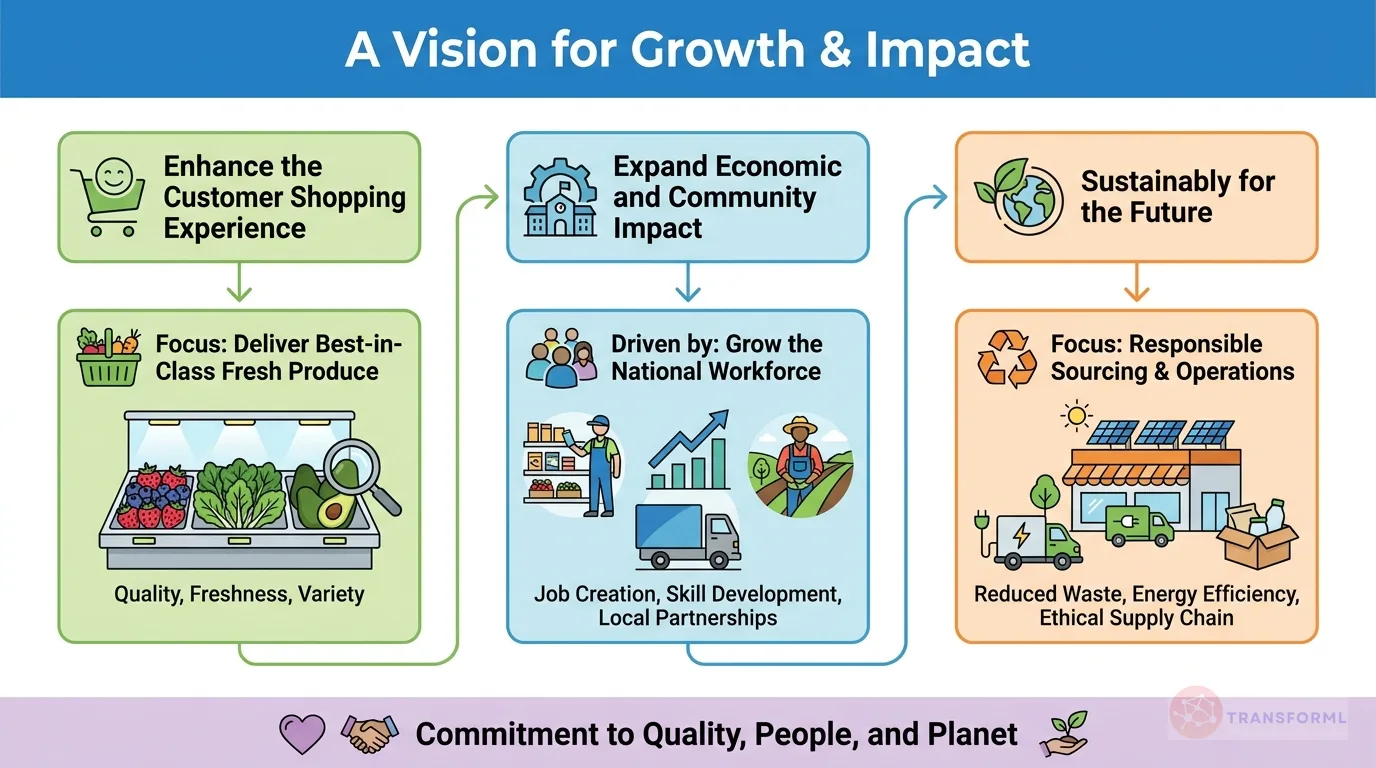
Three core values: "Simplicity" to lower costs, "Consistency" to protect top quality, and "Responsibility" to reduce environmental and social impact — Aldi's three officially stated values
A limited assortment: while a typical supermarket carries 30,000-40,000 SKUs, Aldi carries only around 1,400-2,000 per store, more than 90% of which are private label. Fewer items mean lower logistics and inventory costs, and that savings flows straight into the price
The cart deposit ("ALDI Quarter"): using a cart requires inserting a quarter, refunded when the cart is returned — this removes the labor cost of cart retrieval and takes that cost out of the price
Self-bagging and box-stacked displays: customers bring their own bags and pack their own groceries, and products are displayed still in their shipping boxes rather than restocked onto shelves — a device that minimizes in-store labor
No add-on services ("No Hidden Costs"): non-core services such as banking, pharmacy, or check-cashing are simply not offered. The logic: focus purely on grocery sales and return that focus to customers as price
Private-label quality control: more than 90% of exclusive-brand products are taste-tested and verified in Aldi's own test kitchen, with more than 30,000 products taste-tested last year alone. Aldi also runs a "Double Guarantee" policy that refunds and replaces any product a customer isn't satisfied with. The company states its prices run up to 50% below national brands
ALDI Finds: limited-quantity specials released every Wednesday — spanning not just food but small appliances, seasonal decor, and gardening supplies. Once they're gone, they're gone, which also makes them a built-in traffic driver: customers come back every week because they never know what's coming next
Sustainability commitments: seafood is sourced only from certified-sustainable suppliers, and the company carries Fair Trade- and Rainforest Alliance-certified products. Aldi has pledged to remove an additional 44 types of artificial preservatives, colors, flavors, and sweeteners from its private-label products by December 2027
One logic runs through every one of these principles: cut the number of items carried, strip out every labor-intensive add-on service, and put all of the resulting savings straight back into the price tag. What's happening in the US right now — this "Aldi momentum" — is, in the end, the story of an 80-year-old formula finally clicking with American consumers for the first time.
Aldi's growth strategy framework — built on three pillars: shopping experience, contribution to local economies and jobs, and sustainability
What's Happening
Start with what the numbers show.
Global scale: as of 2026, Aldi operates more than 13,600 stores across 18 countries. It's expanding from its European core — the US, UK, Germany, Australia, China, Spain — into a truly global footprint
US expansion: Aldi opened more than 225 new stores in 2025 alone, the largest annual store count in roughly 50 years of US operations. Of those, 100 were conversions of bankrupt Southeastern Grocers' Winn-Dixie and Harveys locations into Aldi format (with 220 total conversions planned by 2027). It will add another 180-plus stores in 2026, reaching 2,800 by year-end, and is targeting 3,200 stores by the end of 2028, backed by a $9 billion investment in US operations and logistics infrastructure
Visitor growth (2025, Placer.ai data): Aldi +8% YoY — ahead of Costco (+5.9%), Albertsons (+1.6%), Kroger (+0.8%), and Walmart (+0.5%)
Customer base: one in three US households visited Aldi in 2025, including 17 million new customers. Its share of grocery store visits rose from 4.3% in 2022 to 5.7% in 2025
Yet market share remains small: Aldi 2.8-3.5% vs. Walmart 21-24%, Kroger 10%, Costco 9%, Albertsons 6%, Publix 5% — "small, but the fastest-growing challenger"
The growth rate is overwhelming while share remains in the single digits. That gap itself means Aldi still has a long way to go — and for the established chains, it's a warning that if this momentum isn't checked now, the gap will keep closing.
The most striking signal comes from an AlixPartners survey of 1,635 consumers conducted in September. Households earning $100,000-plus a year cut their share of spending at traditional supermarkets by 7 percentage points year-over-year. The 25-34 age bracket posted the second-largest decline, down 6 points. The steepest defection showed up not among low-income shoppers, but among high earners and young professionals.
Even more interesting is a separate survey conducted around the same time by Alvarez & Marsal. 42% of respondents said they planned to switch to a cheaper store in spring 2026, up 11 points from the prior fall's 31%. Meanwhile, the share who said they'd "just pick cheaper brands at the same store" fell to 35%, down 14 points from the year before.
Put those two numbers side by side and the picture becomes clear. The old version of "trading down" meant picking private label over national brands within the same store — an easily reversible shift that could snap back once the economy improved. What's happening now is customers switching stores entirely, and that's far harder to undo. Once a customer gets used to the layout and checkout habits of Aldi, Lidl, or Costco, a handful of promotional coupons won't bring them back.
Key Insight #2 — The Stigma That "Cheap Equals Shoddy" Has Broken
This channel shift had a precondition: consumer perception of shopping at discount stores has itself changed. In the survey, 68% of respondents agreed that "discount stores are just as clean as traditional stores," and 63% said customer service quality was on par.
Matthew Hamory, AlixPartners' global co-head of grocery, puts it this way: "American consumers have learned that shopping at a discount store doesn't mean buying junk. They're buying good-quality fresh food and good-quality private label." More than 90% of Aldi's shelf assortment is private label — a structure built on extreme simplification of buying, logistics, and shelf operations, with all of the resulting margin savings returned directly to price. For that structure to work, trust that private-label quality is on par with national brands has to be established first — and that trust now appears to have crossed a tipping point.
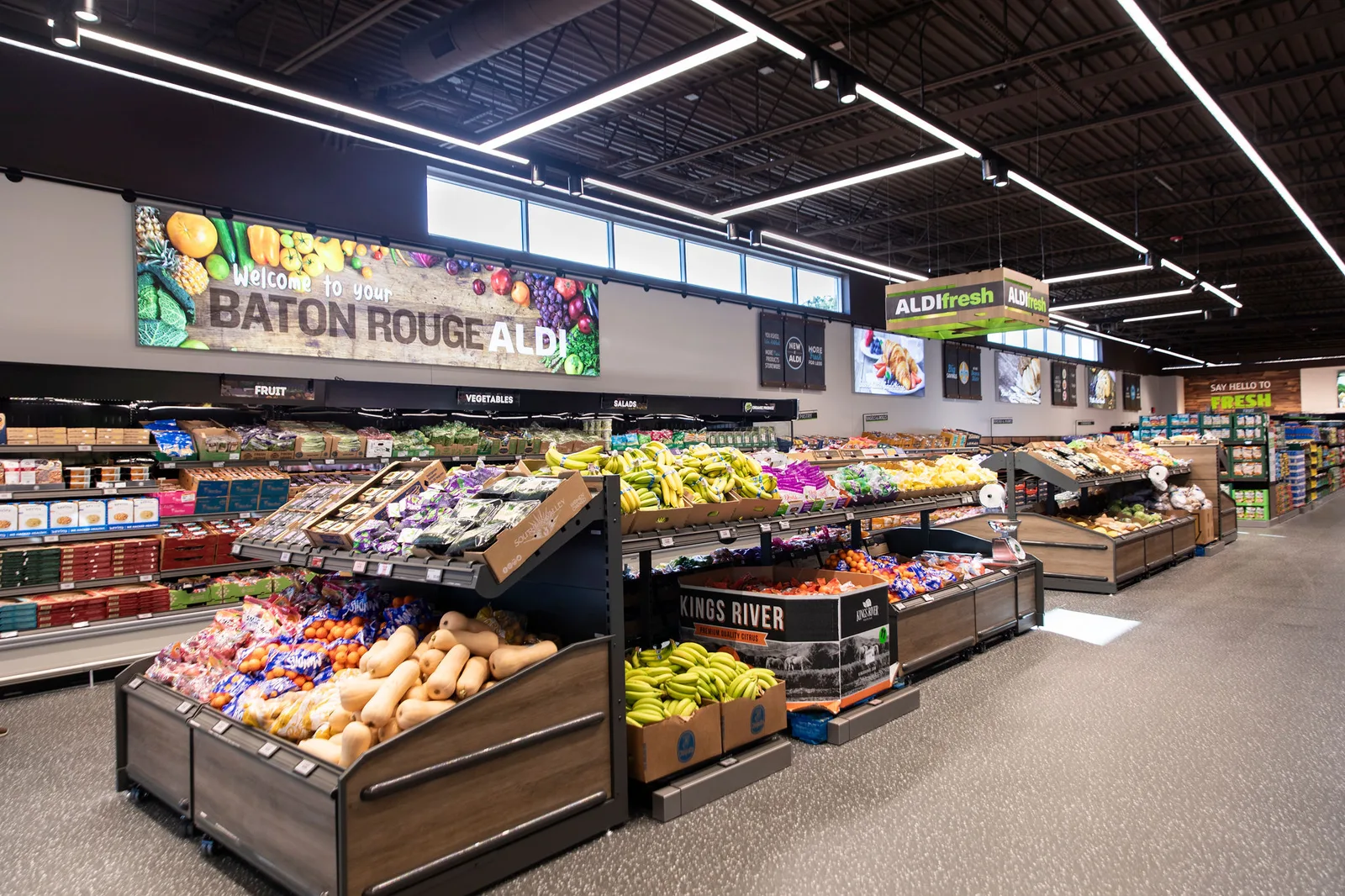
The produce section at a new Aldi store in Baton Rouge, US — products displayed still in their shipping boxes, Aldi's signature approach to cutting restocking labor costs on full display
Key Insight #3 — This Isn't Just About the Downturn. It's About Trust.
There's another point traditional supermarkets are missing. Among consumers who regularly shop at traditional supermarkets, only 13% believe their own store offers low prices. Even as these chains flood shoppers with weekly promotions and discount coupons, customers themselves don't actually believe they're getting the best price.
The cause is promotion fatigue. About two-thirds of respondents said they like discounts in principle but find it "too complicated to keep track of every deal." 40% avoid buying more than they need in order to get a better price, 30% avoid buying multiple units of the same brand to unlock a discount, roughly 25% don't use digital coupon apps at all, and 16% refuse to sign up for loyalty programs altogether. AlixPartners partner John Clear describes this as "a collapse in consumer trust — because shoppers can't tell when they're actually getting the best price."
By contrast, the Every Day Low Price (EDLP) model used by Aldi, Costco, and Walmart is predictable — today's price is next week's price too. The simplicity of EDLP is winning out over the fatigue and distrust generated by promotion-driven, high-low pricing.
This trend isn't unique to the US either. Aldi's UK unit posted 2024 revenue of £18.1 billion, up from £17.9 billion the year before, but operating profit fell about 21% to £435.5 million (from £552.9 million the prior year), pushing its operating margin down to 2.4%. The company cited three causes: price cuts, infrastructure investment, and wage increases. Revenue is growing and so is market share, yet profit is being squeezed — in effect, Aldi is paying for market share with margin.
Even so, Aldi's UK unit didn't back off. Instead, it committed an additional £1.6 billion over the following two years to open 80 new stores, with a long-term plan to expand to 1,500 UK locations (up from roughly 1,060 today). The result: 2025 revenue growth reaccelerated to 4.8%, and market share climbed to 10.8%. Aldi UK's CEO summed up the strategy this way: "trusted prices, not clubs, gimmicks or tricks." Sacrificing near-term margin to buy trust that "this store is always cheap" is Aldi's shared strategy worldwide right now — and the momentum seen in the US should be understood as running on the same underlying math as this UK playbook.
Business Impact — Kroger and Albertsons, Caught in the "Squeezed Middle"
The biggest losers in this shift are traditional large chains like Kroger and Albertsons — what the industry calls the "squeezed middle." They can't beat Walmart and Aldi on price, and they can't beat Costco on loyalty and membership lock-in. Albertsons CEO Susan Morris admitted on an earnings call that "even higher-income customers are becoming more sensitive to price and value." After its merger with Albertsons fell through, Kroger pivoted toward regional scale instead, acquiring Giant Eagle for $1.65 billion — sidestepping a head-on price fight in favor of markets where it doesn't overlap with existing rivals.
There's also evidence for reading this as a structural shift rather than cyclical belt-tightening. Over the past three years, inflation-adjusted spending growth has run at 2.3% annually for households earning $125,000-plus, versus 1.6% for middle-income households ($40,000-$125,000) — a gap that still exists but is narrowing. On top of that, US consumer sentiment fell to 84.5 in January 2026, its lowest reading since 2014 and a sharp drop from the prior month's 94.2. 72% of US adults rate the economy as "below average," with 66% citing grocery and consumer-goods prices as a concern and 45% citing job availability. With white-collar layoffs on the rise, even high earners no longer feel psychologically secure. The two legs of the so-called "K-shaped economy" are gradually flattening out.
Implications for Korea's Retail Market
None of this can be read as someone else's story — Korea's retail market has already entered the same phase.
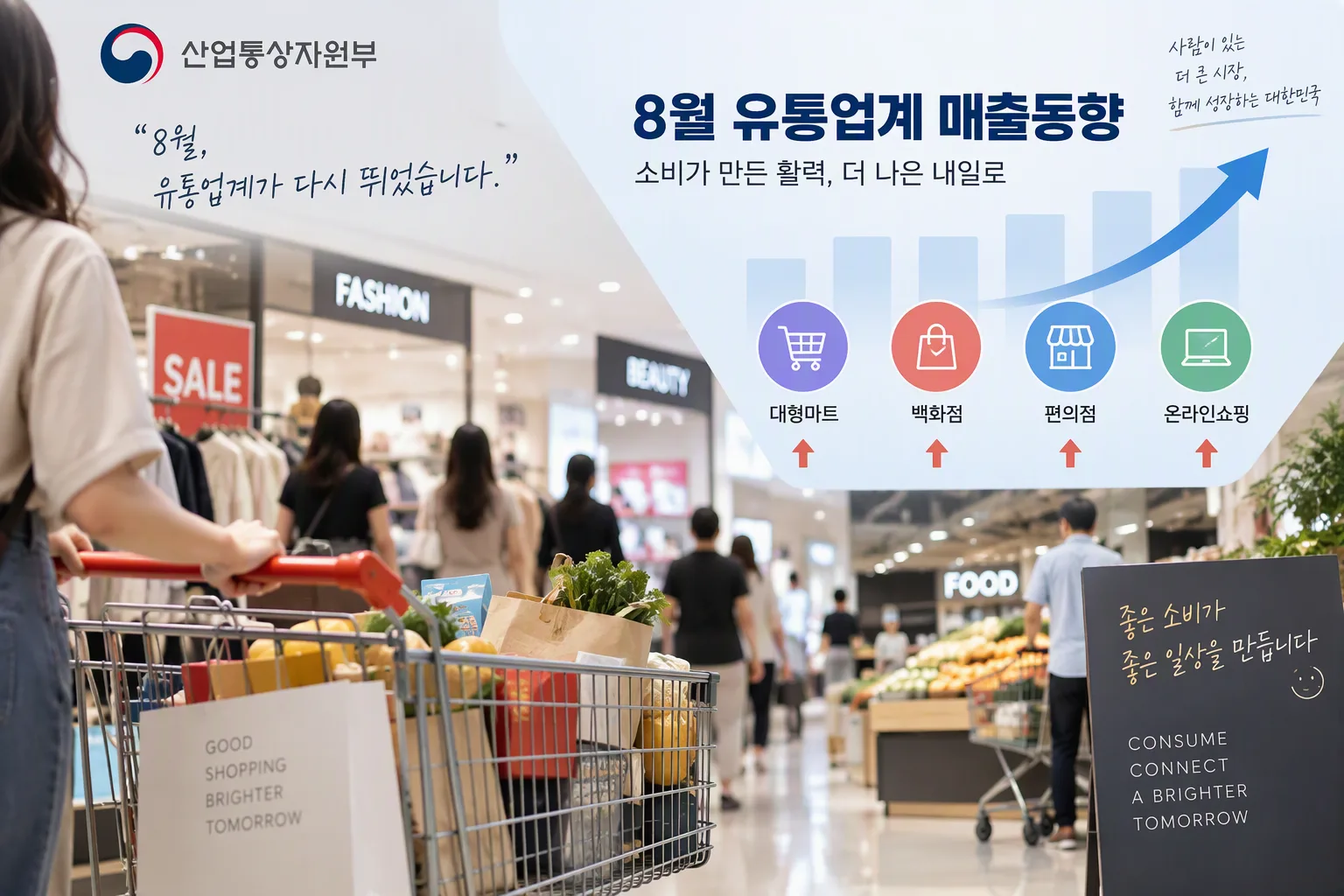
In a slow-growth environment, "value formats" beat "premiumization." According to Korea's Ministry of Trade, Industry and Energy's tracker of major retailer sales, total sales in May 2026 (the latest figure available) rose 9.0% year-over-year. Notably, that growth was led by offline (+9.3%) rather than online (+8.8%). But look closer at what's actually driving that offline growth: department stores did the work, up 24.5%, while large discount stores (hypermarkets) actually shrank -5.1% — a steeper decline than 2025's full-year figure of -4.2%. Behind a headline number that looks like offline is recovering, large discount stores alone keep losing ground. This is, in the end, the same reason Aldi is growing in the UK and the US. In a high-inflation environment, consumers move not toward "premiumization" but toward channels that offer "a price you can trust every day." It's the same reason Coupang, Traders, Costco, No Brand, and Daiso are all strengthening in Korea at once — and the same reason large discount stores alone keep sliding.
Large discount stores need to redefine themselves from "general non-food-plus-food stores" into "grocery discounters." With large discount stores' non-food competitiveness bleeding rapidly into online, the way to survive is to push the food- and necessities-focused "transactional format" to its extreme. Aldi has proven this model through a limited assortment, private-label focus, and stripped-down operations; in Korea, Emart splitting its formats across Traders, No Brand, and Starfield Market, and Lotte Shopping's grocery-focused "Grand Grocery" experiment, both point in the same direction.
Private label shouldn't be a margin patch — it needs to be the core weapon of price positioning. This is exactly why Aldi UK didn't retreat even after telling investors in its 2024 results that "price investment was the primary driver of the margin decline." Setting a private-label price benchmark in frequently repurchased categories — milk, eggs, tofu, ramen, bottled water, frozen food, HMR, detergent, pet supplies — can lock in a customer's entire grocery routine. But because online grocery shopping and dawn delivery are already so strong in Korea, private label can't stay confined to physical stores. Only by holding the same price benchmark across a retailer's own app, delivery apps, and fast-delivery channels can it earn customers' trust that "this brand costs the same no matter where I buy it."
The axis of competition is shifting from "promotions" to "cost structure." The news that Aldi UK's operating profit fell 21% looks bad in the short term, but strategically it's a deliberate choice to buy market share. Without lowering the underlying cost structure itself — through purchasing consolidation, logistics efficiency, SKU compression, and better inventory turnover — no retailer can sustain this game. One-off coupons or card discounts alone won't build structural competitiveness.
The offline answer may not be "bigger stores" but "formats close enough to visit often." Both Aldi UK's long-term target (1,500 stores) and its aggressive US expansion (225-plus new stores in 2025) point toward growing a store network that supports repeat visits within a customer's living radius, not large flagship stores. In Korea, where expanding onto large sites isn't easy, this principle is likely to show up instead as small- and mid-sized grocery discounters, urban fresh-food stores, and pickup/delivery hub formats.
Even against Coupang and Kurly, "online is the only answer" doesn't hold. It's true that online delivery growth in fresh food and daily necessities is one of the core causes of large discount stores' struggles. But Aldi's case shows offline can still grow if it has a clear value proposition. That proposition, though, can't rest on "store experience" alone — it needs to beat or differ from online on at least two of price, quality, speed, and convenience. Rather than competing head-on on delivery speed, it's more realistic to combine offline's inherent strengths: freshness, made-to-order food, bulk sizes, experiential grocery, and pickup convenience.
Implications for Korean Retailers by Company
The lesson for Emart and Traders is "price trust" plus "format differentiation." Traders should lean into Costco-style bulk value, No Brand into Aldi-style private-label value, and Emart's core stores into fresh food, HMR, and neighborhood-focused grocery, with each role defined more clearly. In Q2 2025, standalone Emart swung to an operating profit of KRW 15.6 billion (versus a loss of KRW 21.0 billion a year earlier), and Traders posted revenue of KRW 900.3 billion (+8.1%) with operating profit of KRW 30.9 billion — the format-differentiation strategy is starting to show up in the numbers.
Lotte Mart's situation is different. It still lacks Aldi's "simple, strong price position." Grand Grocery (Dogok store visitors +17%, Eunpyeong store food-category customer count +15%) is directionally right, but Lotte Mart doesn't yet have a signature item that customers immediately associate with "definitely the cheapest here." Its grocery business (Lotte Mart and Super) posted an operating loss of KRW 45.3 billion in Q2 2025, wider than the year-earlier loss of KRW 13.0 billion — a result of slowing consumer sentiment compounded by the added burden of the e-grocery business transferred over from Lotte On. The homework that remains is to narrow its focus onto a signature set of fresh, ready-to-eat, HMR, and private-label categories and compete there.
The most extreme case at the opposite end is Homeplus. Five straight years of losses, a net loss of KRW 1 trillion, and equity that shrank to KRW 239.1 billion pushed Homeplus into court receivership in March 2025, with a plan to consolidate around 67 core stores — but it failed to raise the KRW 200 billion it needed. The closure of 37 stores was finalized in June 2026, and on July 3 the Seoul Bankruptcy Court terminated the receivership process altogether, ruling the rehabilitation plan unworkable — effectively a path to bankruptcy. Viewed through Aldi's lens, this looks like a case of trying to hold onto every store and ending up holding onto none. The decision to redefine surviving stores as high-turnover grocery discounters or regional delivery hubs was needed far earlier.
Coupang and Kurly need to view Aldi not just as an offline competitor but as a reference point on private label, sourcing, cost reduction, and price trust. If a reputation for being expensive builds up around online grocery shopping, customers could defect right back to offline discount channels like Aldi and Costco. Convenience stores and SSMs can't match Aldi's blanket low pricing, but they can carve out a "mini Aldi zone" within frequently repurchased daily-necessities and ready-to-eat categories. Guaranteeing everyday-low pricing and private-label quality on 20-30 core staples alone can be enough to drive destination purchasing.
One conclusion runs through all of these cases. Aldi's momentum isn't a news story about one German discount chain doing well in the US — the real story is that American consumers are redefining not "what they buy" but "where they buy it," and that redefinition is spreading beyond low-income households to families earning $100,000 a year or more. Brand discount coupons can't stop this shift, because what customers no longer trust isn't the brand — it's the store's own price. In practical terms, what traditional retailers trying to survive need to rebuild isn't more promotions. It's price trust at the store level.
✦RIT's Insights
The first thing this article brings up is that the old assumption — "discount stores only do well in a downturn" — may not hold this time. Looking at three years of spending data alongside consumer sentiment readings together, this looks less like temporary belt-tightening and more like a signal that the very criteria consumers use to choose a store have shifted. The fact that defection is steeper among high earners than low earners is not a small detail. In the end, this judgment call is the strategic fork in the road — whether to read today's discount-channel growth as cyclical or structural changes the response completely.
From long experience watching this industry, the number that stands out most is "13%." That even regular customers don't believe their own store offers low prices is evidence that retailers have long mistaken promotions for the whole of marketing. No amount of coupon-blasting builds trust once it's gone missing, and eventually customers leave — and this isn't just an American story. There's something pricing and MD teams can act on right now: cut promotion dependence starting with core categories and pilot EDLP. Consumer trust comes from the certainty that a price stays the same every time, not from how often discounts run. The same goes for CRM and loyalty design. Fatigue with apps, coupons, and loyalty sign-ups runs deeper than expected — 16-30% of respondents refuse to participate in these promotions at all — and a single, simple, predictable benefit tends to outperform a complicated reward structure.
One more thought after looking at Aldi UK's numbers. That it kept investing even as operating profit fell 21% suggests this company treats consumer trust in the brand — not this quarter's results — as the asset worth protecting. A company that treats private label only as a margin-defense tool can never keep up with this structure; private label only gains the power to shift an entire channel once it's positioned as "something you can only buy at this store." Talking with executives at Korean retailers, most of them already know price trust matters. The question is whether they have the nerve to accept it showing up as margin decline on the financial statements, and the logic to sell that to their board. Most retreat back to promotions the moment margin wobbles — and that retreat is exactly what feeds the "promotion fatigue" we're seeing now. Without designing this tradeoff in advance, the moment margin turns down, not even the board can stop the retreat from cost-structure reform back into discount events.
Korean retailers, in RIT's view, are standing at exactly this fork right now. The evidence is that Emart and Lotte Mart moved in precisely opposite directions over the same period. Emart split into Traders and No Brand, gave each format a clear role, and swung back to profit in Q2; Lotte Mart, weighed down by new-business burdens on top of everything else, saw its losses widen further. And at the far end of that spectrum sits Homeplus — five straight years of losses, decisions deferred again and again, ending in a rehabilitation process that itself got thrown out, effectively a bankruptcy. It never staked a direction on margin the way Aldi did, but it also couldn't hold onto its old way of doing business — it simply let time run out. What concerns RIT most in this data is that not many companies are yet checking, with their own numbers, whether the shift toward ultra-low-price channels like Daiso, No Brand, and Emart Everyday is spreading to middle-class-and-above households here too. US trends have historically served as a leading indicator that shows up in Korea later, so failing to check this now means the response will always be a beat behind. Sales and clearance events can generate short-term traffic, but if that traffic never turns into trust that "this store is always cheap," customers eventually get pulled away to EDLP channels like Aldi and Costco — that's the conclusion all of this data points to in common. Building trust in the price itself rather than the promotion, and having the will to spend some margin to buy that trust — that's the real homework Korean retail needs to work through over the next few years.
DART electronic disclosure system (dart.fss.or.kr) — E-Mart, Lotte Shopping, and Homeplus quarterly reports (cited by name where a specific filing URL could not be pinpointed)