Revenue Up 15%, Operating Profit Up 36% — Samsung C&T Fashion Has Rebounded, but Margins Remain Below 2023
2026-10-13 8:30 AMFashion & Luxury
Overview
Samsung C&T's Fashion Group reportedly posted first-half 2026 revenue of KRW 1.166 trillion (+14.9%) and operating profit of KRW 91.2 billion (+36.1%). The two-year slide in profitability has been halted, but the 7.8% operating margin is still short of 2023's 9.5%. Whether the 9.1% margin reached in the second quarter holds in the second half, and whether exports — just 0.3% of sales — begin to grow, will determine how durable this rebound is.
Samsung C&T's Fashion Group posted first-half 2026 revenue of KRW 1.166 trillion and operating profit of KRW 91.2 billion, ending two years of declining profitability. First-half revenue rose 14.9% year over year and operating profit rose 36.1%. According to CEO Score Daily's report, Samsung C&T Fashion Rebounds on Stronger Own Brands and Global Brand Expansion, the strategy of strengthening its own brands and expanding global brands drove the improvement.
A closer look at the numbers, though, suggests it is too early to call this a full recovery. The operating profit growth rate is high, but a good part of it reflects the low base left by last year's weak results, and the operating margin — the measure of profitability — has not yet returned to 2023 levels.
A Clear Rebound in the Numbers, but Not a Full Recovery
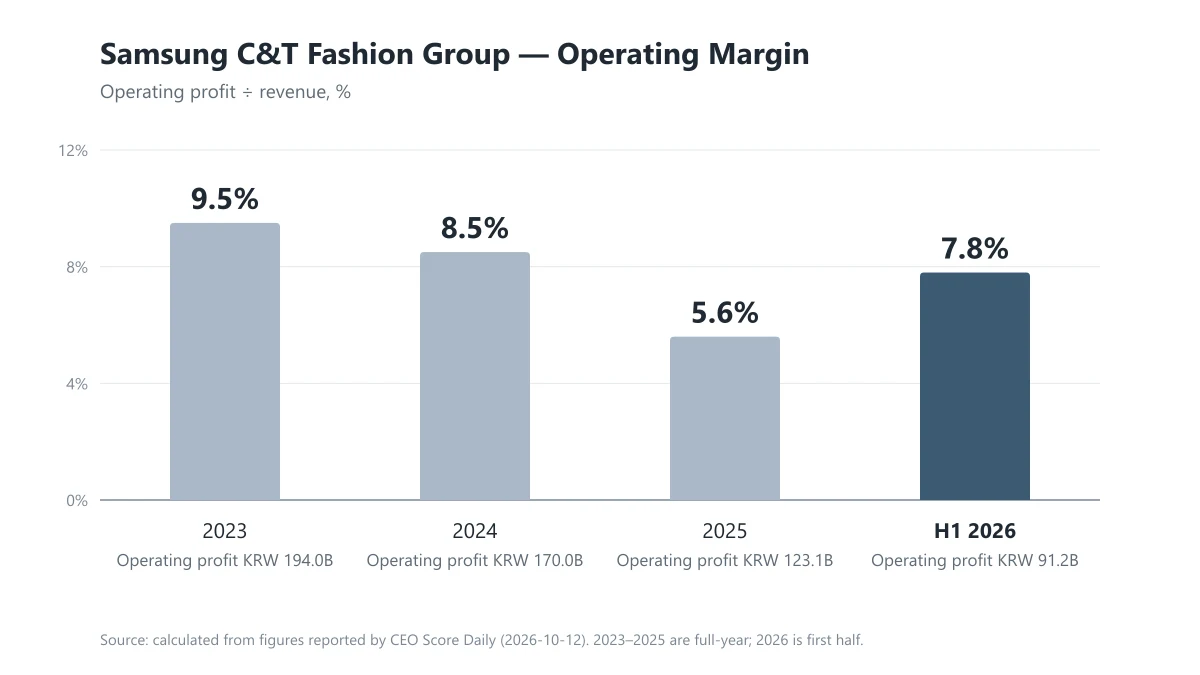
Organizing the annual results by operating margin makes the trend clearer.
Samsung C&T Fashion Group operating margin (2023–2025 full-year, H1 2026) — revenue and operating profit are reported figures; margins are calculated from them (Source: own calculation based on CEO Score Daily)
Since 2023, the Fashion Group's operating profit has fallen from KRW 194.0 billion to KRW 170.0 billion and then to KRW 123.1 billion. This year's first-half result can be read as the first sign of a rebound that has put a brake on that decline.
The first-half operating margin is 7.8%, which is 2.2 percentage points higher than last year's full-year margin of 5.6%. Compared with 8.5% in 2024 and 9.5% in 2023, however, it is still low — 1.7 percentage points below 2023. Put another way, margins have recovered to about 82% of the 2023 level.
So "rebound" is an appropriate word, but "back to previous levels" is still premature.
The Second Quarter Led the Rebound
The quarterly trend is also encouraging.
According to quarterly results announced earlier, the Fashion Group posted revenue of KRW 573.0 billion and operating profit of KRW 38.0 billion in the first quarter, and revenue of KRW 593.0 billion and operating profit of KRW 54.0 billion in the second quarter. The operating margin was 6.6% in the first quarter and 9.1% in the second.
It was effectively the second quarter that lifted first-half profitability. For the second-quarter improvement, the company cited the recovery in consumer sentiment, stronger product competitiveness and improved operating efficiency.
One discrepancy needs checking, however.
On a quarterly basis, adding first-quarter operating profit of KRW 38.0 billion and second-quarter operating profit of KRW 54.0 billion gives first-half operating profit of KRW 92.0 billion. CEO Score Daily, by contrast, reported first-half operating profit of KRW 91.2 billion.
The KRW 0.8 billion gap could stem from adjustments in the half-year report, differences in consolidation basis or other accounting treatment, but this cannot be confirmed from publicly available material. Which of KRW 91.2 billion or KRW 92.0 billion is the final figure in the half-year report therefore needs further verification.
Imported Brand Expansion Paired with Own-Brand Renewal
The most striking change in the course of this improvement is the portfolio strategy.
In March, the Fashion Group signed a contract with French fashion company SMCP and began its domestic business for four brands: Sandro, Maje, Claudie Pierlot and Fursac. It operates 121 offline stores — 95 in department stores and 26 in outlets — and has opened a dedicated brand shop on its SSF Shop site.
It also expanded the sales network for FitFlop and, in September, signed an exclusive domestic distribution partnership with British brand Margaret Howell, launching its Korean business. Plans for additional store openings within the year have also been disclosed.
Its own-brand strategy, by contrast, has shifted toward strengthening existing brands rather than launching new ones.
Starting with Cotello in 2021, the company introduced Sandsound, The Aperture, Anggae and Stitch Comes Blue in turn, but Cotello ended operations in 2025. Since then, current management has put its weight on strengthening existing brands rather than new ones. The February renewal of Beanpole Golf is one example. The company is concentrating on raising the product quality and brand value of Beanpole, 8seconds, Galaxy, Kuho and others.
According to a company official, own brands and imported brands currently account for roughly 70% and 30% of sales respectively.
This shows the center of gravity moving away from the aggressive new-brand investment of the past and toward strengthening proven own brands and bringing in proven overseas brands.
However, the effect of a rising imported-brand share on profitability has yet to be verified. The revenue contribution and profitability of the SMCP brands have not been disclosed, and neither has how much of the cost of running such a large store network is reflected in the results.
The Overseas Business Is Still a Blank
The biggest limit on this earnings rebound is overseas business.
The Fashion Group's first-half domestic sales were KRW 1.1623 trillion, up 15% year over year. Exports, by contrast, were KRW 3.7 billion, down 2.2%.
Exports account for only about 0.3% of total sales.
The company says it is pushing overseas expansion centered on brands such as Juun.J and 8seconds, but their current contribution to results is effectively negligible.
That makes this rebound more a result of domestic consumer recovery than of overseas growth. In other words, Samsung C&T Fashion's earnings structure can still be read as highly dependent on the domestic consumer economy.
What to Watch: Second-Half Margins
The most important fact this first-half result shows is not the growth in operating profit itself but the potential for improved profitability.
In the second quarter, the company recorded an operating margin of 9.1%, showing profitability close to the 2023 level.
Whether it can hold an operating margin of around 8% or higher from the third quarter onward is therefore likely to be the key indicator of how sustainable this rebound is. When it announced second-quarter results, the company cited concerns over weakening consumer sentiment in the second half and said it would pursue full-year revenue growth and profitability improvement by strengthening its products and brand competitiveness.
The other factor is overseas business. If exports stay stuck at the current 0.3% share, this rebound is likely to be judged as an improvement that depended heavily on the domestic consumer recovery.
In the end, the first half of 2026 can be called "the start of a rebound" for Samsung C&T's Fashion Group, but it is still hard to call it "the completion of a recovery." The bigger task, more than revenue growth, is regaining 2023-level profitability and securing a growth engine that can reduce its dependence on the domestic market.
✦RIT's Insights
With the company itself wary of weakening consumer sentiment in the second half, it is hard to assert that the 9%-range margin of the second quarter will simply carry on. A larger imported-brand share lifts revenue faster, but how the profit structure differs from that of own brands will only come into focus once third-quarter disclosures arrive. The two indicators I will check are whether the margin holds in the 8% range and whether the export share, stuck at 0.3%, moves at all.
Operating margins are calculated from the reported revenue and operating profit and may differ because of rounding. First-half operating profit of KRW 91.2 billion is a reported figure; the half-year report itself could not be checked directly.