Duty-Free Survey Finds Gen Z Browses, Millennials Buy
2026-07-09 10:41 AMGlobal
Overview
New research from Swiss consultancy m1nd-set, presented at the TR Consumer Forum in Geneva, finds that Gen Z travelers enter duty-free stores at the same rate as every other generation, but convert at under 60%. Millennial business travelers, meanwhile, have emerged as travel retail's top spenders, averaging $151 per head. Two completely different spending patterns are now coexisting inside the same store.
What if the generation that shows up most often at the duty-free counter isn't the one actually paying at it? A study presented at the TR Consumer Forum, held at Geneva Airport from July 1 to 3, poses exactly that question. Gen Z enters duty-free stores at almost the same rate as every other generation, but the share that actually opens their wallet is noticeably lower. Millennial business travelers, on the other hand, have now become the biggest spenders in all of travel retail. This isn't a story about a generational handover in progress — it's a story about two generations spending in completely different ways inside the same store.
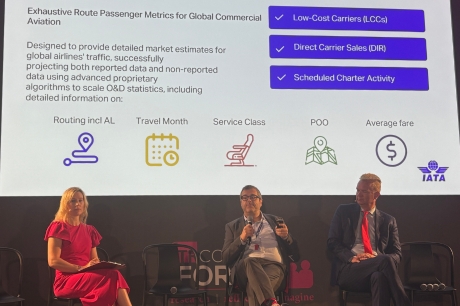
TR Consumer Forum, Geneva Airport (2026.7.1–3)
The Numbers Out of Geneva
The TR Consumer Forum, hosted by IATA and co-organized by TRBusiness and m1nd-set, held its sixth edition this year. In his keynote, m1nd-set founder and CEO Dr. Peter Mohn summed up the industry's problem in a single line:
"The market has the passenger volume, but the challenge is converting that into higher retail relevance, spend and profitability."
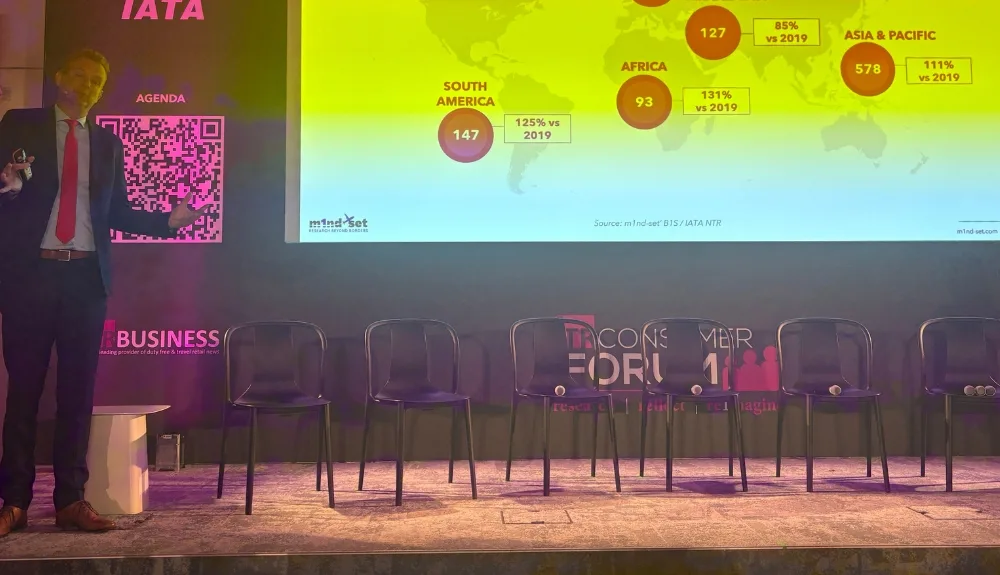
Dr. Peter Mohn (m1nd-set), TR Consumer Forum keynote — passenger traffic recovery by region vs. 2019
The backdrop Mohn laid out gives that line its weight. International departures in 2026 reached 2.414 billion, or 122% of 2019 levels. Yet airports' share of non-aeronautical revenue actually fell, from 40.2% in 2019 to 36.7% in 2023, and within that, retail concession revenue slipped to around 20% of total non-aeronautical revenue, down from 27% in 2019. Passenger traffic didn't just recover — it grew past its old level. Store revenue hasn't kept pace. m1nd-set calls this gap the "efficiency paradox," and points to the growing share of Gen Z travelers as one of its core drivers.
It's against this backdrop that the survey's Gen Z and Millennial data matters. According to the research unveiled at the forum, Gen Z footfall into duty-free stores runs 36–45% — effectively no different from any other generation. Simply walking into the store, in other words, doesn't vary by generation at all.
The problem starts after that. Gen Z's purchase rate sits in the mid-20% range, clearly below the roughly 30% seen for other generations. That gap carries through to conversion: Gen Z converts below 60%, while other age groups hover around 65%. The more interesting detail is why they walk in at all. The top reason Gen Z gave for entering a duty-free store was "to kill time before the flight" (27%) — meaning they're using the store as a place to spend spare time, not as a place to shop for products.
Millennial (ages 29–44) business travelers, by contrast, make up roughly 40% of global passenger traffic in the same survey and spend an average of $151 per head — well above the overall average of $128. High-margin premium categories like beauty, fashion, jewelry, and watches are led by Millennials, while Baby Boomers remain concentrated in traditional categories like spirits, tobacco, and confectionery. Worth noting too: more than 80% of Millennial respondents said staff interaction had a positive effect on their purchase decision, versus only around 60% for Baby Boomers.
Same Store, Two Different Generations
The point worth focusing on here isn't the gap in spending power between the two generations — it's where that gap opens up. Contrary to what's usually assumed, Gen Z's problem isn't a lack of money. They come into the store — footfall itself is identical to every other generation. The problem is that whatever happens once they're inside fails to pull them toward a purchase. The reasons Gen Z cited for not buying make this clearer: they'd already bought the item elsewhere, they never intended to buy anything to begin with, they didn't want to add to their luggage, prices felt higher than at home, the assortment lacked anything unique or innovative, promotions were limited, or there wasn't enough genuinely local product. Most of these are complaints about the in-store experience and assortment, not price.
At the same time, the research also found that Gen Z responds more actively than other generations to storytelling, interactive store design, and experiential brand presentations. Lining products up on a shelf and waiting won't convert this generation, but brands that have invested in in-store activation have already won them over.
Millennials, meanwhile, operate on a completely different logic. They're exposed to duty-free communications well before they travel, through social media and in-flight platforms, and actively use price-comparison tools before ever reaching the store. In other words, they arrive as a buyer segment that has already more or less decided what to buy. And once inside the store, they respond far more strongly than other generations to staff recommendations. For Millennials, what matters about the store experience isn't "discovery" — it's the touchpoint that cements a decision already made.
In other words, even in the same duty-free store, the two generations expect completely different things from it. For Gen Z, the store is still an unverified space of discovery; for Millennials, it's the place that completes a purchase already planned.
Why This Gap Matters Now
This survey result doesn't end as merely an interesting statistic, for two reasons.
First, the fact that Millennials have overtaken Baby Boomers as travel retail's top spenders shakes the premise behind decades of store, merchandising, and marketing strategy in the industry. Duty-free's traditional core categories — spirits, tobacco, fragrance — and its VIP service model were largely built around the spending habits of Baby Boomers and Gen X. Millennials becoming the primary spending cohort is a signal to rebalance investment toward premium beauty, fashion, and jewelry categories, and toward pre-travel digital touchpoints such as social media and in-flight commerce.
Second, Gen Z contributes little to revenue today, but it will be travel retail's core spending base for the next 10 to 20 years. Leave them now as "the generation that doesn't convert," and that learned indifference risks carrying forward once they reach Millennial age. Invest now in experiential retail and storytelling that shapes Gen Z's buying habits, and it's effectively laying the revenue foundation for the next decade. This gap, then, isn't simply a difference in generational spending — it's simultaneously a question of today's revenue (Millennials) and the seeds of future revenue (Gen Z).
✦RIT's Insights
From what has been observed on the ground for a long time, duty-free operators have already been running generation-differentiated strategies for a while. But it's also true that those strategies have mostly been segmented only by spend-based "VIP tier," not extended all the way to designing the in-store experience by generation.
The most striking part of this research is that Gen Z's footfall matches every other generation. That means they aren't customers who need more marketing pull to get through the door — they're customers who are already inside the store and being missed. That's precisely the most wasteful point of revenue loss.
Looking at this data, RIT's first thought is that the shelf mix itself needs to be redesigned. Merchandising managers should consider expanding shelf space and promotional budget in premium beauty, fashion, jewelry, and watch categories in line with Millennial spending data, while gradually scaling back traditional shelves centered on spirits, tobacco, and confectionery in step with Baby Boomer attrition. Store operations and CS organizations also have room to improve. Since Millennials respond especially strongly to staff interaction, investing in product knowledge and recommendation-skill training for premium-category sales staff is likely to show up quickly as better conversion. Marketing and digital teams need to accept that the pre-departure stage now matters more than in-store promotion itself. Because Millennials complete much of their decision-making on social media and in-flight platforms before they ever reach the store, pre-journey digital communication and a strategy for countering price comparison deserve as much attention as in-store promotion.
Whoever handles store design and brand activation needs to change their entire frame of reference. Gen Z isn't failing to buy because of price — it's the lack of experience — so investments that give people "a reason to stay," such as storytelling pop-ups, interactive displays, and experiential tastings and demonstrations, are the real lever for lifting this generation's conversion rate. RIT believes domestic operators should start by securing the data here first. Pulling generational breakdowns from Incheon and Gimpo airport traffic to separately analyze Gen Z and Millennial share and spending patterns would show whether the domestic pattern resembles what Geneva found — and if it does, that opens a chance to be first in Korea to claim a category-by-generation targeting strategy.
Korea's duty-free industry is right to focus on Millennial premium-category investment for now — that's where today's revenue comes from. But at the same time, RIT recommends piloting a Gen Z-focused experiential corner in even a single store at Incheon Airport. The operator that moves on this data now will own the market ten years from now.